‘We want to empower parents’: OpenAI on safety, privacy and ChatGPT for Teens
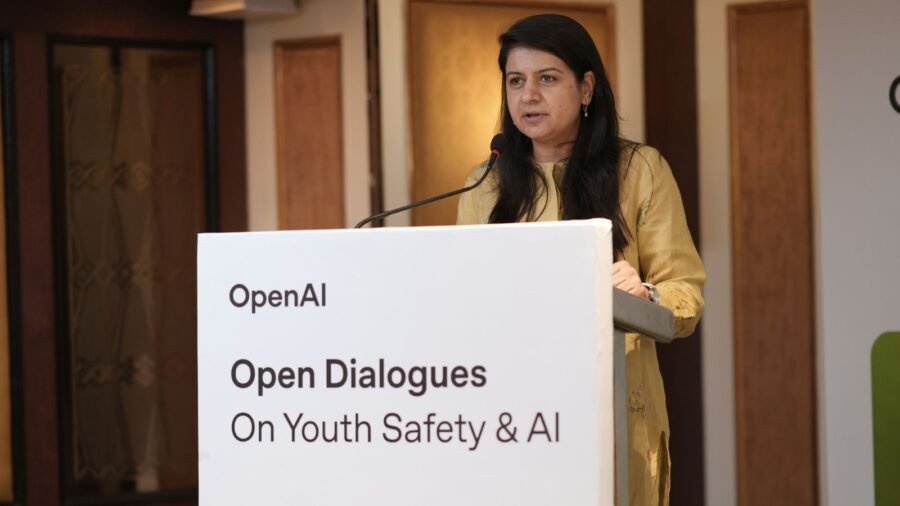
“This is really a parent’s guide to learning with ChatGPT, which means making sure the under-18 experience is age-appropriate, with all the safety guardrails in place,” said Pragya Misra, OpenAI’s Head of Strategy and Global Affairs, India, at the launch of ChatGPT for Teens. On Tuesday, August 18, the AI company introduced ChatGPT for Teens in India. The company is betting on age-appropriate defaults, parental oversight and a stronger focus on AI literacy as the country’s appetite for the technology continues to grow.
In the past few months, the ChatGPT maker has been touring India as part of its flagship initiative, Open Dialogues, focused on AI and youth safety. The initiative has brought together parents, educators, civil society groups and public figures in Delhi, Bengaluru and Mumbai to discuss how young people are actually using AI. The Mumbai event this week coincided with the launch of ChatGPT for Teens, a dedicated experience for users aged 13–17, backed by stronger safety measures and new tools for parental oversight.
What is ChatGPT for Teens?
ChatGPT for Teens has been designed for users aged 13–17, with stronger safety protections and features focused on learning. It also includes Study Mode, which uses guiding questions and step-by-step support instead of simply offering answers. Other features, such as Responsible Homework Reminders, encourage students to solve problems collaboratively, while quizzes and learning visualisations help reinforce concepts. Another feature, Study Hours, allows teens or parents to set periods when Study Mode is automatically enabled.
The teen experience comes with stronger safeguards around high-risk areas, including self-harm, violence, eating disorders, dangerous activities and sexually explicit or graphic content. Parents with linked accounts can manage selected settings, set Quiet Hours and receive safety notifications in limited high-risk situations. Besides, teens also get more frequent reminders to take breaks during extended use. OpenAI said that these features are designed to make ChatGPT a safer, more age-appropriate tool for learning, creativity and exploration.
For Misra, the timing is not incidental. “Today young people are already using AI,” she said, explaining that the idea for a teen-specific product emerged from tracking what people actually use ChatGPT for in India. “Nine out of 10 use cases that we have, or chats that we have, are learning use cases, and many of them are under 18,” Misra told indianexpress.com.
Defining ‘age-appropriate’
When asked about what “safe and age-appropriate” AI use means for teenagers in practical terms, Misra shared that the company relies on a mix of behavioural signals instead of a single checkpoint.
“The timing when you use ChatGPT is one indicator,” she said. Usage around 3 or 4 pm, when many Indian students are just out of school, can suggest a teenage user. The phrasing of prompts and questions is another. A third comes from images: teens frequently photograph handwritten notes, and handwriting patterns offer a further clue.
Story continues below this ad
Where the model can’t confidently determine a user’s age, OpenAI defaults to caution. “We’d much rather be safe than be sorry,” Misra said. “By default, we actually put you into the much safer experience, which is the under-18 experience.”
What OpenAI is guarding against
When asked about the biggest risks facing teenage users, Misra pointed to three areas the company has explicitly designed against. The first is around self-harm and self-image, along with a pattern of emotional or romantic dependency in conversations with the chatbot. “We expect the model to have a conversation more like a friend and less like a partner,” she said of the under-18 experience.
The second risk is a diminished learning experience, what Misra described as ‘brain rot’, the erosion of the productive struggle that comes with genuinely learning a concept. That concern is part of the reasoning behind Study Mode, launched last August and now built into ChatGPT for Teens, which pushes the model toward a Socratic style of teaching rather than simply supplying answers.
“The model actually nudges you for it to become like a tutor and less like an answering machine,” Misra said, describing an experience that adapts to how a student learns best, whether through reading, listening or visual aids, before testing what they’ve absorbed with quizzes.
Story continues below this ad
The third risk, according to Misra, is simply the absence of adult guidance. Parental controls are meant to close that gap. This means if the system flags a distress signal or an inappropriate conversation, a linked parent account receives a notification by SMS or email, prompting them to step in. “That responsibility, in a social context, does not go away,” she said. “We can only do whatever we can on the product… but we want to empower the parents to have better understanding and knowledge so that they can take action.”
The privacy trade-off
This oversight is likely to clash with teenagers’ expectations of privacy. When asked how OpenAI balances parental oversight with a teenager’s right to privacy, Misra recounted a conversation from the Mumbai event in which a parent influencer asked whether OpenAI could let parents view every message their teenager sends the chatbot. “That is the ideal world where we want to be able to do it, but that is not the way that we would expect young adults to grow up and also to interact,” she said. Instead, the company’s approach leans towards flagging genuine risk rather than blanket surveillance, paired with what Misra called “real-world conversations with parents, with adults, with friends, with teachers” about responsible use. That guidance is also published by OpenAI through its OpenAI Academy, its online resource hub for students, teachers and parents.
Why India and what comes next?
The OpenAI executive framed India’s importance to OpenAI in structural terms. India is the company’s second-largest market for ChatGPT users and, in her view, a country positioned to benefit vastly from AI-assisted learning. “There is a large community and a large population in India where just some sort of learning is better than no teacher at all,” she said, pointing to underserved communities now reaching quality educational content through a phone rather than a classroom.
On regulation, Misra backed the Indian government’s current posture of “principle-based, risk-based regulation”, arguing that it protects room for innovation while still requiring companies to build in safeguards for higher-risk, younger users. Misra also hailed the government’s recent push, announced by the Prime Minister on Independence Day, to bring AI literacy to 10 crore students, adding that schools and teachers had shifted markedly in their stance over the past year. From wanting to restrict AI outright to asking how to use it well, institutions are embracing it according to her.
Story continues below this ad
When asked to share her advice to parents discovering a child has been using AI unsupervised, her response was a more practical one. She firmly feels it’s unlikely to happen unannounced in the first place, since most parents already have some visibility into their child’s device. But if it does come up, her advice is simple – don’t panic; just link the accounts. Go into settings, turn on parental controls, confirm you are the parent, and add your email. “Once the two accounts are linked, parents can use the parental controls and safety features available in ChatGPT for Teens,” she said. “That’s where you step in.”