Water-guzzling data centres need treated used water
If cities price the sale of TUW to data centres appropriately, it could convert a water security threat into a measurable improvement in river and lake quality.
Updated on: Aug 31, 2026, 06:15:52 IST
Prefer HTon Google
Share via
Copy link
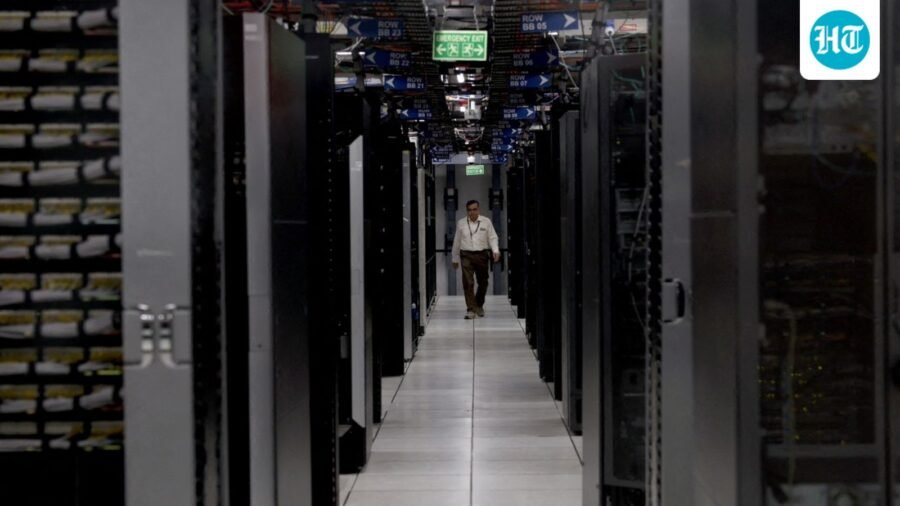
India’s operational data-centre capacity stands at roughly 1.4–1.6 GW (2025) and is projected to reach about 5 GW by 2030. This expansion is backed by close to $30 billion in committed investment. The current footprint is spread across 300 facilities in 33 markets, with very large, new hyperscale clusters announced in Andhra Pradesh and Maharashtra. Many cities where these data centres are located are already water-stressed, which is raising concerns. AI data centres tend to rely on water-intensive evaporative systems in cooling towers. The quantum of water needed depends on ambient temperature and humidity.
Data centres in India typically consume between 1.5 to 2.5 liters of water per kWh of IT load. A mid-sized 20 MW centre can use approximately 1-1.2 million litres of water daily (MLD), depending on cooling technology and climate conditions. This is not actually a large volume of water, but the demand from multiple hyperscale data centres (>100 MW) in a single city can quickly add up. Importantly, demand will be highest in the hottest and driest months. At a city scale, a data-centre cluster could eventually account for 5-10% of municipal water demand, albeit only 1-2% of basin water use. While the basin-level or national footprint looks trivial, at the level of a single stressed city, the demand would compete with supply for domestic use. Conflicts are likely to arise in drought years.
As water evaporates, dissolved minerals and salts get concentrated in the remaining water. At high concentrations, dissolved solids cause scaling and corrosion. Low levels are maintained by adding freshwater to each cycle. To recirculate water many times in a cooling tower though, the water source needs to have a low enough total dissolved solids (TDS) level. Groundwater is typically high in TDS, and if used by data centres, needs additional investment to remove dissolved salts. Alternatively, it has to be used for fewer cycles. This raises data centres’ consumption of water.
The current regulatory structure for data centre water use is not specific enough. Data-centre policies in most states are oriented almost entirely towards attracting investment. States offer power tariff concessions, land, stamp-duty waivers, and capital incentives, with data centres enjoying infrastructure status. Water typically appears only as a supply assurance to be promised to investors, not as a common pool resource to be governed.
Water supply is regulated generically through municipal allocations by urban local bodies; and groundwater abstraction via Central Ground Water Authority’s no-objection certificates.
Treated used water (TUW) is a reliable, low TDS source that data centres can benefit from. There is a potential win-win in reusing treated municipal wastewater. Reuse of treated wastewater is encouraged by the National Water Policy and some state reuse policies, but is not yet mandated for data centres. At present, data centres also do not have standard reporting of water-use efficiency, source mix, or reuse.
This is an opportunity. Around 80% of the water a city supplies returns as sewage. Untreated and partially treated sewage remains one of the biggest pollution threats to urban water bodies. A data centre cluster that treats and reuses 15% of a city’s sewage volume will not be adding to the pressure on freshwater at all. Indeed, it will create demand for a waste stream that the city is currently failing to manage. In the absence of such a mandate, the default would be groundwater. Much of India’s groundwater, especially across peninsular India’s hard-rock aquifers, is unreliable for bulk use. Groundwater levels drop quickly in dry years, with widespread borewell failures during droughts. Sewage, by contrast, is effectively a drought-proof urban water source; people wash, bathe, and use toilets every day, regardless of rainfall. A constant, high-quality source of supply, therefore, could prove highly valuable to a 24×7 data centre.
Data centres are relatively price-insensitive on water, given the monetary value of their services. Operators could plausibly pay up to about 5-10 times the cost of treatment (~ ₹ 200-300/kL) for treated water polished to a high quality. And this would still be less than 0.5% of their operating costs. At this price, the revenue generated could help defray a substantial portion of the cost of municipal sewage treatment.
This can address the single biggest failure in India’s urban water management today. The capital cost of sewage treatment plants (STPs) is typically funded by schemes like AMRUT and the Swachh Bharat Mission. The operations and maintenance costs remain a problem. Many cities are unable to meet these costs. This has left many STPs underutilised or dysfunctional, with effluent flowing untreated into water bodies.
If cities price the sale of TUW to data centres appropriately, it could convert a water security threat into a measurable improvement in river and lake quality. Even where a data centre facility is not situated near a centralised plant, neighbourhood-scale STPs or on-site apartment STPs can be viable water sources.
If a data centre has to rely on groundwater, the same outcome can be achieved through water credits. Specifically, data centre operators could fund groundwater banking or managed aquifer recharge (MAR) investments. These projects would divert monsoon floodwater, or sewage from STPs (treated to near potable standard), into recharge wells. This would replenish the aquifer they draw on. This would thus offset their abstraction, keeping the net effect neutral-to-positive.
The opportunity here goes beyond water. Data centres can help make Indian cities more liveable. They can become stewards of water resources rather than competitors.
Veena Srinivasan is founder and executive director and Gayathri Muraleedharan is managing partner, Urban Water Programme at WELL Labs@IFMR. The views expressed are personal
Get Current Updates on India News, Elections 2024, Lok sabha election 2024 voting live , Karnataka election 2024 live in Bengaluru , Election 2024 Date along with Latest News and Top Headlines from India and around the world.
See Less

Heart attacks in fit women in their 30s and 40s: The hidden risk doctors want you to know
By Sohail Khan · 29 Sep
40 years ago September 29, 1986: Violence and arrests in Punjab
By Sohail Khan · 29 Sep