Tracing Ashoka in Ujjain: What fresh dig at Vaishya Tekri ‘stupa’ can and cannot reveal
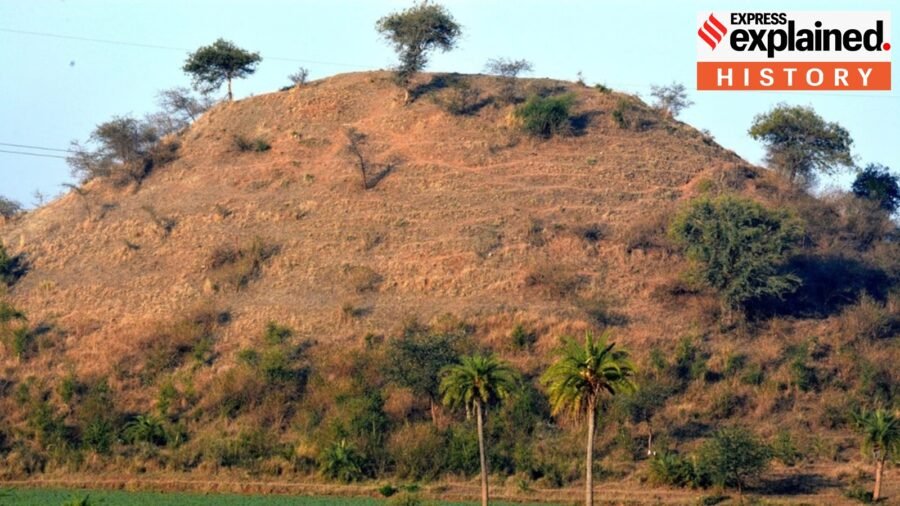
The Madhya Pradesh government has begun restoring Buddhist monuments linked to the Mauryan emperor Ashoka, starting with a fresh excavation at Vaishya Tekri.
In his 2011 paper, Aśoka and Buddhist Nuns: Early Buddhism in Ujjain and Malwa, academic Peter Skilling wrote: “The largest stupa, popularly called Vaisya Tekri, is about 350 feet at its base and 100 feet high. Nearby is a smaller stupa, called Kumbhar (or Kumhar) Tekri. Both are relatively undisturbed, except for the unfortunate fact that a power line runs between them, and a giant pylon squats rudely on Kumbhar Tekri’s shoulder.”
Initial excavations by the Department of Archaeology of the erstwhile Gwalior State in 1938–39 unveiled large bricks and punch-marked coins, prompting archaeologists to date the structures to the Mauryan period.
But academic Himanshu Prabha Ray, in an interview with , urged caution, noting that the excavation report is decades old and that its interpretation was shaped by earlier accounts, particularly Alexander Cunningham’s writings on Ashoka. While acknowledging the mound’s impressive size and its reported comparison with the Great Stupa at Sanchi, Ray said, “I think we are jumping the gun. We need to investigate further beyond the 1938-39 excavation.”
Ashoka’s years in Ujjain
Ujjayini (modern Ujjain), on the banks of the Sipra, a tributary of the Chambal, was the capital of Avanti and an important commercial centre. Historian Romila Thapar, in Asoka and the Decline of the Mauryas, notes that Ujjain was a major crossroads, linking trade routes to western coastal ports such as Broach and Sopirà, as well as to Pataliputra. “Ptolemy refers to it as Ozone.”
Ashoka was sent to Avanti as viceroy by his father, Bindusara. Unlike his brief sojourn in Taxila, he is believed to have spent about a decade in Avanti, with Ujjain as his headquarters. Thapar adds, “We feel that he was sent to Taxila for a special purpose and after having completed his work there, he was then appointed to the viceroyalty at Ujjain in recognition of his work.”
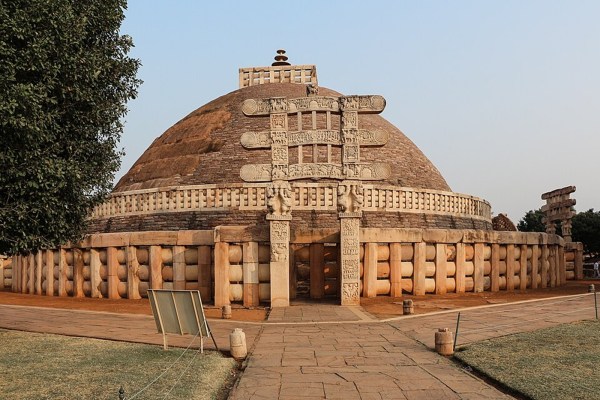 The Sanchi Stupa, in Sanchi, Madhya Pradesh, was built by the Ashoka in the 3rd century BCE.
Historian Nayanjot Lahiri describes Ujjain as the “Greenwich of India” in Ashoka in Ancient India (2015), because Hindu astronomers reckoned the prime meridian of longitude from the city. She suggests that Ashoka arrived there around 282 BCE, roughly a decade before the death of his father, Bindusara. “By the time Ashoka got there, it was an urban centre of respectable antiquity, having flourished along the Sipra river for 300 years or more before it became the Magadhan prince’s place of functioning,” she notes.
Story continues below this ad
Mud fortifications were first built around Ujjain in the seventh century BCE. By about the sixth century BCE, Avanti, with Ujjain as its capital, had emerged as a powerful independent kingdom.
Where Ashoka met Devi
On his way to Ujjain, Ashoka stopped in Vidisha, where he met Vedisadevi, the daughter of a merchant. “Her name was Devi and the romance began in the city of Vidisha, where her father was a prominent merchant. Soon enough, Ashoka married Devi and moved on to Ujjayini,” writes Lahiri. Thapar, however, believes Devi was ‘not legally married’ to Ashoka, since historical records do not mention it.
The couple later had a son, Mahinda, and a daughter, Samghamitta.
Ashoka’s appointment to Ujjain appears to be well supported by historical evidence: his own edicts, issued after he became emperor, refer to the presence of a prince, or kumara, at Ujjain. Lahiri also points to the geography, “Ashoka is shown as meeting Devi at Vidisha, and Vidisha falls on the way to Ujjayini from Pataliputra”
Story continues below this ad
“I do not find it unlikely that, at such an important site as Ujjain, Aśoka should have had pillars erected, or have had edicts engraved. Perhaps it would even be odd if he had not done so,” writes Skilling. Ray, however, disagrees. “As of now, there are no known Ashokan pillars in Ujjain, particularly around the stupas…Moreover, the excavations tell us little about the political structure of Ujjain at the time Ashoka came here.”
The stupa and the hell
Interestingly, local traditions in Sri Lanka connect Vaishya Tekri with Devi. According to Lahiri, “It is locally known as the Vaishya Tekri (‘Vaishya caste’s mound’) since Devi was the daughter of a merchant, this being a characteristically Vaishya occupation.”
However, travellers’ accounts suggest that the two stupas had different associations. While Vaishya Tekri is linked to Devi, Kumhar Tekri is said to have been a ‘hell’ built by Ashoka. Chinese scholar-pilgrim Xuanzang, who visited Ujjain in the seventh century, wrote in his Record that “not far from the city is a stūpa built to mark the place where King Ashoka made a hellish prison”. Thapar notes that earlier excavations at Kumhar Tekri revealed a burial-cum-cremation ground dating to the third century BC, while Hsuan-tsang too identified it as the site where Ashoka had built a hell.
About a decade after Ashoka became viceroy at Ujjain, his father, Bindusara, fell critically ill in Pataliputra. He therefore returned to Pataliputra, where he would soon make his bloody bid for the Mauryan throne.
Fresh excavations
Story continues below this ad
“At the time of my visits,” Skilling recalls in his article, “Undasa seemed a pleasant site in the midst of an expanse of undulating green fields— but on the horizon huddle the buildings of an industrial zone.” He expressed concern that the once-bucolic site could soon be engulfed by the expanding city of Ujjain.
The government’s decision to fund further excavations is therefore welcome to scholars. “There is always very little money available for archaeology, so the fact that the government is taking an interest and putting money into it is good news. Having said that, my interest would be in recovering the larger cultural landscape of the stupa, not just the stupa itself,” says Ray.
She points to Sanchi, where the ashes of Buddhist teachers who taught or stayed at its monasteries were buried in cemeteries around the stupas. “The stupa does not occur as an isolated structure. It always has smaller stupas and other structures around it. I would suggest that the excavations look beyond the stupa itself and use the money to understand how the site grew over time: what other structures were around it, and who were the monks who taught or stayed there.”

Malaika Arora, 52, reveals a dietary staple she refuses to skip: ‘I can’t have salads’
By Sohail Khan · 28 Sep
A smoke and mirrors summit in which Xi emerged with the upper hand
By Sohail Khan · 28 Sep
Why must a woman always trade curiosity about the world for safety?
By Sohail Khan · 28 Sep