Tough conversion law kicks in Friday, Mumbai pastors ask worshippers to sign form they pray of their own ‘free will’
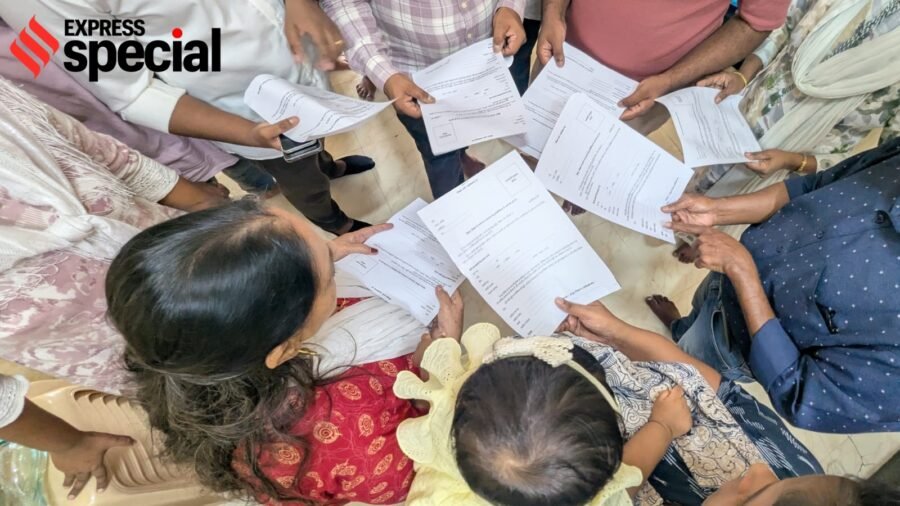
The Maharashtra anti-conversion law that toughens legal provisions against forced conversion comes into effect August 28. Its shadow has already fallen on Christian congregations across the Mumbai Metropolitan Region. At prayer halls in Vasai, Virar, Mira-Bhayandar and beyond, local pastors are asking worshippers to do something they never had to before – fill a form.
This “self-declaration” states that they are attending the prayer meeting of their own “choice” and face “no pressure, inducement, temptation, lure, or threat of any kind”. It further says their decision to attend church “is completely personal, voluntary, and independent.” The form asks for a passport-size photograph and an Aadhaar or PAN number.
Until this year, anyone could walk in.
Over the past month, found these forms being circulated – in English, Marathi and Hindi – to congregations in Mumbai, Mira-Bhayandar, Vasai-Virar, Palghar and Thane. This follows a run of Sunday disruptions at prayer meetings over the past five months: there have been nine FIRs linked to five such disruptions between April and July.
Pattern of prayer, protest
Story continues below this ad
Typically, a prayer meeting is held on a Sunday, often in a rented hall, school, banquet hall or home. People identifying themselves as Bajrang Dal or VHP workers object, often alleging that Hindus are being converted. Police are called, both sides are taken to the station, and in some cases an FIR follows.
Seven of the nine FIRs are against those who organised the prayers and worshippers, two are against Bajrang Dal members.
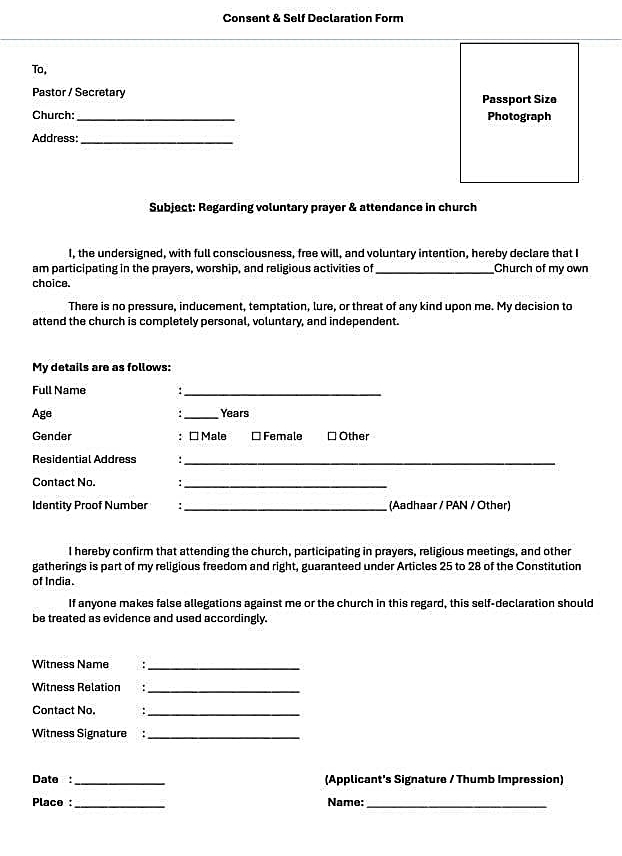 This ‘self-declaration’ states that they are attending the prayer meeting of their own ‘choice’.
An illustrative case is from April 12 in Vasai East, where a Sunday prayer meeting at Dhiraj Shopping Centre, attended by an estimated 100 to 150 people, was disrupted when a group of men, among them Bajrang Dal members, entered the hall. What followed over the next 24 hours was five FIRs at Achole police station, four against the person who conducts the meetings and one against his accusers.
It is against this backdrop that the forms have taken hold, described by organisers less as paperwork than as insurance.
Story continues below this ad
At New Hope Church in Virar, which has recently built an iron grille gate that stays locked during prayers, Pastor Steven Rozario, 49, handed out the forms during a Sunday service this month and explained why. Around 30 people were present.
“This is a self-declaration form. I want all of you to fill it out, attach a passport-size photograph, and bring it with you next Sunday when we meet for prayer. Considering the continuous disruptions and attacks during prayer meetings, we are keeping these forms with us so that if someone questions us in the future and claims that we forced or compelled you to attend the prayer meeting, we can show this as proof,” he told the congregation.
Speaking to , Rozario said pastors had held several meetings after the recent incidents. “In most cases, police do not even register FIRs against those who cause the violence. This is why we all came up with these forms, hoping they will help us if such a situation arises in our church. The new law has given a free pass to those who break the law,” he said.
Caution and ‘precaution’
For those signing, it is unfamiliar territory. Anita Patel, 55, a resident of Virar, said she has followed Christianity for 16 years and this was the first time she had been asked to declare in writing that she was attending voluntarily.
“Earlier, there was a freedom to choose and believe what we wanted to follow, and nobody questioned us about why we were following a particular faith. It is strange that I have to fill out such a form. It feels as though I no longer have the freedom to follow what I want to,” she said. “But it is okay; considering the current situation and the attacks on prayer meetings, this is perhaps the only way to live.”
Story continues below this ad
Robin Alexander, 41, who sings during the service at New Hope Church in Virar, called it a precautionary measure. “It is good that we have this form. It is for our protection and is proof that we are coming here of our own free will and are not being forced,” he said.
Devdan Tribhuvan, state president of the Maharashtra Christian Development Association, said the forms were introduced as a security measure after people attending prayer meetings began being questioned, threatened and, in some cases, saw services disrupted.
“The allegations of conversion were already being made, so we started taking a simple declaration to make it clear that people were attending the prayer meeting of their own free will. It is purely for security purposes. The forms are not government documents; they are signed by the person and kept with the pastor,” he said.
He said the choice to attend a place of worship was protected by consent. “There is no allurement or compulsion. If I am a Christian, I can choose to go to any church in Mumbai,” he said. Churches have also started using CCTV cameras and taking photographs, Tribhuvan added, because those involved in disruptions are often unidentified when FIRs are registered.
Story continues below this ad
The Bajrang Dal claims it acts within the law. Gautam Ravariya, the outfit’s Konkan region co-convenor, said it monitors prayer meetings on social media and informs police rather than acting alone. He acknowledged FIRs had also been registered against its members.
“If our workers are attacked, they will defend themselves. We are not going there either to get beaten or to beat anyone, but self-defence is everyone’s right,” he said. Ravariya alleged some prayer groups first provide assistance to vulnerable families and then encourage them to convert.
When contacted, Niket Kaushik, Commissioner of the Mira Bhayandar Vasai-Virar Police, whose jurisdiction covers Vasai East, where five of the nine FIRs were registered, said: “There was one local incident in the past few months related to the issue and necessary action was taken. We have not seen any recurring instances to call it a trend.”
When asked about the form that prayer groups and churches are asking attendees to fill, he said, “We are unaware of any such consent form.”
Story continues below this ad
On July 2, representatives of Mumbai for Peace and 24 civil society organisations met Mumbai Police Joint Commissioner (Law and Order) Manoj Kumar Sharma, seeking preventive action over repeated disruptions. “There is a pattern. People attend prayer meetings, then call in groups of 40 to 60 people. This has been happening repeatedly over the past three to four months,” said Dolphy D’Souza, spokesperson for the Bombay Catholic Sabha.
On the forms, D’Souza: “We do not know how much they will help, but what options do we have at this point? Churches and prayer places are open to everyone—people come to pray for peace of mind, with friends, or because they have a particular prayer or wish. So, these forms are essentially intended to protect the church’s interests.”
Making the law clear
Mumbai Police Joint Commissioner (Law and Order) Manoj Kumar Sharma, said, “There have been a few incidents in Mumbai which I remember, complaints were filed from both sides, we had given warning to those who were disrupting prayers, otherwise Mumbai has been peaceful and no such incidents have occurred recently. Yes, we have received the memorandum from Mumbai for Peace and if any such incidents occur we will take action accordingly, our team is also investigating those complaints.”
Church leaders are worried the disruptions may grow once the law takes effect. The legislation criminalises religious conversion brought about through coercion, fraud, force, threats, misrepresentation, inducement or undue influence, and covers conversions allegedly linked to marriage or a promise of marriage. It places the onus on the person facilitating the conversion to establish it was voluntary and prescribes stricter punishment when the alleged conversion involves a minor, woman, member of a Scheduled Caste or Scheduled Tribe, or a person of unsound mind. The state notified the law on July 31.
Story continues below this ad
Speaking to on the consent form, Fr. Nigel Barrett, spokesperson for the Archdiocese of Bombay, said, “Taking a consent form is a wise precaution…It establishes that people are attending voluntarily and that no one is forcing them to come. Given the current law and the manner in which certain groups, such as the Bajrang Dal, enter these spaces, people are taking precautions to safeguard themselves.”
Ganpati Visarjan Processions Move Towards Juhu Chowpatty Amid Heavy Security, Traffic Curbs
By Sohail Khan · 25 SepWATCH: Cat Takes A Nap Inside Mumbai Metro Ticket Box; Viral Video Melts Internet
By Sohail Khan · 25 Sep