This octopus can mimic many dangerous sea creatures. Here’s how its bizarre trick works
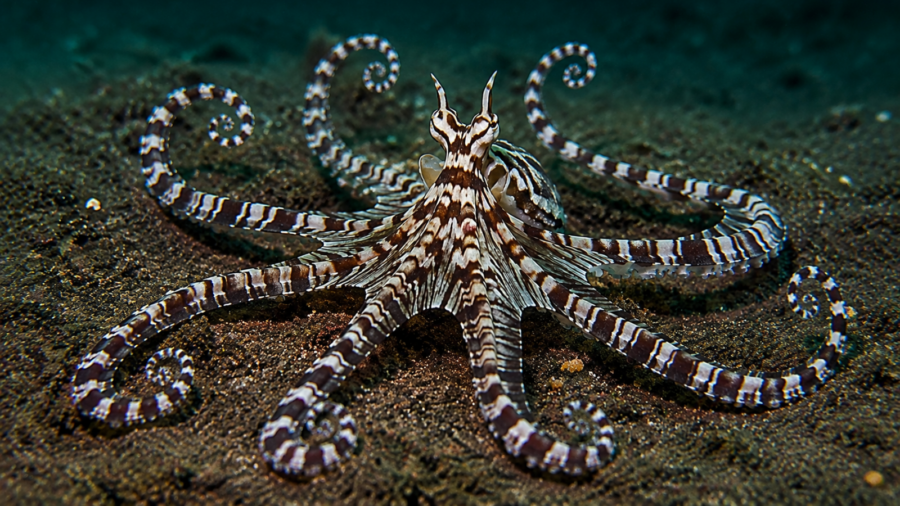
Imagine spotting a flatfish gliding across the seafloor, only for it to suddenly turn into a sea snake or maybe a lionfish. No, this isn’t a magic tale or a scene stolen from sci-fi. This remarkable shape-shifting act of fooling belongs to the mimic octopus, Thaumoctopus mimicus.
Found in tropical Indo-West Pacific waters, particularly around shallow, sandy or muddy coastal habitats, the mimic octopus is known for changing its colour, body shape, posture and movements to resemble other marine animals.
Scientists have documented its various avatars resembling flatfish, lionfish and sea snakes.
How does the mimic octopus imitate other animals?
The mimic octopus doesn’t simply change colour and disappear into its surroundings. It can manipulate several aspects of its appearance and behaviour at the same time.
Its flexible arms can be arranged to change the outline of its body, while its skin can change colour and pattern. It can also alter its posture and swimming movements to create the impression that it is another animal.
That makes its behaviour different from simple camouflage.
Camouflage generally helps an animal blend into its surroundings, whereas mimicry involves resembling something else. In the case of the mimic octopus, this has been described as a form of dynamic mimicry, because the animal actively changes its appearance and behaviour.
Why would an octopus pretend to be a sea snake?
The leading explanation is defence. The mimic octopus is thought to use these displays to deter potential predators. One of the best-known examples is its sea-snake imitation. When faced with a potential predator, the octopus has been observed adopting a posture and movement pattern resembling a banded sea snake.
Story continues below this ad
That could make a predator think twice before attacking, particularly because some of the animals the octopus resembles can be dangerous.
However, there is an important caveat: while predator deterrence is a likely function of these displays, the protective benefit has not been experimentally demonstrated in every situation.
So it is more accurate to say the mimicry is thought to help the octopus avoid predators, rather than saying scientists have conclusively proved that every disguise works this way.
View this post on Instagram
A post shared by Geetanjali | Biologist (@a.curious.biologist)
Does it choose a disguise depending on the threat?
This is where things get even more fascinating and less certain. Researchers suspect that the octopus’s displays may vary depending on the situation, but exactly how it selects a particular form is not fully understood.
It is tempting to imagine the octopus consciously deciding, “A sea snake will scare this predator away,” but scientists cannot establish that kind of thought process from the behaviour alone.
Story continues below this ad
What we do know is that the animal can coordinate its arms, skin, posture and movement to produce remarkably different appearances.
However, the octopus isn’t physically changing into a sea snake, flatfish or lionfish. It is only using its own highly flexible body and remarkable control over its skin and movements to create a convincing imitation.

From Nepal to India, how AI is improving disaster management
By Sohail Khan · 28 Sep
40 years ago September 28, 1986: Relief for Haryana farmers
By Sohail Khan · 28 Sep
Between Trump’s US and Xi’s China, the trap India must avoid
By Sohail Khan · 28 Sep