The limits of air power, implications for theatre-isation
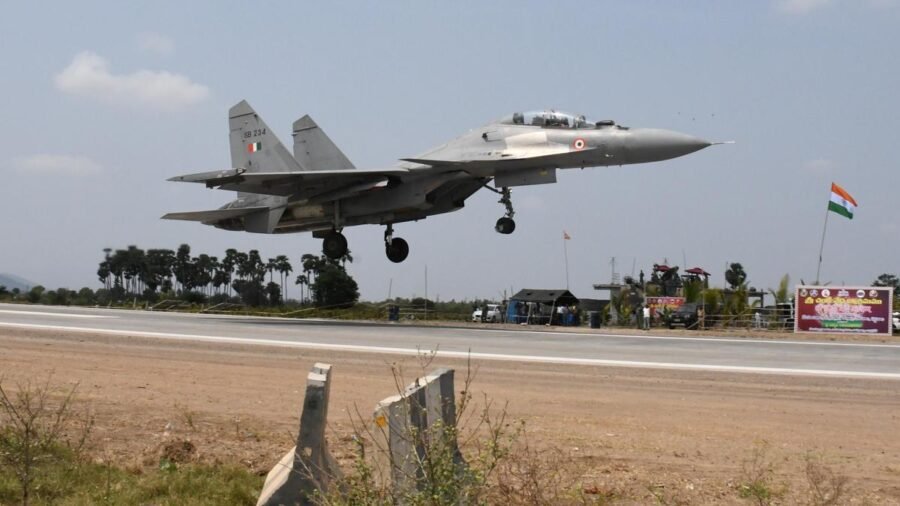
The wars in Ukraine and Iran delivered the same verdict to every air force. Ukraine kept the larger air force at bay, while in Iran, the skies were dominated by the opposing side, yet air superiority still failed to end the war. Both point to the same limitation of air power: it has not grown weaker, but it is no longer sufficient to win a war on its own.
That is the real stake in India’s own debate: its Air Force has long favoured operational flexibility over fixed commands — an approach proven against Pakistan but untested against China.
Air power’s limits exposed
Two wars and one wider pattern illustrate three ways in which air power falls short.
The first is the denial of airspace. What determined control of Ukraine’s skies was not Russia’s aircraft numbers, but Ukraine’s networked air defence. This is what the United States Air Force’s 2025 guidance concedes: contested low-level airspace is a problem that air superiority alone cannot solve. For India, this cuts both ways — integrated air defence could deny China control of the skies, or leave India exposed to the same risk in reverse.
The second is dominance of the air space. The allied air campaign against Iran is the clearest case of dominance without a decisive outcome. The allies had complete control of the skies, yet Tehran held firm. What they could see, they hit; what Iran hid, it survived. That should concern India, because what has worked against Pakistan may not hold against China. Pakistan lacks strategic depth and can be stressed quickly; China, given its military capacity, can absorb losses and continue fighting.
The third is the cost-arithmetic. This structurally favours the weaker force. A Shahed-type drone (Iran) costs roughly $20,000 to $50,000, while the interceptors can cost millions. India saw a version of this during Operation Sindoor (May 2025), when Pakistan’s cheaper drones forced the use of costlier interceptors. Against China, that arithmetic operates on a much larger scale, and India is not yet prepared for it.
These limits are already forcing a doctrinal rethink across most modern air forces. For India, the challenge is structural: the centralised model of the Indian Air Force (IAF), proven against Pakistan, remains untested against China, where the terrain could compound these limitations.
The IAF’s case against theatre-isation
The IAF favours flexibility over fixed commands. Four tests decide whether that position holds against China too.
The first is the flexibility principle. The IAF’s claim is that what has worked before will work again. Against Pakistan, it did — Balakot (2019) and Sindoor demonstrated that. Against China, however, the numbers are tighter: 460-520 combat aircraft against the People’s Liberation Army Air Force’s roughly 65 squadrons. The mountains make the challenge even greater, with fewer airbases and less room to redeploy. So the flexibility that defines the IAF’s approach may not hold where it matters most.
The second is the integration deficit. If flexibility cannot close the gap, then joint-ness might. Two parts can help bridge this deficit. The first is joint-force generation, which has never been built sufficiently for the China front. The second is peacetime jointness, which requires no new hardware, only training and shared planning. Kargil exposed this gap in 1999; the Ladakh crisis in 2020 showed that it still persisted.
The third is more institutional, than operational. Two aspects matter. The resistance is more about career progression than doctrine. Also, ranks do not map evenly across the three services, leaving joint chains of command unsettled. Neither factor determines whether flexibility or jointness will actually work, although both matter. The United States made joint postings mandatory; not a career risk.
The fourth is consultative authority. The IAF’s own proposal – a Joint Coordination Centre – depends on everyone agreeing, and a crisis leaves no time for that. A theatre command puts one person in charge, with the power to act. The U.S., China and Israel have each already made that choice — not proof that it guarantees success, but evidence that a consultative process has its limits.
Of the four questions here, only one concerns how the IAF fights. The rest concern how India organises itself for the next war. That decision lies beyond the IAF; it belongs to India’s political leadership, which has a larger stake in the outcome.
The cost of delay
The IAF’s position is defensible where it has been tested — in Balakot and Sindoor. What it does not tell us is how quickly the force could mobilise or how effectively it could conduct joint operations against China.
The cost of leaving this debate unresolved is real. If, for instance, China moves into Ladakh the same week that Siachen Glacier flares up, someone will have to decide, in real time, which front gets the limited pool of Rafales and S-400 systems.
A jointness gap left unaddressed for another decade could mean that an Integrated Battle Group (IBG) commander along the Line of Actual Control is still planning around air support that may not reliably arrive when needed to defend India’s territorial integrity. And if that were to happen, people would not remember the missing theatre command, but a military that was simply not ready for war.
None of this is a case against the IAF. It is a case against testing the IAF’s convictions in a crisis, when there may be no second chance. Therefore, one could argue that theatre-isation does not dilute the IAF’s flexibility; rather, it is the missing structure that could allow that flexibility to survive contact with the one border crisis India has not faced in many decades.
Harinder Singh is a retired Lieutenant General who commanded the Leh Corps during the 2020 Ladakh crisis

Chemically ripened bananas: What consumers need to know before buying
By Sohail Khan · 26 Sep
Kochi Is changing the way it dates, talks about sex and relationships
By Sohail Khan · 26 Sep
Post-World War II norms cannot fix today’s problems
By Sohail Khan · 26 Sep