The Baltic Way — Gandhi’s imprint on Baltic freedom
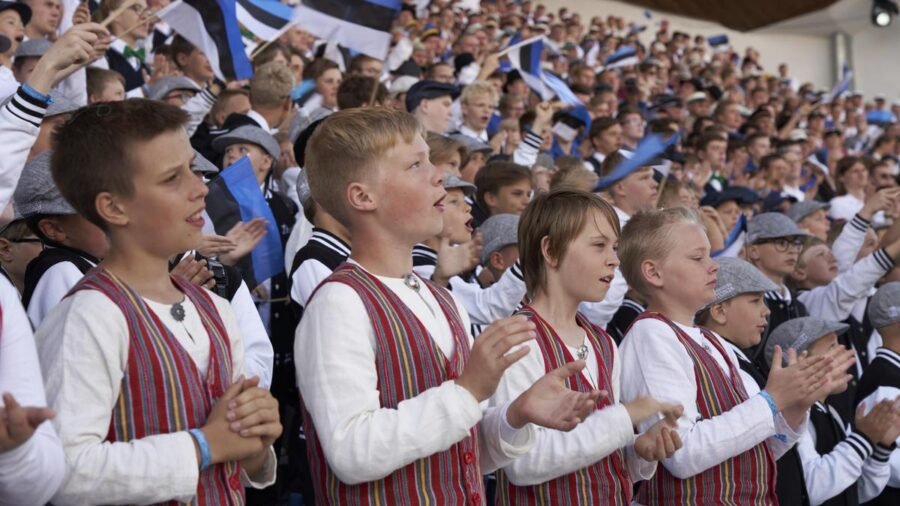
August 23, 2026, marked the 37th anniversary of the Baltic Way, the historic 1989 human chain that became a watershed moment in the Gandhian-inspired Singing Revolution in Lithuania, Latvia, and Estonia, culminating in the restoration of Baltic independence in 1990-91. Conversations across the Baltic states revealed powerful personal reflections on the Baltic Way and Gandhian non-violence: “We studied India’s freedom struggle and chose Gandhian non-violent resistance to reclaim our national freedom from Soviet rule.” “We watched the film Gandhi on Lithuanian national television, telecast for 24 hours.” “It was thrilling to join a non-violent protest against the Soviet army at Vilnius Cathedral Square; even as a bullet passed near my ear, I stood firm.” “Baltic Way matters a lot for us today.”
A turning point
The Singing Revolution (1986-91), shaped by songs and non-violence during Mikhail Gorbachev’s perestroika and glasnost, reached a turning point with the Baltic Way, when two million people formed a 675-kilometre human chain from Tallinn through Riga to Vilnius, demanding freedom from Soviet rule. It remains a powerful symbol of unity, solidarity, and freedom. The Baltic Way was organised on the 50th anniversary of the 1939 Molotov-Ribbentrop Pact to expose its secret protocol, which divided Eastern Europe into German and Soviet spheres of influence, and paved the way for the Soviet annexation of the Baltic states in 1940. Having gained independence in 1918, the Baltics lost it after 22 years. The Baltic Way exposed Soviet-era repression, leading to the Soviet Union’s acknowledgement of the secret protocol’s existence and the Baltic states’ re-independence in 1991. Its global media coverage drew international attention, while its inscription in UNESCO’s Memory of the World Register and Guinness World Records recognition reinforced its international legacy.
An enduring influence
Gandhi’s ideas travelled globally, inspiring movements from the American civil rights struggle to South Africa and beyond. Today, the Baltic Way reflects the enduring relevance of his principles of non-violence, truth, and human dignity, while echoing the non-cooperation and civil disobedience of his 1930 Dandi March.
Gandhi showed that moral authority could outweigh military power through ahimsa, satyagraha, civil resistance, mass mobilisation, and the principle that a nation’s rule depends on people’s consent and cooperation. The Baltic Way and the Singing Revolution stand as a testimony to the success of people’s power and civilian-based defence drawn from the Gandhi-led Indian freedom movement.
The Singing Revolution’s leaders drew on global traditions of non-violent resistance. Latvian scholar Maija Kūle noted that, lacking local theorists, they turned to Gandhi and Martin Luther King Jr.; Latvia’s earlier cultural links with India may also have encouraged this attraction to Gandhian ideas. Lithuania, too, played a key role in developing non-violent civilian-based defence inspired by Gandhi.
In a 2012 conversation with this writer, the late Prof. Gražina Miniotaitė, a leading ideologue of Lithuania’s Singing Revolution, recalled that non-violence was widely understood from the outset as essential. The December 1990 “Republic in Danger” declaration urged adherence to “non-violence and non-cooperation with the occupational authorities”.
Unlike other thinkers of non-violence, Miniotaitė regarded Gandhi as the most successful in both theory and practice, demonstrating that non-violent struggle could effectively resist foreign rule. Richard Attenborough’s 1982 film Gandhi was broadcast on Lithuanian national television to educate citizens about non-violent resistance. Confronting Soviet troops, people repeated: “We won’t fight,” “We follow Gandhi,” and “We are peaceful people.”
Building closer ties
Since 1992, the Baltic states have drawn on Gandhian and cultural ties to deepen relations with India, expanding cooperation in technology, sustainability, the blue economy, and culture. The Government of India’s Ministry of Commerce and Industry estimates show that India’s total bilateral trade with Lithuania reached $490.61 million; with Latvia, $475.66 million, and with Estonia, $219.69 million in 2025-26.
Baltic political discourse reflects Gandhian influence through Gandhi’s Lithuanian-born Litvak “soulmate” Hermann Kallenbach; Vydūnas’s engagement with Gandhian thought; Antanas Poška’s meetings with Gandhi; Sonja Schlesin’s secretaryship; and Estonian translations of Gandhi by Linnart Hall. These ties continue through annual commemorations of the 2015 Gandhi-Kallenbach monument in Kallenbach’s birthplace, Rusnė, most recently in July 2026; the Kallenbach Memorial Lectures; and the India-Lithuania Friendship Award (this year, it honoured the people of Goa during the 400th anniversary of missionary Andrius Rudamina). India has also gifted Gandhi memorials to the Baltics, including a bust unveiled in Latvia in 2019 and a statue installed in Estonia in 2025.
The Baltic Way endures as a chain of freedom and ideas, linking courage with conscience. Its contemporary significance is multifaceted: a model of non-violent resistance, a site of contested memory, a narrative in Russia-West tensions, and ultimately, a tribute to Gandhi and India.
K.B. Usha is Associate Professor, School of International Studies, Jawaharlal Nehru University, New Delhi

Essar eyes $18-billion US steel plant: Why Indian firms are investing in US amid tariffs
By Sohail Khan · 29 Sep
The volume knob we often forget to turn down
By Sohail Khan · 29 Sep
Woman loses 43 kg in 8 months: What experts say about losing 10 kg in a month
By Sohail Khan · 29 Sep