Russia’s SMR edge: Why India’s new nuclear rules could favour Moscow
Russia’s nuclear sector advantage in India could only get more pronounced if the draft rules issued by the Department of Atomic Energy for the Sustainable Harnessing and Advancement of Nuclear Energy for Transforming India (SHANTI) Act are anything to go by.
The rules specifically state that foreign nuclear technology sourced for a nuclear power plant or reactor in India must mandatorily have its design certified or approved by the regulatory body in its country of origin and must already be operational there or in another foreign country.
“The technology intended to be imported or acquired domestically does not adversely affect the interest of India, does not constitute an unreasonable risk to public health and safety and is in conformity with the national policies framed under the Act,” the rules read. This could be a big factor when it comes to the small modular reactor (SMR) sector, an area where India is keen to step up its presence.
Russian nuclear company Rosatom State Corporation, a state-owned company based in Moscow that specialises in nuclear energy and non-nuclear energy products, has made a strong pitch for deploying its small modular reactors (SMRs) for targeted applications in India, alongside efforts to position its large new-generation atomic power reactor-based projects as the cornerstone of bilateral cooperation between the two countries in the field of nuclear energy. It has a clear edge over its Western competitors.
Russia’s SMR lead
While it is already building conventional nuclear projects in India, Russia has a lead in the nascent field of SMRs, which are advanced nuclear reactors that have about a third of the generating capacity of most traditional nuclear power reactors but can produce a large amount of low-carbon electricity.
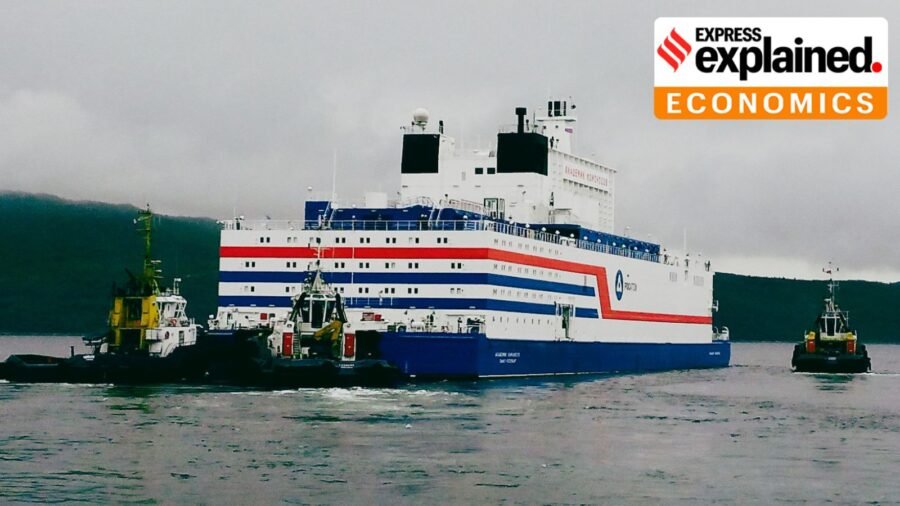
Currently, two SMR projects have reached the operational stage globally, including an SMR named the ‘Akademik Lomonosov floating power unit’ that has two modules of 35 MWe (megawatt electric) and started commercial operation in May 2020.
The Lomonosov is a non-self-propelled power barge that doubles up as a floating nuclear power station and is docked in Pevek harbour, providing heating for the Arctic port town of Pevek and supplying electricity to the regional Chaun-Bilibino power system. It is designated as the world’s northernmost nuclear power plant.
Story continues below this ad
The other operational SMR is a demonstration project called HTR-PM in China that was grid-connected in December 2021 and is reported to have started commercial operations in December 2023.
Other global companies that are in the fray for SMR leadership include New Jersey-based Holtec International, Rolls-Royce SMR, NuScale’s VOYGR SMR, Westinghouse Electric’s AP300 SMR and GE-Hitachi’s BWRX-300. But nearly all of these reactors are in the design certification phase and are yet to be cleared by their domestic regulators, and none of them are operational yet. So, in effect, that clause could be a problem for most of these players if they seek to make an India entry.
Russia is learnt to have made a strong pitch for SMR-based projects at a working meeting that took place in Mumbai on November 10 between Ajit Kumar Mohanty, Chairman of India’s Department of Atomic Energy, and Alexey Likhachev, Director General of Rosatom.
During the November meeting, the two sides reviewed the progress of the Kudankulam nuclear power project (KKNPP) in Tamil Nadu — the largest nuclear power station in India and the flagship project of Russian-Indian energy cooperation. KKNPP Units 1 and 2, where Russia’s earlier generation ‘VVER-1000’ light water reactor units have been deployed, were connected to the national power grid in 2013 and 2016 respectively and currently supply electricity to India’s southern region. The project provides for the construction of six power units with ‘VVER-1000’ reactors and a total installed capacity of 6,000 MWe.
Story continues below this ad
One of the key negotiating points for Moscow is the promise of serial construction of high-capacity nuclear power units of Russian design in India, based on the new-gen ‘VVER-1200’ reactor models. Technical specifications for a new nuclear power plant in India featuring ‘VVER-1200’ reactor units are being proposed by the Russian side, government officials indicated. This is alongside the SMR push.
A new area of cooperation that was learnt to be under discussion is the construction of SMRs of Russian design in India. In April 2024, Rosatom had presented its Indian partners with information on the corporation’s floating nuclear power solutions. Russia is the only country in the world with expertise in this field.
SMR technologies are aimed at supplying clean electricity to remote regions with limited grid infrastructure, as well as to individual industrial enterprises. India is looking at SMRs as a solution for localised applications, such as energy-hungry data centres, and for quickly scaling up baseload capacity.
Rosatom’s fuel company TVEL already supplies India with nuclear fuel TVC-2M, which offers new capabilities for Kudankulam NPP — allowing the station to operate on an 18-month fuel cycle, thereby significantly improving the economic efficiency of the power units compared with the traditional 12-month cycle.
Cost of LWR could favour Russian companies
Story continues below this ad
In terms of pressurised water reactors (PWRs) or light water reactors (LWRs), too, Russian companies are likely to have an edge, particularly on cost. According to industry insiders, LWRs offered by French and US companies are significantly more expensive than India’s indigenous pressurised heavy water reactors (PHWRs).
Russian reactors, on the other hand, are estimated to be only marginally more expensive than their Indian counterparts, while retaining a clear cost advantage over other LWR makers from Western nations. Some estimates peg the cost of indigenous reactors at around Rs 18 crore per MW-electric, compared with about Rs 34 crore per MW-electric for Russian reactors.
While fuel costs account for a relatively small share of the overall cost of nuclear generation, high upfront capital costs remain a key challenge for new nuclear projects. The World Nuclear Association notes that capital costs can account for at least 60% of the levelised cost of electricity (LCOE) from nuclear plants — the total cost of building and operating a plant over its lifetime divided by the electricity it generates. Financing costs and the length of the construction period are also critical determinants of the final cost of nuclear power.

Heart attacks in fit women in their 30s and 40s: The hidden risk doctors want you to know
By Sohail Khan · 29 Sep
40 years ago September 29, 1986: Violence and arrests in Punjab
By Sohail Khan · 29 Sep