Rochester Institute of Technology Deepens India Engagement With Global Scholar Quest: Winning Team Gets Access To USD 50,000 Scholarship Pool & ₹1 Lakh Prize
Mumbai: Rochester Institute of Technology (RIT) is stepping up its engagement with India, combining a new student innovation programme with a broader push to build long-term relationships with schools, counsellors, educators and students.

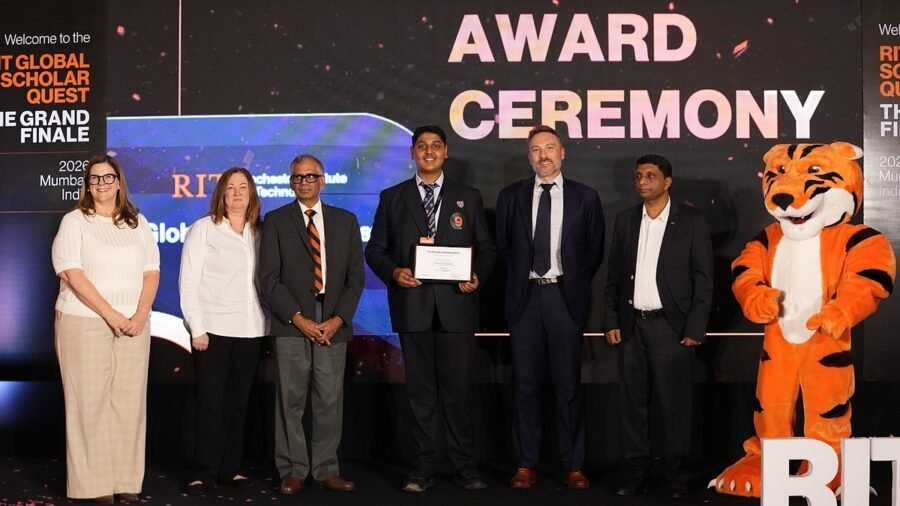
The US university brought its inaugural Global Scholar Quest (GSQ) to India this year, giving Grade 11 and 12 students an opportunity to work on real-world problems, develop solutions and present their ideas before an RIT-led jury. The initiative culminated in a Grand Finale in Mumbai, where the winning team received access to a USD 50,000 RIT scholarship pool along with a Rs 1 lakh cash prize to support its idea. Three Rising Star Awards were also presented to students who stood out during the competition.

But GSQ was only one part of RIT’s India visit. The university’s delegation, led by senior enrollment and global strategy officials, also hosted an evening gathering in Mumbai with more than 120 school principals, counsellors and education leaders. The focus was less on conventional recruitment and more on conversations around international education, student mobility, innovation and how universities and educators can work together over the long term.
RIT brings Global Scholar Quest to India
The first India edition of GSQ ran from May to August and was conducted through nominations. Students from International Baccalaureate, Cambridge and Indian board schools were invited to participate in a four-level process designed to assess how they identify problems, develop ideas and turn them into workable solutions.
The programme featured 10 innovation tracks, including areas such as artificial intelligence, climate and healthcare. Following an online screening and team submissions, shortlisted participants received mentorship from Dr M A Rehman, physicist at TIFR and founder of Creator International School, along with industry specialists.
The final-stage teams travelled to Mumbai to present their concepts and prototypes before an RIT and industry jury. The entries were assessed on originality, feasibility and potential real-world impact.
For RIT, the exercise was deliberately designed to look beyond examination scores.
‘We Want A Deeper Relationship With India’
Kathleen B. Davis, Vice President for Enrollment Management and Associate Provost at RIT, said the university sees GSQ as a way of engaging with students before they enter higher education and understanding a side of their potential that conventional academic assessments may not capture.
“GSQ allows us to meet students earlier and see a different dimension of their potential,” Davis said, pointing to students’ ability to deal with ambiguity, experiment and turn curiosity into something tangible.
Elizabeth Sullivan, Associate Vice President for Enrollment Marketing and Global Strategic Initiatives at RIT, similarly emphasised that the university’s India strategy is not limited to recruitment.
“We want a deeper relationship and deeper understanding with our education partners about what they’re seeing, and how they can guide and advise RIT to continue to build a relationship with students and families,” Sullivan said during an interaction in Mumbai.
The approach is part of a wider strategic shift at RIT, where global engagement and experiential learning have emerged as key priorities under the university’s new strategic framework.
The university is also strengthening its existing engagement with Indian schools through Tiger STRIPES, its hands-on learning initiative. Sullivan said the programme has expanded in terms of participating schools and student awareness.
RIT highlights Co-op as a major advantage
For Indian students considering the US as a study destination, RIT’s long-standing cooperative education programme remains one of its major selling points.
Davis said experiential learning, with co-op at its centre, is a key part of RIT’s academic model. The university’s co-op programme is ranked among the top programmes in the US, she said, and allows students to gain workplace experience while they are still pursuing their degrees.
The university also maintains a dedicated office to help students identify and maximise these opportunities. According to Davis, students have secured co-op and employment opportunities with companies including Disney, Apple, PwC and Deloitte.
RIT also publishes information on its programme websites about where students undertake co-ops and their post-graduation employment outcomes, allowing prospective students and families to assess the practical value of their education.
Davis made a distinction between co-op and Optional Practical Training (OPT), explaining that co-op takes place during a student’s studies, while OPT is a separate post-graduation work opportunity.
For Indian students weighing the cost of an overseas degree, the employment and workplace experience that comes with the RIT model can therefore be an important consideration.
Indian students remain an important market
India continues to be among RIT’s important international markets. Davis said undergraduate applications from India have remained broadly at similar levels compared with the previous year, while the graduate market has seen fewer applications.
Engineering and computing remain the strongest areas of interest among Indian students, followed by programmes in business, particularly those connected with data analytics and sports.
RIT also has a sizeable alumni network in India, with Davis putting the number at around 30,000 alumni.
The university’s undergraduate model also offers students opportunities to participate in research, something Davis said can be less common at the undergraduate level at some institutions.
For applicants, RIT follows a holistic admission process. Davis said the university is currently SAT- and ACT-optional, with greater emphasis placed on academic performance, essays, recommendations and a student’s overall profile.
She cited an average class GPA of about 96 on a 100-point scale and an average SAT score of around 1360 among students who submit scores, while stressing that submitting a standardised test score is not mandatory.
RIT launches Bachelor’s programme in AI
One of the most significant academic developments discussed during the Mumbai interaction was RIT’s new Bachelor’s programme in Artificial Intelligence, which is beginning with its first cohort this fall.
Davis said the four-year degree is distinct from RIT’s existing master’s programme in AI. The undergraduate programme is designed for students entering college, while the master’s programme serves a different group, including students who may need to build a stronger computing foundation before specialising in AI.
RIT is also looking at AI more broadly than a single degree programme. Davis said the university is establishing an AI institute and plans to integrate AI-related components across disciplines.
The university’s approach also places emphasis on responsible use of AI. Davis said students are encouraged to do their own academic work, while AI will be addressed as a tool that needs to be used ethically.
Beyond technology, RIT is expanding in health sciences, with occupational therapy already launched and physical therapy and nursing identified as areas expected to follow. Its academic portfolio also spans art and design, liberal arts, business and other disciplines.
Visa uncertainty is changing the conversation
The RIT delegation acknowledged that changes in US immigration policies can influence how international students assess study destinations.
Sullivan said the university is still learning about changing regulations but stressed that RIT’s focus remains on supporting students through admission and their overall university experience.
For Indian students, she said, the decision ultimately comes down to individual priorities and circumstances, with options ranging from the US and UK to Australia and other global destinations.
At the same time, RIT believes there remains value in the US degree experience, particularly when combined with experiential learning and opportunities to gain professional experience.
‘We Are Investing In Time And Relationships’
The Mumbai visit also reflected a deliberate attempt by RIT to move beyond the conventional university recruitment model.
More than 120 educators and school leaders attended the evening gathering, which combined discussions on global education with a distinctly Mumbai-themed experience. RIT incorporated its orange branding and tiger-stripe motifs into the venue, while the culinary experience included a playful “Vadadog”, combining the city’s famous vada pav with the idea of a New York-style hot dog.
The event brought together educators and education professionals, including representatives from Indian schools and EducationUSA, along with RIT alumni.
Sullivan said the university’s presence in India was about investing in relationships rather than simply asking students to apply.
“This is not going to be a quick thing. It’s time. It’s relationship building,” she said.
The approach also extends to RIT’s interactions with Indian universities and schools. While there are some faculty and research exchanges, Sullivan said much of the current engagement is centred on building relationships with high schools, counsellors and educators.
The idea, she said, is to create a two-way exchange in which RIT also listens to educators and understands what Indian students and families are looking for.

Mumbai Drunk-Driving Cases See Closer Police And Court Scrutiny Amid High-Profile Crashes
By Sohail Khan · 27 Sep