Post-Operation Sindoor chill, message underlines Delhi stand, signal to Pak too
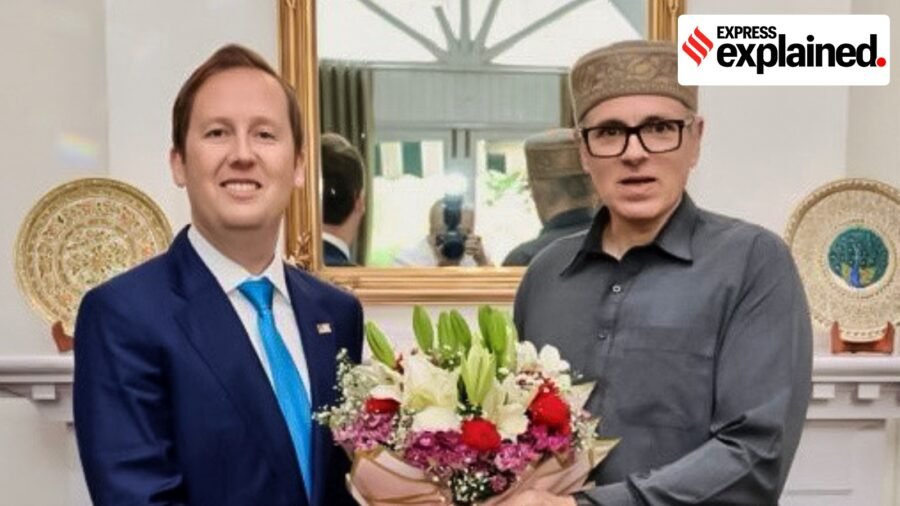
US Ambassador Sergio Gor’s declaration from Srinagar that Jammu and Kashmir is “an important part of India” is not just Washington’s public affirmation of New Delhi’s long-standing position on J&K, but it is also being seen as a message to Islamabad and Beijing, especially post the Pahalgam terror attack and Operation Sindoor.
A close confidant of President Donald Trump, Gor is also his special envoy to South and Central Asia. His meeting with Chief Minister Omar Abdullah signals both acknowledgement and engagement with J&K’s first elected government post the 2019 constitutional changes.
For New Delhi, this has significance given that the India-US chill was precipitated by the India-Pak conflict amid Trump’s repeated claims of brokering the ceasefire following Operation Sindoor last year.
From Srinagar, however, Gor has reinforced Trump’s approach on Kashmir – from his first term itself – viewing it as an “internal matter” of India.
This is the first standalone visit to the Valley by a serving US Ambassador since 2019 when Article 370 was abrogated and the State of J&K bifurcated into two Union Territories.
In January 2020, Kenneth Juster, who was the US Ambassador then, had been there as a member of a government-facilitated delegation of 15 foreign envoys. This was around the time groundwork was being done for Trump’s visit to India in February that year.
Between the visits by Juster and Gor, at least two American delegations travelled to Kashmir. In May 2023, a US delegation attended a G20 working group meeting on tourism. Another delegation from the US embassy visited in August 2024, before the elections in the Union Territory and met Omar Abdullah, in his capacity as the NC chief, and Lt Governor Manoj Sinha.
Story continues below this ad
Ever since the abrogation of Article 370, the evolution of the US position has been noteworthy from India’s perspective – it saw least interference by the Trump 1.0 administration in 2019-2020.
The US administration’s statements were quite carefully crafted.
On August 5, 2019, when J&K’s special status was ended, US State Department spokesperson Morgan Ortagus had said, “We are concerned about reports of detentions and urge respect for individual rights and discussion with those in affected communities.”
Ortagus had called on “all parties to maintain peace and stability along the Line of Control” between India and Pakistan.
On August 8, a US State Department spokesperson had said that the US was “closely following” the broader implications of these developments, including the potential for increased instability in the region.
Story continues below this ad
“We continue to support direct dialogue between India and Pakistan on Kashmir and other issues of concern,” the spokesperson said, adding that “the US calls for calm and restraint by all parties”.
On August 19 that year, three days after informal consultations at the UNSC, Trump spoke with Prime Minister Narendra Modi and conveyed the importance of reducing tensions between India and Pakistan and maintaining peace in the region.
A day later, US Defence Secretary Mark T Esper spoke to Defence Minister Rajnath Singh and “appreciated India’s position that the recent developments in Jammu & Kashmir are an internal matter of India”, according to a statement from the Ministry of Defence.
This was the first time the US had said that the developments in J&K were an “internal matter” of India. Russia became the first UNSC permanent member to underline that the changes had been carried out “within the framework of the Constitution of the Republic of India”.
Story continues below this ad
On August 22 that year, Trump suggested, for the third time in a month, that he would do the best he could to “mediate” on Kashmir.
But four days later, after meeting Modi in France on the sidelines of the G7 summit, Trump said the Prime Minister “really feels he has it under control”.
On September 6, a month after political leaders were detained and communication restrictions were put in place across J&K, the US expressed concern and also urged New Delhi to “resume political engagement with local leaders” and hold “elections at the earliest”.
Weeks later, speaking at the Howdy Modi diaspora event in Houston in late September 2019, Modi spoke on Article 370: “The country was also facing another challenge for the last 70 years, a challenge to which India bid farewell only recently… Article 370 deprived the people of Jammu, Kashmir and Ladakh of development and equal rights. The forces funding terrorism and separatism were exploiting the situation. Now, the same rights that were given by the Constitution of India to the rest of Indians have also been given to the people of Jammu, Kashmir and Ladakh.”
Story continues below this ad
Targeting Pakistan, Modi said “India’s actions within its boundaries are causing discomfort to some people who are unable to manage their own country… These are people who want unrest. These are people who support terrorism and who nurture terrorism. You know them very well. You know who they are… The whole world knows who they are. Whether it was 9/11 in America or the 26/11 attack in Mumbai, where were the conspirators of these attacks found?”
“The time has come to fight a decisive battle against terrorism and against all those who promote terrorism… President Trump is firmly committed to fighting this battle against terrorism,” he had said.
Six years later, the visit to J&K by Trump’s envoy reinforces the strategic ties between India and the US amid changing geopolitics, alignments in regions not far away.
A smoke and mirrors summit in which Xi emerged with the upper hand
By Sohail Khan · 28 Sep
Why must a woman always trade curiosity about the world for safety?
By Sohail Khan · 28 Sep
Best places in India to see tigers in the wild
By Sohail Khan · 28 Sep