PM Modi’s 100 GW nuclear target: Why India needs more power for AI, chips and data centres
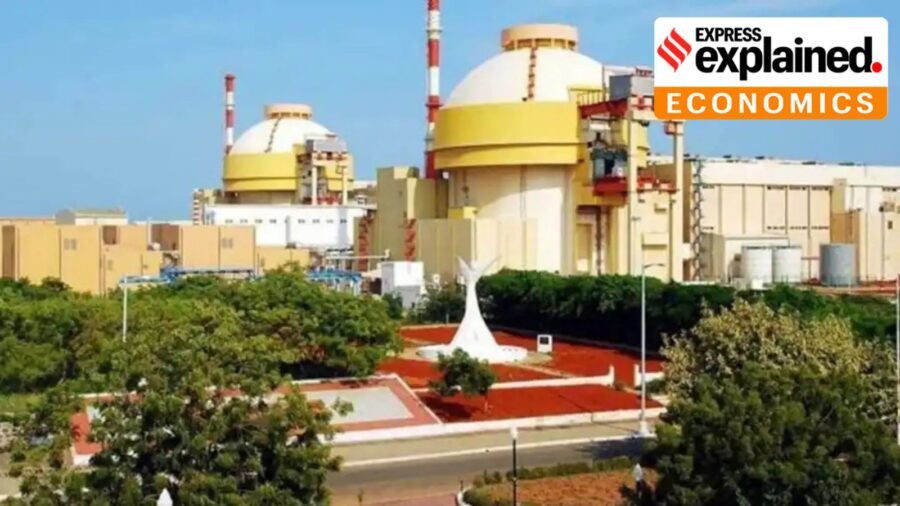
India is betting on nuclear power to meet the rapidly rising electricity demand from emerging sectors such as semiconductors, artificial intelligence (AI) and data centres, with Prime Minister Narendra Modi setting a target of commissioning five new nuclear reactors in the current decade and expanding nuclear capacity to 100 GW by 2047.
In his Independence Day address, Modi said the growing adoption of future technologies would drive a sharp increase in electricity demand. “It will be difficult to run this new world without energy, and therefore, whether it is chips, AI or data centres, we will need very large amounts of electricity,” he said.
“We are working towards a target of 100 GW of nuclear power by 2047. In this decade itself, we have set a target of commissioning five new nuclear reactors,” he added.
PM Modi’s comments come against the backdrop of the Parliament passing the SHANTI Act last year, paving the way for wider private participation in India’s tightly regulated civil nuclear power sector and drawing interest from global nuclear technology suppliers from Russia, the US and France.
On Friday, the Department of Atomic Energy (DAE) also released the draft rules under the Act, laying out the regulatory framework for a broader nuclear power ecosystem, including private participation, captive generation, licensing, safety oversight and nuclear liability.
But can the government achieve this ambitious target? Where does India’s nuclear power sector stand today, and how has the country’s civil nuclear programme evolved?
Small modular reactor push
As the Centre targets expanding India’s nuclear energy capacity to 100 GWe by 2047, the government is pursuing a two-pronged approach: the deployment of large-capacity reactors as well as the use of small modular reactors (SMRs) to ensure faster deployment of units.
Story continues below this ad
Even though India’s indigenous pressurised heavy water reactors (PHWR) will continue to form the backbone of the country’s nuclear expansion plans, SMRs are increasingly viewed as a promising technology that could help in industrial decarbonisation.
These are also seen as important in offering baseload power that could give grid operators a degree of flexibility, especially given the imperative of inducting large-scale renewables into the grid that comes with the challenge of ramping up baseload generation to balance out the vagaries of renewable power output. While thermal generation is seen as important in this regard, nuclear energy offers a more carbon-neutral baseload generation option.
SMRs are also becoming the focal point in India’s international outreach for nuclear collaborations, with the high project costs of large light water reactors (LWRs) triggering questions about the feasibility of their large-scale deployment in the country.
In May, a high-level American nuclear delegation was informed during meetings with top government functionaries about India’s goals to progressively enter the manufacturing value chain of SMRs.
Story continues below this ad
It is learnt that India is actively seeking foreign expertise and investment to support the development of a domestic SMR ecosystem. For now, any foreign collaboration is likely to be centred on SMRs rather than large conventional reactors due to cost concerns linked to LWRs.
Five indigenous SMRs by 2033
On the domestic front, India is pursuing an indigenous small reactor programme, with three types of SMR being designed and developed by the Bhabha Atomic Research Centre for demonstration: the 200 MWe Bharat Small Modular Reactor (BSMR-200), a 55 MWe small modular reactor (SMR), and a 5 MWt high-temperature gas-cooled reactor for hydrogen production by coupling with a suitable thermochemical process for hydrogen production. The government has set a target of having at least five indigenously designed and operational SMRs by 2033.
India has announced the Nuclear Energy Mission to research, design, development, and deployment of SMRs with a total budgetary outlay of Rs 20,000 crore.
Meanwhile, the government is also conducting studies to repurpose old thermal power plant sites for nuclear sites. Such repurposed sites may ultimately be more suitable for SMRs and smaller-capacity nuclear projects rather than large conventional reactors, an official familiar with the development had earlier told .
Three-stage nuclear programme
Story continues below this ad
On the large-reactor front, India currently has 25 operational nuclear reactors totalling 8.7 gigawatt-electric (GWe) of capacity, with 10 reactors — with around 8 GWe of capacity — under construction. Another 10 units — with some 6.6 GWe of capacity — are in the pre-project stage.
India has already developed and mastered indigenous PHWR technology and is following a three-stage nuclear power programme aimed at achieving long-term fuel self-reliance.
The first stage is based on PHWRs using natural uranium as fuel. The plutonium generated in the spent fuel from these reactors is then used in the second stage, comprising fast breeder reactors (FBRs). FBRs initially use plutonium plus depleted uranium to obtain Uranium-233 (U-233) from Thorium-232 (Th-232), which is used as a blanket in such reactors.
In the third stage, it is Th-232 that will get converted into U-233, which would be fuel for the advanced reactors. FBRs represent a crucial intermediate step between the first and third stages of India’s nuclear programme, enabling the country to utilise its abundant thorium resources and move towards greater self-reliance in nuclear fuel.
Story continues below this ad
In April, India’s first indigenous fast breeder reactor at Kalpakkam attained criticality, marking a major milestone in the country’s civil nuclear programme.
“This year, India crossed an important milestone by mastering fast breeder nuclear technology. With this, we have taken a major step towards achieving self-reliance in nuclear fuel and have made significant progress in that direction,” PM Modi said in his speech.

Between Trump’s US and Xi’s China, the trap India must avoid
By Sohail Khan · 28 Sep
Farmers need a share of the solar boom
By Sohail Khan · 28 Sep
Fraying exchange of ideas, and a world torn by conflict
By Sohail Khan · 28 Sep