Nepal faces secondary flash flood threat
Benchmarks
Nifty24,121.5030.66
Precious Metal
Gold (MCX) (Rs/10g.)159,374.00378.0
Enter search text:
Business News›News›International›World News›Nepal faces secondary flash flood threat as debris forms dam: ICIMOD cryosphere specialist
Read Today's Paper
Nepal faces secondary flash flood threat as debris forms dam: ICIMOD cryosphere specialist
Synopsis
Nepal faces secondary flash flood risks as debris forms a temporary dam. Over 470 people have died and nearly 1,000 are missing from recent floods. Researchers are investigating an ice-rock avalanche as the initial disaster cause. A similar event in Chamoli, India, saw a gradual lake breach without a major flood. Nepal has issued a new flood warning after water levels rose at the affected site.
 PTI
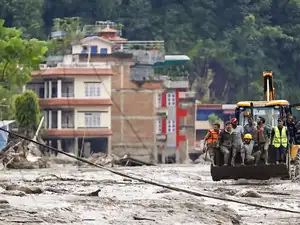
PTINew Delhi: Chances of a secondary flash flood prevail in Nepal as debris from the ice-rock avalanche that possibly triggered the flash floods is accumulating at the river confluence and creating a temporary dam, senior cryosphere specialist at ICIMOD, Mohd Farooq Azam, has warned.
The term cryosphere refers to the parts of the Earth's surface covered by frozen water.
As of Friday, the death toll from the flash floods in Nepal and Tibet has exceeded 470, with nearly 1,000 people still reported missing as search and rescue operations continue into their third day.
"This debris that came down with this flash flood is now also accumulating at the river confluence, where there is temporary damming at the moment. This dam is collecting water, and it is expected that over the next three days, there will be more water collected in this temporary pond or lake. So, there are chances that there may be some secondary flash flood in this valley," he said.
Azam noted that it's also possible that the lake breaches gradually and water may be released without causing a flash flood.
Drawing similarities with flash floods that hit Uttarakhand's Chamoli in February 2021, Azam said, "I would say that this is the same kind of situation when in Chamoli, some mass came down and blocked the Rishi Ganga river for some time."
"Fortunately, the secondary lake that developed breached slowly without any flash flood. So, let us hope that there is no secondary flash flood (in Nepal) because of (a) sudden breach of this temporary lake," the cryosphere specialist said.
Nepal has issued a fresh flood warning after the water level at the already-affected flash flood site increased. The National Disaster Risk Reduction and Management Authority (NDRRMA) has said that a rise in the water level at the same site raises the risk of another flood in the area.
Even a small secondary flash flood in the region could be more devastating as the valley is "already much more vulnerable and very sensitive", Azam cautioned.
On whether such disasters can be prevented, Azam said, "It is difficult to say that such disasters can be prevented, but there are several disasters where we understand in advance that there may be a disaster. Specifically, when we talk about glacial lake outburst floods, because these lakes are very much visible and they are expanding."
An assessment of a glacial lake can suggest if it is potentially dangerous or not, he explained further.
"In that case, if we are basically monitoring the lake and we are sharing the data, then it helps to develop some strategy at regional scale," Azam said.
Azam highlighted that a flash flood or glacial lake outburst flood occurring upstream has no borders and can travel downriver, affecting other countries.
"In this particular case, we see that the disaster happened in the Nepal Himalaya and downstream, it immediately entered into the Tibetan boundary, where it hit the infrastructure there and then again it came down towards Nepal," the cryosphere specialist said.
"So, this is why we need to have a regional cooperation and data sharing policy to better understand these disasters and perhaps to be ready for such disasters in advance," he said.
Add 

(You can now subscribe to our WhatsApp channel)
(You can now subscribe to our WhatsApp channel)
Read More News on
Nepal flash flood warningsecondary flash flood Nepalglacial lake outburst floodTibet flash floodssearch and rescue operations NepalICIMOD cryosphere specialistNMDRRMA flood riskavalanche debris damNepal Tibet floodNepal flash flood


Enter search text:
Stories you might be interested in
Sugar prices see sharp drop at mill gates, decline yet to fully reach consumers
By Sohail Khan · 5 Sep
GQG sale of Adani Energy shares said to disrupt hedge fund bets
By Sohail Khan · 5 Sep

Leave a Reply