Making GIs fashionable and fair
August 21 is observed every year as World Fashion Day to celebrate the art and spirit of fashion. The fashion industry draws heavily on traditional arts and crafts for design inspiration. This can lead to iniquitous outcomes for the indigenous peoples and local communities from whom ideas are taken.
A specific kind of intellectual property (IP) — Geographical Indications (GIs) — is considered a legal solution against cultural appropriation. A GI is a name or a sign that identifies goods that come from a particular place and have special qualities or reputation because of their said geography.
It is because of the European Union (EU) that GIs were first inserted in the text of the World Trade Organization (WTO)’s Agreement on Trade-Related Aspects of Intellectual Property Rights (TRIPS). WTO requires member countries to provide legal means for GIs. India’s Geographical Indications (GI) of Goods (Registration and Protection) Act was legislated in 1999 to comply with the WTO. The law tags goods, such as agricultural produce and handicrafts or other manufactured products, with specific geographic origin. As of May 2026, a total of 822 GIs are registered in India, which include traditional footwear such as Chamba Chappal from Himachal Pradesh, textile patterns such as the Pochampalli Ikat from Telangana, and several handicrafts made by tribal people.
GIs are meant to be collective by nature, creating a legal shield for community knowledge and shared skills against their unauthorised use. GIs also function as a marketing tool in rendering recognition for place-based traditional techniques helping producers to charge a premium in a market that increasingly cares about authenticity and sustainability. But this protection is not handed out equally.
Lopsided global trade architecture
The TRIPS Agreement carves out a two-tier system: wines and spirits — dominated by European exporters — that get automatic, robust protection under its Article 23. Everything else, from local handicrafts to traditional foods that anchor rural economies across Asia, is left with the far weaker safeguard of Article 22. The gap is not an accident — it’s the product of the lopsided global trade architecture and its IP rules built on structural biases against the developing world.
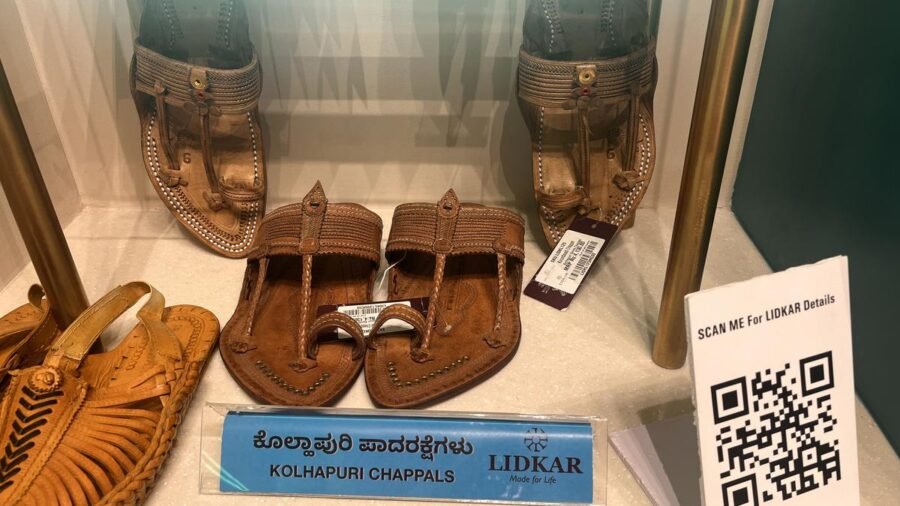
In June 2025, an Italian fashion house known the world over — the Prada group — featured lookalikes of India’s Kolhapuri chappal in its show during the Milan Fashion Week in Italy. The show exhibited male models wearing the footwear on the runway embossed with the word “Prada” as part of its Spring-Summer 2026 Men’s Collection. Prada simply termed it “leather footwear” without any credit to the original designers — the communities in Karnataka and Maharashtra. A huge debate ensued on whether Prada inappropriately used a traditional cultural expression without acknowledgement.
In July 2025, six advocates initiated public interest litigation petitions at the Bombay High Court seeking action against the Prada group. They sought to prevent Prada from commercialising the unique design of the Kolhapuri chappal without consent of the GI-holders. These petitioners also sought a public apology from Prada, to make them acknowledge the unauthorised use of “Kolhapuri Chappal” GI and expressly recognise the rights of the Indian craftsperson community and compensation to the craftspersons for reputational and economic damages. The court observed that the GI Act confers on the government-run bodies in Maharashtra and Karnataka — LIDCOM and LIDKAR — the legal right to obtain relief in respect of infringement of GI. It questioned the locus standi of the petitioners, stating that they were neither registered proprietors nor the authorised users of the GI tag. It dismissed the petition on July 16, 2025.
The matter was settled out of court, since neither LIDCOM nor LIDKAR sued Prada. A memorandum of understanding (MoU) was signed on December 11, 2025 between the Prada group and LIDCOM and LIDKAR on the occasion of the Italy-India Business Forum in Mumbai. As per that, Prada is marketing “Made in India x Inspired by Kolhapuri Chappals crafted by LIDCOM and LIDKAR artisans”.
LIDCOM and LIDKAR were set up to preserve traditional leather craftspersonship and empower marginalised artisans — whose caste position has, for generations, kept both the craft and its makers at the margins of India’s economy. A GI tag was meant to change that calculus, converting local skill into a legally recognised globally saleable asset.
What the Prada episode shows is that the GI tag alone did not safeguard the artisans. It took public outrage, some courtroom drama, and a business summit to arrive at an MoU — and even thereafter, the final product carries Prada’s name, not India’s or its artisans’.
EU-India FTA
2026 began with a joint EU-India statement on a bilateral free trade agreement (FTA). On January 27, both sides tasked their teams with completing a separate agreement on GIs. India has already granted GI recognition to some 30 European wines, cheeses, and meats. For Indian handicrafts to get equivalent standing in Europe will require Indian negotiators to raise the concerns of its artisans.
Fair use of traditional design needs to be more than a passing trend. Ethical fashion implies collaborative innovation with due respect of, permission from, and compensation for the artisan communities.
Shalini Bhutani is a senior law and policy analyst, and Seema Singh Rawat is Dean of the School of Innovation & Entrepreneurship at IRMA-TSU

Malaika Arora, 52, reveals a dietary staple she refuses to skip: ‘I can’t have salads’
By Sohail Khan · 28 Sep
A smoke and mirrors summit in which Xi emerged with the upper hand
By Sohail Khan · 28 Sep
Why must a woman always trade curiosity about the world for safety?
By Sohail Khan · 28 Sep