Is ‘panthic’ politics returning to Punjab ahead of polls?
Three developments in Punjab this week have brought the politics of religion, militancy-era legacies and the Sikh prisoner issue back into the political conversation.
First, Chief Minister Bhagwant Mann met Governor Gulab Chand Kataria and sought a 10-day parole for Jagtar Singh Hawara, convicted in the 1995 assassination of former Punjab chief minister Beant Singh, on humanitarian grounds so that he could meet his ailing mother. The Governor subsequently recommended the parole. Hawara, whose death sentence was commuted to life imprisonment in 2010, has been in custody for 31 years. Interestingly, BJP leader Ravneet Singh Bittu, the grandson of Beant Singh and a vocal opponent of leniency towards the convicts, also backed the request “on humanitarian grounds”.
The second development was more clearly electoral. Shiromani Akali Dal (Waris Punjab De), headed by jailed Khadoor Sahib MP Amritpal Singh, announced Satwant Singh, the son of Kehar Singh — who was convicted in the Indira Gandhi assassination case and hanged in 1989 — as its first candidate for the 2027 Assembly elections. Satwant Singh is set to face Amrit Kaur Maloya, daughter of Beant Singh, an assassin of Indira Gandhi, who has decided to contest as an independent, in Bassi Pathana. Many are already calling it a “qurbani vs qurbani” battle.
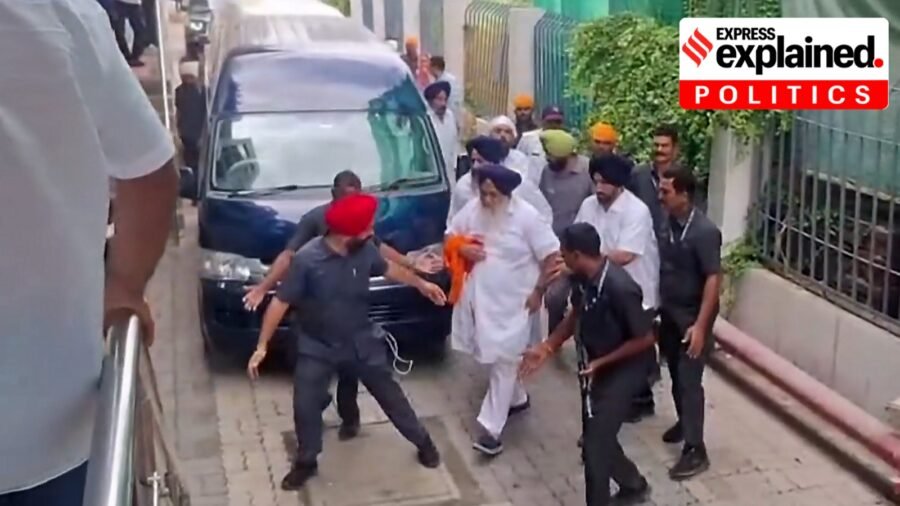
Third, on Thursday, Shiromani Akali Dal president Sukhbir Singh Badal was attacked at a gurdwara in Maharashtra’s Nanded by a man dressed as a Nihang. The incident came days after Badal met Prime Minister Narendra Modi, triggering speculation about a possible reunion between the former allies.
Taken together, the three developments have fuelled speculation about a resurgence of hardline or “panthic” politics in Punjab. That conclusion may be premature. The more interesting question is whether political parties are beginning to occupy the panthic space because they see an electoral opportunity.
The politics of parole
Chief Minister Mann took many by surprise when he sought parole for Hawara after opposing it in the Punjab and Haryana High Court until March.
It is an interesting turn for the Aam Aadmi party that swept to power in 2022 on a development agenda.
Story continues below this ad
Pramod Kumar, a veteran Punjab watcher who heads the Institute for Development and Communication in Chandigarh, sees the move as an attempt to shift the political goalposts and divert voters’ attention from the government’s performance.
“So, on one hand, it is trying to appeal to panthic voters by rooting for Hawara’s parole; on the other, it is trying to woo Hindu voters through its teerth yatras, bhajan sandhyas, temple projects and other programmes. In essence, it is trying to appropriate a political space occupied traditionally by the Akalis and the BJP,” he says.
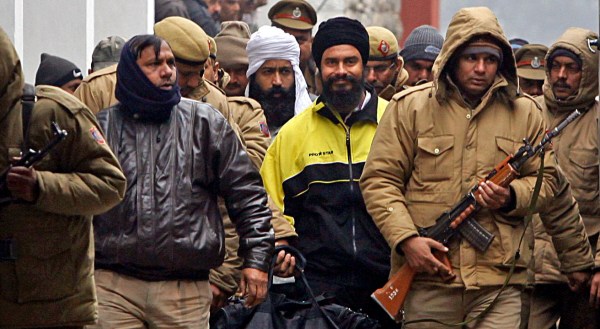 Jagtar Singh Hawara (in yellow) is produced before a court in Chandigarh in 2013. Express
But the politics around the Bandi Singhs (Sikh prisoners) did not begin with Mann.
For more than three years, the Qaumi Insaaf Morcha has kept the ‘Bandi Singhs’ issue alive through its prolonged agitation at the Chandigarh-Mohali border. Beginning in January 2023, the protest, with tents, langars and support from farmer unions and Sikh organisations, disrupted a key link between the two cities for many months before the road was opened following a court intervention.
Story continues below this ad
Though the agitation has ebbed and flowed, its persistence, including the call for an Independence Day protest, has kept alive an issue that was once largely confined to panthic organisations and brought it into the wider political conversation.
The BJP has maintained a legally cautious stand on the Bandi Singhs, arguing that their release has to be decided by the state governments where the cases originated or where the prisoners are held.
At one point, Union Minister Gajendra Singh Shekhawat even signed an SGPC (Shiromani Gurdwara Parbandhak Committee) form seeking the release of eligible prisoners. The AAP government in Delhi — where some of these prisoners are lodged — had also faced frequent criticism from various Akali factions over its position on the issue.
Story continues below this ad
The BJP, which has said it will go it alone in the coming elections, is also seeking to make inroads into the panthic constituency once occupied by its former alliance partner, the Shiromani Akali Dal (Badal). Its challenge is to do so without appearing to depart from its stated legal position on the prisoners.
Misreading Punjab?
This is where Punjab’s electoral history offers a reality check.
A look at elections since 1992, when Punjab entered its post-militancy electoral phase, shows that the state has rarely voted on an explicitly religious plank. It elected three Congress governments despite the shadow of Operation Blue Star and the 1984 anti-Sikh violence.
Sikhs have never voted as a bloc in Punjab, just as Hindus and Dalits have not. Electoral politics has traditionally been driven by a complex mix of class, caste, region, rural-urban divides and, increasingly, governance and performance.
Story continues below this ad
Today, however, there is considerable political confusion.
The Congress is a house divided, consumed by internal dissent. The moderate Shiromani Akali Dal (Badal) is still struggling to regain the ground it lost after 2017, following a series of sacrilege incidents.
Waris Punjab De, meanwhile, is attracting young voters with little or no memory of the turmoil that set Punjab back by decades. By raising long-pending issues such as river waters, Chandigarh, and the incarceration of prisoners who have completed their sentences, it seeks to portray Punjab’s problems as the result of discrimination by successive governments.
But does that give it the upper hand? Not necessarily.
Story continues below this ad
Punjab has historically resisted the politics of exclusion. The danger is that the political conversation could shift from issues that matter to voters, particularly development, education and governance, to emotion and identity.
For a state that has seen the consequences of such politics before, that may ultimately benefit no one.

The paradox of de-Sinification in global production
By Sohail Khan · 28 Sep
Letters to The Editor — September 28, 2026
By Sohail Khan · 28 Sep
Kashmir as India’s gateway to Eurasian opportunity
By Sohail Khan · 28 Sep