At Ujjain’s historic mosque, long night as residents gather ahead of demolition, court hearing
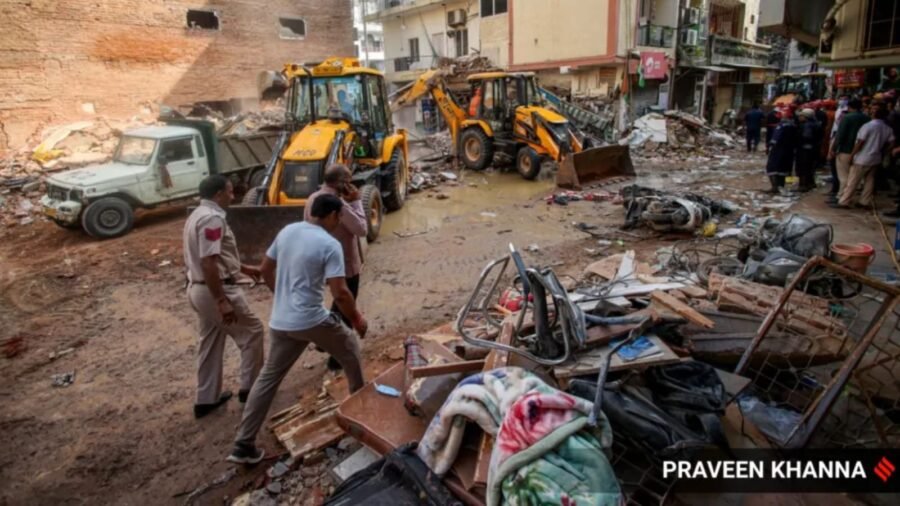
“We have deployed adequate force to maintain peace in the area. We have had conversations with the masjid committee members over the issue and explained the legalities of the case. We are trying our best to convince them to demolish the structures themselves. We are not proceeding with any demolition for now and are trying to sort this out through dialogue,” Sharma said.
The resistance centres on the portion of the mosque that falls within the proposed alignment of the road, which the Ujjain Municipal Corporation plans to widen to 15 metres. Community members have questioned why the road cannot instead be widened by removing the building opposite the mosque.
Imam Mohammad Ibrahim said the mosque should be excluded from the widening exercise. “This is a religious city. None of the religious sites should be demolished. Widening should take place excluding religious sites,” he said.
Story continues below this ad
Ibrahim claimed that the mosque dates back 636 years, to 1390, and said previous road-widening exercises had left religious structures untouched. “We have filed a petition in the High Court double bench, which is being heard on Monday, September 28,” he said. “We told the administration that we gave as much as we could according to Sharia, including many shops. Now we cannot give away any mosque.”
Mohammad Zakir, a member of the Muslim Representative Committee, said members of the community had gathered at the mosque because they were determined to prevent its demolition.
“This is our request to the government and administration regarding the mosque, that it be spared. All the people of our city have been in the mosque all night and are still staying inside the mosque,” Zakir said. “We want to save the mosque. We do not want to give it up at any cost.”
Meanwhile, AIMIM chief Asaduddin Owaisi said the Muslim community was protesting against the demolition in a “Gandhian way”, arguing that mosques and other religious properties could not be demolished “in this manner”.
Story continues below this ad
Speaking to media, Owaisi said the protest was also a reflection of concerns he had raised in Parliament over the Waqf Amendment law. He alleged that the powers granted to collectors and the government under the amended law were intended to enable the authorities to take control of mosques, dargahs, khanqahs, graveyards and Eidgahs belonging to the Muslim community.
“What I had expressed in Parliament is now proving to be true,” Owaisi said, referring to the ongoing action. He alleged that the developments showed that the objective of the Waqf amendment was not to protect Waqf properties but to take them away from Muslims.
“The purpose of the amendment was not to save Waqf. Its purpose was this,” he said, referring to the proposed demolition in Ujjain.
What the court said
The dispute comes despite a September 9 order of the Madhya Pradesh High Court dismissing two petitions challenging the Ujjain Municipal Corporation’s decision to remove the portion of the Shahi Masjid that falls in the proposed road alignment area. The mosque is registered as a Waqf property.
Story continues below this ad
The petitioners had argued that the proposed action would affect part of the prayer hall, a 120-foot minaret and the Mazhar Chowk Shahi, and had challenged the action under Articles 14, 25 and 26 of the Constitution, besides raising property-rights concerns under Article 300A.
Justice Sandeep N Bhatt held that the municipal corporation had followed the statutory procedure and had provided the affected parties an opportunity to raise objections.
The court rejected the argument that the mosque was being singled out because it was a religious structure, noting that the corporation had already taken action affecting other religious structures as part of the road-widening exercise.
The court noted that portions of 10 temples and one mosque had already been removed along the same road, while authorities had taken action involving around 80 religious places across Ujjain. On that basis, it rejected the petitioners’ allegation of discriminatory treatment and held that the corporation could not be said to be acting arbitrarily merely because the property in question was a religious place.
Story continues below this ad
The court also considered the larger purpose of the road-widening project. The corporation had argued that the widening was being undertaken under the Ujjain Development Plan, 2035, and was necessary to facilitate traffic during the Shahi Sawari, Peshwai and Simhastha 2028. The court took note of the expected arrival of crores of devotees and the need to provide better facilities and manage traffic during the event.
The location of the mosque was also relevant to the court’s reasoning. The judgment noted that it is situated almost opposite the Mahakaleshwar Temple and close to the Kshipra river. Considering the expected crowds during Simhastha and the requirements of public safety and traffic management, the court found that the action had been taken in accordance with the law and in the larger public interest.
The court also addressed the petitioners’ contention that the authorities were giving differential treatment to the mosque. It observed that the petitioners appeared to be raising “one or another dispute” on the premise that the religious structure was being given special treatment, and rejected that contention. The court ultimately found that the corporation had taken the necessary steps under the law and that no interference under Article 226 was warranted.
All eyes on Monday
The court’s order, however, has not ended the dispute on the ground. The mosque committee has moved before a larger bench, with the matter expected to be heard on Monday.
Story continues below this ad
Community members have said that if they do not get relief, they will consider approaching the Supreme Court.
The latest protests have added another layer to Ujjain’s preparations for Simhastha, as the administration seeks to widen roads and increase traffic capacity while residents and religious groups resist the removal of structures they say should be preserved.
Ending relationship, blocking calls not abetment to suicide, says Rajasthan High Court
By Sohail Khan · 28 Sep
Leave a Reply