Indian make a point vs Olympic silver medallists China in World Cup opener
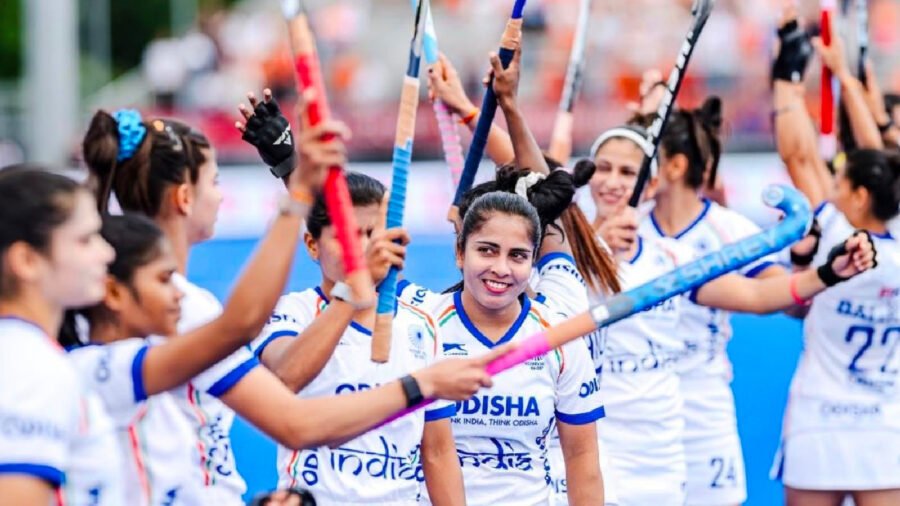
One moment, Navneet Kaur was holding off a defender inside the Chinese circle, turning sharply and finding the space to fire India into the lead. Minutes later, she was sprinting into her own half, winning possession and giving her defence a chance to reset.
That was India’s afternoon in a nutshell.
Nikki Pradhan sat in front of the back three like a sentry, reading danger before it fully developed and cutting off passing lanes as China pressed. Baljeet Kaur’s explosive runs ensured the Chinese defence never had the luxury of settling into shape. Deepika Soreng attacked the baseline, slipping behind defenders and stretching the field.
And when China inevitably found openings, Savita Punia and Bichu Devi, who alternated the quarters, were there to keep India in the contest.
There were moments of individual brilliance throughout the match. But India’s 2-2 draw against one of the World Cup favourites wasn’t the result of one outstanding performance. It was built on contributions from every corner of the field.
India had lost to China in their last four outings. Each defeat had been more damaging than the previous one. But this Indian team is different. The dressing room that once looked fractured has found some of its old rhythm; players seem clearer about their roles, and the defensive discipline that had been missing is now becoming a defining feature.
A splendid first-time finish! 🤩
Navneet Kaur bags India’s first goal against China. 💪
— Star Sports (@StarSportsIndia) August 16, 2026
Head coach Sjoerd Marijne, back for a third stint with the team after his previous one ended with a fourth-place finish at the Tokyo Olympics, has spent much of his time bringing that ‘joy’ back into the group. His four pillars have been role clarity, team unity, defensive discipline and precise finishing.
The FIH Nations Cup, which India won in June without losing a match, was an early glimpse of a programme beginning to yield results. The World Cup opener in Amsterdam on Sunday reinforced that belief.
Alyson Annan wanted her team to play fast hockey from the get-go. For much of the first half, though, it was China who were being forced to chase.
Story continues below this ad
India took the lead in the eighth minute. They earned a foul at the edge of the semicircle on the right and Baljeet played the ball quickly towards Neha Goyal, who played it into the circle first time. Navneet received it under pressure, with a Chinese defender hovering over her. The forward from Shahbad didn’t panic. Instead, with her back to the goal, she showed great positional awareness and pushed the ball hard and low to the far post, beating the defenders and goalkeeper to give India the lead.
They, however, couldn’t hold on to it. In the 15th minute, Shilpi Dabas pushed Zhong Jiaqi inside the ‘D’, and the referee had no hesitation in awarding a penalty stroke. India challenged the call, but it was upheld, leaving them without their review and allowing China to equalise after Zhang Ying caught Savita flat-footed.
The goal didn’t swing momentum China’s way. India deployed a half-court press to counter China’s offensive push. They absorbed pressure and recoiled like a spring whenever a counterattacking opportunity presented itself. Deepika Soreng’s goal came from one such move.
India won possession and charged forward. Deepika made a penetrative run down the right flank, entered China’s ‘D’, kissed the baseline and drew a foul to win a penalty corner. She then converted it, her drag-flick taking two big deflections before finding the back of the net.
Story continues below this ad
China began the third quarter with a subtle tactical tweak. Their two forwards in the 4-4-2 formation pressed very high and operated in their zones, making India uncomfortable and smothering them for space. The tactic worked as China equalised again in the 39th minute, Ma Ning drilling a powerful drag-flick to Savita’s right.
But India held on and ended the match stronger. They could even have won had Lalremsiami found a touch to Navneet’s cross that flew across the goalmouth.
India, however, seemed content with a point against an opponent who will be their biggest rival at next month’s Asian Games.
“It’s better than losing,” Navneet smiled after the game. “This was a learning experience for us. If we score early, we have to keep the lead. The match was a bit up and down but we are happy. The one point is a good result.”


In Nagoya, the real art is under your feet, not the Asian Games
By Sohail Khan · 28 Sep