Ground not covered in talks with China
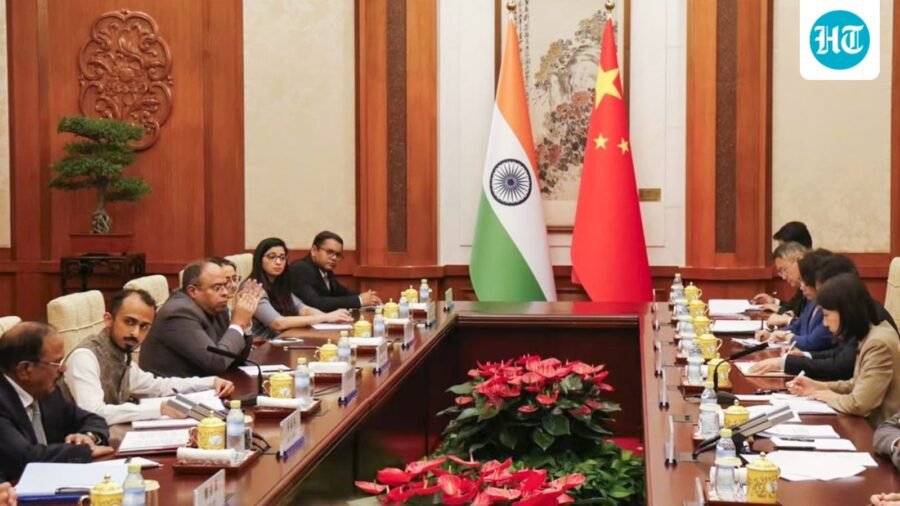
The pre-2020 status quo has to stay on the table as an Indian demand that will not be given up under any circumstances.
Updated on: Aug 31, 2026, 06:16:41 IST
Prefer HTon Google
Share via
Copy link
The eight-point outcomes that India and China released on Wednesday last week, after the Special Representatives (SRs) of the two countries met in Beijing, signal much-needed diplomatic progress. But they also mask unresolved structural issues on the border dispute. To be sure, the outcomes are better than nothing, but they are also less than what we needed. In a sense, the agreement is also a description of the position India is bargaining from, than what an ideal agreement should have looked like.
The talks between the SRs indicate progress. For instance, two more meeting points for senior commanders, two more hotline channels in the Eastern and Middle Sectors, a September meeting on trans-border rivers, three trading points reopened, the pilgrimage expanded, and the next round of talks in India in 2027, are all examples of progress. After the 2020 Galwan standoff and the uncomfortable years that followed, there is little doubt that this is significant progress.
My broader concern, however, pertains to what the document doesn’t refer to any longer, and what it has started referring to instead.
Let me begin with the silences. A key achievement of more than two decades of SR negotiations, the 2005 Agreement on Political Parameters and Guiding Principles, continues to be invoked in the Sino-Indian joint documentation, and it provides great clarity on what a final resolution should entail. Article III of the 2005 Agreement commits both sides to make adjustments to their positions so as to arrive at a “package settlement”, and then adds a sentence of its own: “The boundary settlement must be final, covering all sectors of the India-China boundary.” That is mandatory language not to be cast aside easily.
Last week’s text signed by Ajit Doval and Wang Yi reaffirms the 2005 agreement in point 2, but it does not reaffirm the package deal. To be fair, it does say that the framework will be pursued in accordance with the 2005 agreement and the consensus reached in subsequent SR Talks. For sure, the spirit of the 2005 agreement remains, but the letter has seemingly changed.
Point 3 of the 2026 agreement sets the Expert Group on Boundary Delimitation to advance an Early and Substantial Harvest of boundary delimitation, with the creation of its own terms of reference as its first task. Early harvest is an interesting phrase because it comes from the vocabulary of trade negotiations, where parties arrive at a limited set of concessions and agreements ahead of a comprehensive deal. But here’s the problem: In trade, a partial deal is a down payment on what comes thereafter; in a boundary negotiation, a sector once settled is closed, and what remains on the table is only the ground nobody wanted to give up in the first place.
There is another substantive issue regarding the phrase. If early harvest means beginning where agreement is easiest (to be fair, we do not know yet if that is the case), making concessions in the sectors where agreement comes easily will take us to the harder sectors with a weaker hand, and nothing obliges China to move there at all, except goodwill. If that happens, would there be any incentive for China to concede in the harder sectors once the easier ones are settled?
The same danger may reside in sequencing delimitation ahead of restoration of status quo ante bellum. While talks begin in one sector (or after they conclude), the military balance could shift in another: Infrastructure, deployments and, in China’s case, the border village programme continue to change the facts on the ground. Article VII of the 2005 agreement says a settlement must safeguard the due interests of settled populations in the border areas. That clause was traditionally understood in India’s favour. But today, it could read differently considering the establishment of Chinese villages in the vicinity.
None of this means that last week’s agreement was deeply flawed or has no merits. In reality, the package settlement Article III described in 2005 has produced no framework in 21 years, and certainly did not prevent 2020. If that is the experience of the past two decades, endlessly waiting for a desirable package deal which may or may not arrive might not be a great strategy. The bilateral power differential is widening: India’s economic dependence on Chinese inputs is greater now than when the 2005 agreement was signed, and the military asymmetry is there to see. Therefore, insistence on the perfect format from a weakening position may end up getting neither the desired format nor a settlement. Delhi appears to have judged that partial progress now is better than a comprehensive deal later.
And yet, India must insist on three things in its approach to China going forward.
One, the pre-2020 status quo has to stay on the table as an Indian demand that will not be given up under any circumstances, without consigning it to the general commitment to peace and tranquillity. For us this is a must, not a wish. So, the item on de-escalation must be brought back into the text at the 26th round next year.
Two, the Expert Group’s terms of reference should not confine themselves to the easier sectors. Limiting progress to Sikkim and the middle sector (if indeed that is the case) would not be enough to cater to Indian interests on the LAC. Delhi must spell out what it understands by “Early and Substantial Harvest”, and ensure that the earliness and substance extend to the other sectors as well.
Third, India must maintain constant vigilance and active military presence along the LAC, refusing to lower its guard for vague paper commitments.
Past agreements have repeatedly broken down, and future ones remain vulnerable to the same fate, so it is imprudent to let the improvement in the paperwork be mistaken for an improvement on the ground. Ultimately, robust deterrence is the only true guarantee of peace.
Happymon Jacob is founder & director, Council for Strategic and Defense Research, and editor, INDIA’S WORLD magazine. The views expressed are personal
Get Current Updates on India News, Elections 2024, Lok sabha election 2024 voting live , Karnataka election 2024 live in Bengaluru , Election 2024 Date along with Latest News and Top Headlines from India and around the world.
See Less

Heart attacks in fit women in their 30s and 40s: The hidden risk doctors want you to know
By Sohail Khan · 29 Sep
40 years ago September 29, 1986: Violence and arrests in Punjab
By Sohail Khan · 29 Sep