Delhi SIR deadline ends, nearly 1 in 2 Tughlakabad voters face deletion risk
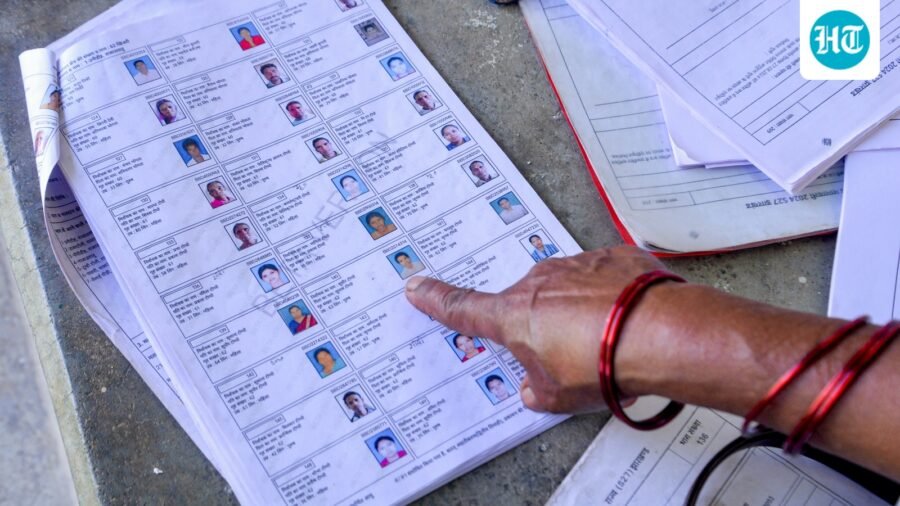
Only two constituencies have crossed 80% digitisation: Rohini in north-west district at 83.43% and Shakur Basti in central north at 81.26%.
Updated on: Aug 18, 2026, 07:19:02 IST
Prefer HTon Google
Share via
Copy link
Roughly one in three voters in Delhi faces the risk of deletion from the electoral list after the first phase of the special intensive revision closed on Monday with official data showing that the assembly constituency of Rohini was set to fare the best and Tughlakabad the worst.
When the first phase of SIR — where people were given partially pre-filled forms by election officials to draw a link to the 2002 base roll — began on June 30, Delhi had a total of 14,510,299 electors.
47.6 lakh forms not digitised
Data shared by Delhi’s chief electoral officer till 8pm showed that around 4.76 million voters, or 32.82%, face the risk of deletion when the draft rolls are published on August 24.
This means that the forms of these 4.76 million people have not yet been digitised when the deadline for the first phase lapsed on Monday.
Electors identified as absent or shifted will have to file applications during the claims and objections period to have their names included in the final electoral roll, scheduled to be published on October 27. Telangana published its draft voter list on Monday while the first phase of SIR also closed in Karnataka and Maharashtra.
“The deadline is till midnight. Some forms are still in the phase of digitisation. The final figures will be known on Tuesday,” said an election official aware of the matter.
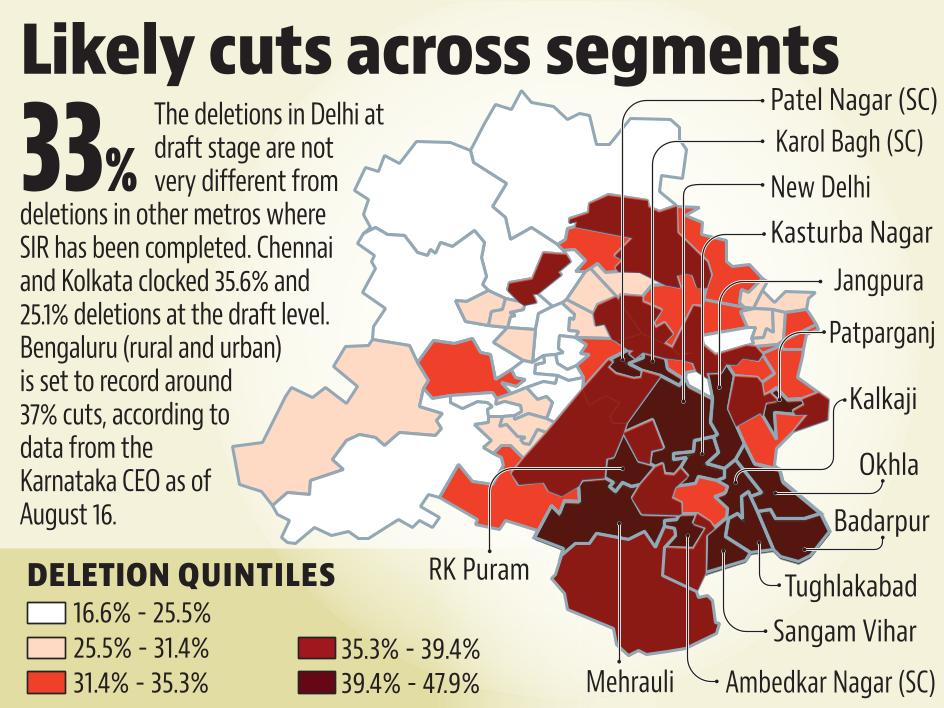
To be sure, the 32.8% deletions likely in Delhi at the draft stage are not very different from deletions in other metro cities at this point in the controversial exercise. Chennai and Kolkata saw 35.6% and 25.1% deletions at the draft stage respectively. Bengaluru (the rural and urban district taken together) is set to record around 37% deletions, according to data from the Karnataka CEO as of August 16.
Rohini tops, Tughlakabad bottoms
According to CEO data, data from all 70 assembly constituencies showed that 125,470 of Rohini’s 150,398 electors, or 83.43%, had their forms digitised.
According to data shared by the chief electoral officer’s office, Outer North district had the largest proportion of its forms digitised (75.68%) as of 8pm on August 17.
West district followed with 73.29%, south-west with 73.16%. North-east and north-west also recorded relatively high digitisation rates of 70.94% and 70.89%, respectively.
South-east recorded the lowest digitisation rate among Delhi’s 13 districts, with only 56.32% of its 1.55 million enumeration forms digitised. New Delhi followed at 60.76%, while south and central recorded 61.32% and 61.96%, respectively. Overall, 9.74 million of the 14.5 million enumeration forms had been digitised, taking the city’s cumulative digitisation rate to 67.18% by 8pm on August 17.
Tughlakabad had digitised 100,323 forms, out of 192,419 electors, or just 52.14%. That means nearly one in every two electors in Tughlakabad faces the risk of deletion from the electoral roll.
Only two constituencies have crossed 80% digitisation: Rohini in north-west district at 83.43% and Shakur Basti in central north at 81.26%. The next three are Rajouri Garden in the west (79.13%), Mangol Puri in the northwest (78.76%) and Uttam Nagar in the west (77.73%), official data showed.
At the bottom, Tughlakabad (south-east) is followed by Okhla (south-east) at 54.66%, RK Puram (south) at 55.52%, Kasturba Nagar (south-east) at 55.94% and Kalkaji (south-east) at 57.18% digitisation.
How key constituencies fared
Kalkaji, the constituency of former chief minister Atishi, had 181,350 electors, while forms have only been digitised for 103,688 (57.18%).
In Shalimar Bagh, the constituency of chief minister Rekha Gupta, forms have been digitised for 69.14% of the 177,429 electors.
In the New Delhi seat, held by public works department minister Parvesh Verma, forms have been digitised for 58.24% of 89,683 electors.
The digitisation percentage for Jangpura is 58.45% of 145,823 electors. Greater Kailash fares slightly better with a digitisation figure of 64.96% of 177,885 electors. The strongest performers are concentrated largely in north and west Delhi. Apart from Rohini and Shakur Basti, Mangol Puri, Rajouri Garden and Uttam Nagar occupy the top five. Bawana, Narela and Mundka — constituencies with significant peripheral and semi-rural areas — also show relatively high digitisation, at 76.29%, 76.21% and 74.52%, respectively. Matiala, another large peripheral constituency, stood at 75.87%, while Najafgarh was at 74.19%.
Minority-heavy seats show mixed picture
Among the seven constituencies generally identified as having particularly large Muslim populations — Seelampur, Matia Mahal, Babarpur, Mustafabad, Ballimaran, Chandni Chowk and Okhla — the average digitisation rate was about 68.6%, marginally higher than the city average.
But there was a 22-percentage-point spread within this group.
Seelampur stood at 76.63%, with 148,038 of 193,194 forms digitised. Matia Mahal followed at 75.50%, Babarpur at 73% and Mustafabad at 71.91%.
But Ballimaran was at 67.35%, Chandni Chowk at 61.02%, and Okhla at just 54.67%.
Okhla had 362,813 electors, making it one of the largest constituencies in the Capital, but only 198,297 forms were digitised.
The figures do not support the idea that minority-heavy constituencies uniformly showed lower digitisation. But the performance of Okhla, Ballimaran and Chandni Chowk showed that several such constituencies were substantially behind the city’s leading seats for digitisation.
Electorate size not a clear factor
The size of the electorate also did not offer a neat explanation.
Matiala had the largest electorate in the dataset, with 438,702 voters, and 75.87% digitisation. Vikaspuri, with 421,792 electors, stood at 65.21%, and Burari, with 428,480 voters, digitised 60.49%.
The much-smaller Delhi Cantonment, with only 64,509 electors, digitised only 64.28%.
The data also shows how digitisation and verification closely follow each other, once forms enter the digital system. In Rohini, for instance, 125,478 forms were digitised and 125,470 verified — a difference of just eight. In Tughlakabad, the gap was only 22: 100,345 digitised against 100,323 verified.
To be sure, the election authorities twice revised the schedule of SIR in Delhi to provide more time to electors to submit their enumeration forms.
See Less

Bhopal minor’s murder: 5 held including 3 minors over alleged body parts plot
By Sohail Khan · 18 Aug

Leave a Reply