Chennai’s second airport: grounded until take-off
Nearly three decades after the idea to build a second airport for Chennai was first mooted, the Tamil Nadu government finds itself at the drawing board again, hunting for a fresh site, after the Tamilaga Vettri Kazhagam (TVK) government cancelled the Parandur airport project.
Cheyyur and Gummidipoondi were among the 11 locations originally considered when the search for the second airport project began nearly seven to eight years ago. At the moment, it is not clear why these two locations had never made it to the shortlist of four sites — Parandur, Pannur, Thiruporur, and Padalam. Though discussions had been held on Pannur too, it is not clear if it is still in the race.
Cheyyur airspace under IAF
Sources say that if the Cheyyur site is pursued, the State government may have to get the approval of the Ministry of Defence since the site could fall within the airspace controlled by the Indian Air Force, Tambaram. At Gummidipoondi, the Pulicat Lake is closer to the site, and it remains to be seen how bird movement will or will not affect air traffic. “No decision has yet been taken on the site. The State government will take a decision soon,” a source says. It is learnt that a site inspection is expected to happen anytime.
After finalising the site, the government must request the Airports Authority of India (AAI) to do the pre-feasibility study and give its recommendation. Subsequently, roping in a consultant and applying for the site clearance will start afresh.
After the Sriperumbudur airport project proposed in the mid-2000s was aborted, Parandur came the closest to hosting Chennai’s second airport. Now, all the procedures for building a second airport must begin from scratch.
For the second airport project planned at Parandur in Kancheepuram district on 5,846 acres, the government had completed the acquisition of 1,802 acres, which Industries Minister Keerthana said would be used for industrial purposes.
Enhancing capacity at Meenambakkam
Since building an airport at any chosen site will take a minimum of five to seven years, the State government has shifted its immediate focus to enhancing the capacity of the existing airport at Meenambakkam by constructing T5 Terminal (near the remote bays and between the main and secondary runways). With the completion of phase 2 modernisation (building of T2 and T3 Terminals), the airport’s capacity will increase to 35 million passengers a year and the handling capacity will further be expanded to 55 million passengers a year on the completion of T5 Terminal. An elevated corridor from National Highway 32 needs to be constructed to enable air passengers to enter T5 Terminal.
But air passengers and aviation experts say a few projects being carried out by the AAI are already reeling under delays. For instance, phase 2 modernisation’s original deadline was 2022. But it is yet to be completed.
Constructing the elevated corridor and the terminal will take years, an aviation expert says. He points out that a detailed project report needs to be prepared for T5 Terminal and the elevated corridor. “To fix the designs, call for bids, and then complete the entire process, it could take a minimum of five years, provided the AAI meets all the deadlines and the project is carried out at a meticulous pace,” he adds.
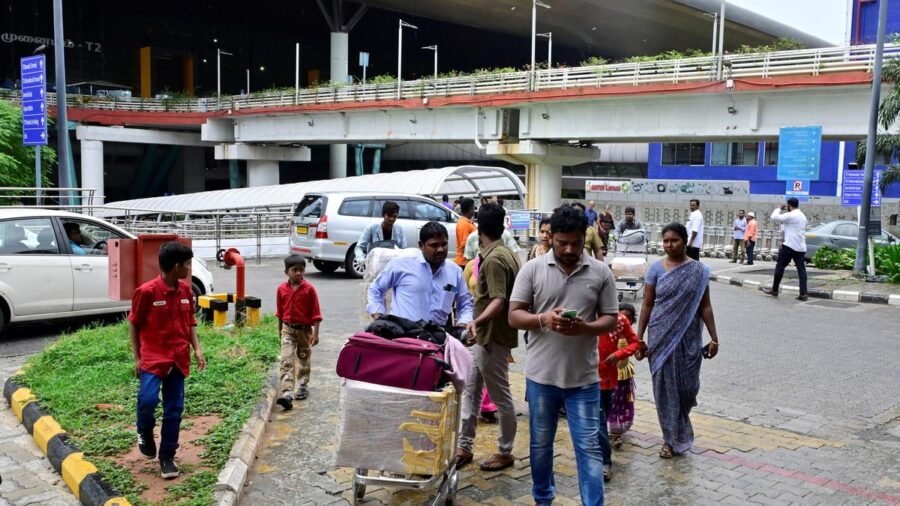
Sandhya Vedullapalli, a frequent flyer, says she has encountered a few issues at the Chennai airport. “It is painful to walk to the multi-level car park to board the cab. For years together, they have been modernising the airport and building an integrated terminal, and this is putting so many people to inconvenience. It is not easy to push the trolley and walk outside the airport since it is not a smooth contiguous path,” she adds.
Be it the state of washrooms or the number of dining and shopping options, everything is so much better at the Bengaluru and Hyderabad airports, Ms. Vedullapalli says, adding that if the second airport had been built at Sriperumbudur by now, air passengers wouldn’t be suffering. “There should be policy continuity. One government proposes it, then another drops it. Until another airport is built, it is the air passengers who will have to put up with various issues, and it is unfair,” she adds.
The government should soon find a site to address the development needs of the city even while balancing the environmental concerns.
Direct flights gone to Bengaluru
A. Sankar, another frequent flyer, says Chennai has lost out on adding direct flights to many destinations, while Bengaluru seems to have grabbed them in time. Earlier, there were direct flights to Paris and Tokyo, but they are no longer available from Chennai. Meanwhile, Bengaluru now boasts direct flights to Tokyo, Paris, Amsterdam, Vietnam, and the Maldives. “Chennai really needs direct flights to many European destinations, and initiatives have to be taken,” he adds.
Industry leaders have reiterated the need for state-of-the-art airport infrastructure as it will not only help in drawing more airlines and connecting the city directly to more domestic and international destinations but will also drive up the economy. The ‘Aerotropolis’ model, which is fast emerging now, revolves around airport-led development wherein businesses, commercial complexes, residential communities, and the logistics industry come up in the airport’s vicinity. Ravichandran Purushothaman, chairman of Confederation of Indian Industry (CII) Southern Region, summed it up rather well: “An airport is far more than a piece of transport infrastructure; for a capital city and economic powerhouse like Chennai, it is a strategic enabler of economic growth, global competitiveness, trade, tourism, investment, and job creation.”
The CII notes in a statement that while modernising the Meenambakkam airport is essential, it is only a medium-term plan for the city. “Choosing a site [for the second airport] quickly is critical and once it is done, the project should be expedited and executed with urgency to ensure Chennai retains its competitive advantage among India’s leading industrial and investment destinations.”
‘A costly mistake’
Vijay Gopalan, former chief financial officer of AirAsia India, says the decision to scrap the Parandur airport project will prove to be a costly mistake, pushing Chennai’s growth behind by at least 10 years. While the government claims that an airport alone will not decide investments, what it fails to acknowledge is that such decisions reflect poorly on a city’s image, he says. “The perceptions matter so much when you have to attract young talent. While I’m glad the government is finally waking up to the need for setting up more Global Capability Centres (GCCs) for young talent and delegates to choose the city, we need better social infrastructure, and of course a good airport. A world-class airport substantially boosts the image of a city and its branding. The faster we understand this, the better it is for the city. Else, we will stagnate while Bengaluru and Hyderabad grow at a phenomenal pace,” he says.
Chennai’s primary competitive advantage lies in its robust manufacturing ecosystem, which continues to attract substantial global investments into Tamil Nadu, says Dinesh K. Krishnan, national treasurer, The Air Cargo Agents Association of India. “However, the current handling of air cargo fails to match this industrial momentum, falling significantly short of the operational efficiency delivered by privately managed airports in Bengaluru and Hyderabad,” he says.
‘Improve utilisation’
There is also an argument in a few quarters on whether Tamil Nadu needs a new international airport. Uvakai Research Foundation, in its recent report, says there is scope to improve the utilisation of the existing airport before going in for another major airport. But aviation experts point out that unless a newly built second airport run by a private operator is established, Chennai’s aircraft and cargo movement cannot increase significantly. From the third position in passenger traffic, Chennai has been pushed to the fifth spot. “The Bengaluru and Hyderabad airports are growing remarkably because of their efficiency,” an expert says.
Mr. Krishnan adds that today, trade logistics face severe operational bottlenecks, and exporters and freight agents frequently complete customs clearance in Chennai, only to transport their cargo by bonded trucks to the Bengaluru airport. “This detour is driven by Bengaluru’s faster cargo processing, lower air freight rates, and overall operational predictability,” he adds. With professionalised terminal management, the Chennai cargo facility can effectively service regional trade for another 10 to 15 years, while long-term second-airport plans materialise, he says.


Two Women Killed In Separate Chembur And Matunga Road Accidents, Police Book Three Drivers
By Sohail Khan · 30 Aug

Leave a Reply