Chandra case: NCLT divided over 99.7% haircut plan
Benchmarks
Nifty24,080.40-95.25
Precious Metal
Gold (MCX) (Rs/10g.)154,058.00-2223.0
Enter search text:
Business News›Industry›Banking/Finance›Banking›Subhash Chandra Rs 22,000 cr case: NCLT fails to get majority view on insolvency plan with 99.7 percent haircut
Read Today's Paper
Subhash Chandra Rs 22,000 cr case: NCLT fails to get majority view on insolvency plan with 99.7 percent haircut
Synopsis
Subhash Chandra's insolvency case: The National Company Law Tribunal has not issued a final order in the Rs 22,000 case. A two-member bench could not reach a majority verdict due to a third member's differing opinion. The matter has been sent back to the NCLT President for further direction. This personal insolvency case involves claims exceeding twenty-two thousand crore rupees. The President may appoint another member or issue an order to resolve the deadlock.
 TIL Creatives
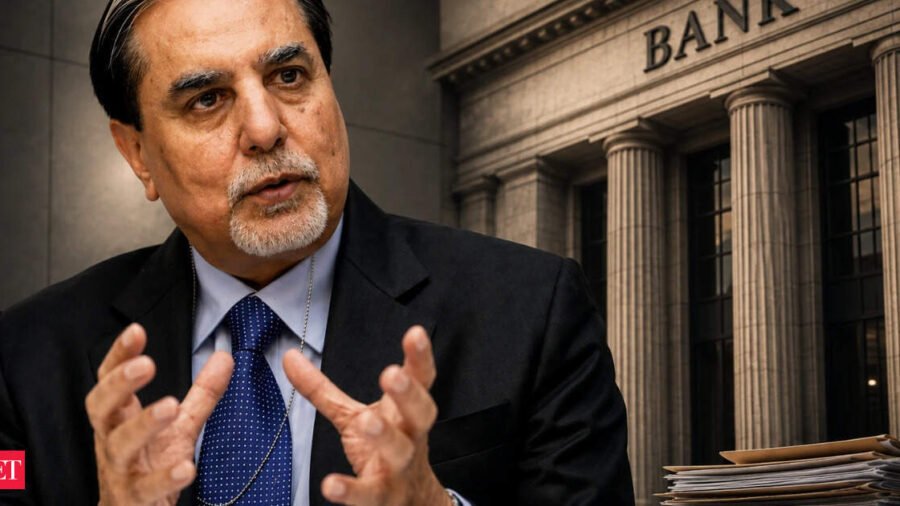
Zee founder Subhash Chandra's insolvency case (AI-generated image)
New Delhi: No final order has been passed by the National Company Law Tribunal in the personal insolvency case against Essel Group Chairman Subhash Chandra over claims of over Rs 22,000 crore, as its two-member bench on Monday failed to reach a majority verdict due to an independent opinion by the third member.
The matter has been sent to the NCLT President again following the difference of opinion. The President may appoint a third member or issue an order himself to reach a majority view.
Also read: Subhash Chandra drops mention of Mukesh Ambani allegations, shifts focus to settling Essel debt
Earlier, the four-year-old personal insolvency matter of Subhash Chandra had been referred to a Third member, as the two-member division bench of Ashok Kumar Bhardwaj, Member (Judicial), and Reena Sinha Puri, Member (Technical), gave a split verdict.
The third member, in its 144-page order on August 25, stamped a Rs 6.5 crore payment by the Essel Group chairman against creditor claims of about Rs 22,006.57 crore in his personal insolvency resolution process, with a nearly 99.97 per cent haircut.
As per the procedure, the third member's order was sent back to the original division bench for a formal order in line with the majority opinion, as required under Section 419 (5) of the Companies Act, 2013.
In an order passed on Monday, the division bench of Ashok Kumar Bhardwaj, Member (Judicial), and Reena Sinha Puri, Member (Technical), said no majority view had emerged despite reconsidering the matter, following a differing opinion from a Third Member of the tribunal, and referred the matter back to the NCLT President.
The bench said the "Third Member consciously passed an independent order. Thus, no majority view emerges" and hence "no order can be passed at this stage".
" While Member (Technical) rejected the plan, the Member (Judicial) confined the plan to those who accepted and approved it and accorded liberty to dissenting creditors to recover their debt. He did not extinguish the claim of banks/financial institutions/dissenting creditors qua principal debtor/debtor/PG. The Third Member approved the plan but extinguished the right of all the creditors by applying Section 115(1) of the Code uniformly," it said.
Also read: How and why Zee founder Subhash Chandra's Rs 22,006 crore debt was chopped to just Rs 6.5 crore
"All said and done, no majority view has emerged in the matter. In the wake, no order can be passed at this stage. Resultantly, we have no option but to make fresh reference to the President in terms of the provisions of Section 419(5) of the Code," it said.
The dispute arose over interpretation of Section 79(2)(g) of the IBC and its interplay with the procedural provisions of Section 115(1), which deals with approval of a repayment plan by creditors.
In the original order, Bhardwaj had confined the approval of the repayment plan only to creditors who voted in its favour – about 80.8 per cent of creditors — while granting liberty to dissenting financial institutions and banks, comprising roughly 19.2 per cent, to independently pursue debt recovery against Chandra outside the plan.
However, the Third Member of the tribunal, in an independent order, took a different view, applying Section 115(1) uniformly to all creditors. This approved the plan but extinguished the claims of all creditors, including dissenting banks and financial institutions, against the personal guarantor.
The bench noted the Third Member also disagreed with both members on the scope of the Adjudicating Authority's jurisdiction to question the Section 112 report submitted by the Resolution Professional on creditors' meetings.
Sharma rejected the claims of the dissenting creditors led by LIC Housing Finance, which had argued that the payout was "unviable and unlawful".
It had contended that against admitted claims of approximately Rs 22,006.57 crore, the repayment plan proposed the payment of only Rs 6.25 crore to creditors and Rs 25 lakhs towards process costs.
Sharma, in its 144-page-long order, said the resolution professional's valuation showed Chandra's personal estate was worth significantly less than the amount offered under the plan, and that dissenting creditors were unlikely to recover more by rejecting it, since he would then face bankruptcy rather than being able to pay from a position of financial recovery.
Add 

(You can now subscribe to our WhatsApp channel)
(Catch all the Business News, Breaking News and Latest News Updates on The .)
…moreless
(You can now subscribe to our WhatsApp channel)
Read More News on
Subhash ChandraEssel Grouppersonal insolvencyNational Company Law Tribunalsubhash chandra loanzee subhash chandrasubhash chandra zeesubhash chandra newssubhash chandra nclt personal guaranteenclt subhash chandra
(Catch all the Business News, Breaking News and Latest News Updates on The .)
…moreless


Enter search text:
Stories you might be interested in

Is Dutton Ranch season 2 returning soon?
By Sohail Khan · 31 Aug
Anna Hazare admitted to Bombay Hospital
By Sohail Khan · 31 Aug
Trump weighs $4M private road through Yosemite
By Sohail Khan · 31 Aug
Leave a Reply