C Raja Mohan writes: A changing Asia demands more from Delhi and Tokyo, together
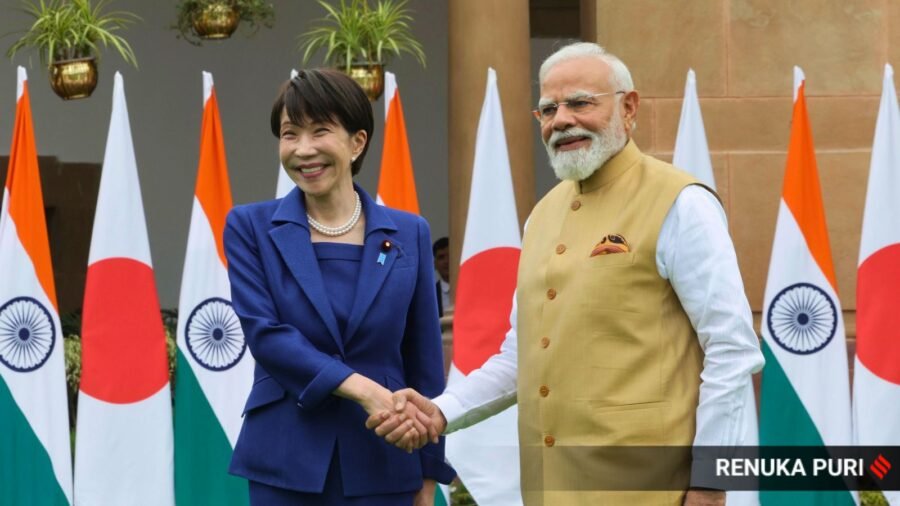
Japanese Defence Minister Shinjiro Koizumi’s visit to India this week comes amid the unfolding transformation of Tokyo’s defence and regional security policies. Japan, long reined in by self-imposed military restraint, is adopting a more vigorous national defence policy and an active regional military diplomacy. That Koizumi is coming to Delhi after consultations in Canberra with his counterparts from Australia and New Zealand indicates new directions in regional security cooperation in the Indo-Pacific. Koizumi’s talks in Delhi should help end the current slow and incremental approaches to defence cooperation and outline more ambitious goals for the security partnership.
Driving Japan’s new defence policies is the rise of China as a great military power and Beijing’s growing political will to translate that power into concrete outcomes. This is a challenge Delhi and Tokyo share as they confront assertive Chinese military policies — on Japan’s maritime frontier with China and India’s contested land border across the Himalayas. The geography is different, but the PLA’s methods are the same: Persistent probing and the slow but definitive alteration of the territorial status quo.
Advertisement
For both Tokyo and Delhi, the challenge from China is magnified by the volatility of American policies. Neither seeks an Asia without America. Japan remains deeply invested in its alliance with Washington, while India sees a continuing American military presence as essential to a stable Asian balance. But Donald Trump’s second presidency has reinforced questions about the predictability of American policy and the nature of its regional commitments.
Part of the answer for Delhi and Tokyo lies in strengthening their own national capabilities and deepening partnerships with each other and other Asian powers. Koizumi’s itinerary captures the possibilities. Japan’s defence partnership with Australia has advanced rapidly. Canberra and Tokyo have expanded military exercises, reciprocal access, logistics and defence industrial cooperation. Australia’s decision to acquire Japanese-designed Mogami-class frigates marks an important breakthrough for a country that, until recently, imposed extraordinary restrictions on exporting weapons.
India-Japan defence cooperation has also expanded, but remains well behind the political rhetoric about their “Special Strategic and Global Partnership”. Koizumi’s visit should therefore be an occasion not merely to review bilateral exercises and exchanges, but to ask how Delhi and Tokyo can give their defence partnership much greater operational and technological weight.
The opportunity arises from the extraordinary changes underway in Japan itself. For much of the post-war era, Japanese strategy rested on a simple bargain. Tokyo concentrated on economic reconstruction while relying on the United States for security. Defence expenditure remained around 1 per cent of GDP, arms exports were tightly restricted, and the Self-Defense Forces operated within narrow political constraints. Those conditions began to change as the China challenge unfolded. In 2010, China overtook Japan as the world’s second-largest economy. Its growing economic resources supported a massive expansion of military capabilities, the consequences of which for Japan soon became evident.
Advertisement
After returning as prime minister in 2012, Shinzo Abe accelerated the effort to adapt Japanese security policy to the new circumstances. As the scale of the China challenge deepened and concerns about American reliability grew, Japan outlined a sweeping set of defence reforms in 2022. One element was a rapid increase in defence expenditure. Tokyo set itself the goal of raising defence-related spending to around two per cent of GDP by 2027, but brought forward that target through additional spending last year.
More important has been the change in doctrine. Japan is acquiring long-range “counterstrike” capabilities, including American Tomahawk missiles, while developing longer-range indigenous weapons. It is strengthening air and missile defence, cyber and space capabilities, unmanned systems and its capacity to operate farther from the Japanese islands. A parallel revolution is unfolding in defence production. Tokyo is revitalising its defence industrial base, easing restrictions on arms exports and breaking down the old barriers between civilian technology and national security. Japan has also begun providing military equipment to friendly countries through its new Official Security Assistance programme.
Taken together, these changes represent something much larger than a Japanese “rearmament”. Tokyo is finally turning to military power, defence technology, arms exports and security assistance as normal instruments of statecraft. Tokyo is also reaching out to South Korea and other regional neighbours, deepening defence ties with Australia and New Zealand, and strengthening security engagement with Europe. Upgrading defence ties with India is a natural part of this wider strategy. Delhi and Tokyo already have much of the institutional architecture they need: A 2+2 dialogue, a logistics agreement and regular exercises across the three services. Prime Minister Sanae Takaichi’s visit to Delhi last month called for more sophisticated exercises, stronger maritime domain awareness and deeper defence industrial cooperation. It also announced the first bilateral defence co-development project, involving the UNICORN naval communications antenna.
But here is the reality check. Defence industrial cooperation has been painfully slow. Delhi and Tokyo need much greater ambition in joint research, development and co-production of weapons and military technologies. Their armed forces must also move beyond exercising together towards greater operational coordination in anti-submarine warfare, maritime surveillance, air defence and logistics. The unfolding transformation of the Asian security environment demands that Delhi and Tokyo do much more together in defence. Japan is demonstrating greater purpose and urgency as it responds to the changing balance of power in Asia. Unlike China, India has long welcomed the prospect of a stronger Japan. It is now time for Delhi to match Tokyo’s commitment and enthusiasm in building a consequential Asian defence partnership.
The writer is a contributing editor on international affairs for . He is also a distinguished professor at the Motwani-Jadeja Institute of American Studies, Jindal Global University and the Korea Foundation Chair at the Council on Strategic and Defense Research, Delhi

Surgeon debunks 4 common cancer myths: ‘Stop the sugar consumption’
By Sohail Khan · 7 Sep