Inflation is back around the world—as is the fight against it
Central banks are raising interest rates again
Published on: Sep 7, 2026, 16:23:32 IST
Prefer HTon Google
Share via
Copy link
WHO REMEMBERS the “soft landing”? In 2022-23 central bankers dreamed of bringing high inflation down without triggering a recession. Some countries came awfully close to achieving it. But with victory tantalisingly close, a growing number of central banks are now redoubling their fight against inflation. Price pressure is building. The world is a long way from the pain of four years ago, but the diagnosis is not promising.
On September 2nd New Zealand’s central bank raised rates. Rate-setters on the other side of the Tasman sea have already increased borrowing costs three times this year. The Bank of Japan did so in June and the Bank of Korea in July and August. On September 10th the European Central Bank (ECB) is expected to raise its deposit rate to 2.5%. Many traders expect that, before long, the Federal Reserve will follow.
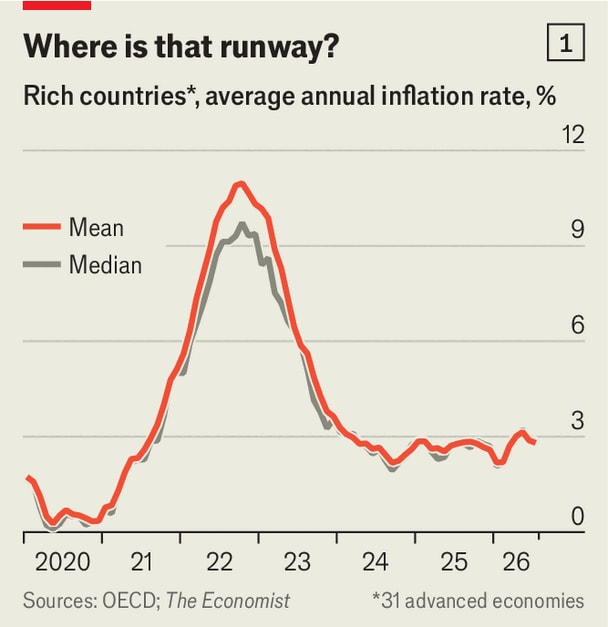
Policymakers are responding to growing evidence of rising price pressure (see chart 1). Average annual inflation across rich countries has stopped falling towards 2%, the target in most of them, and has instead edged up in recent months. In August annual inflation in the euro zone reached 3.3%, the highest in three years. Switzerland has inflation of just 0.8% a year, reflecting economic policy that is one of the wonders of the modern world. But even that is a two-year high. And in some places prices are evoking the sad memories of the “cost-of-living crisis”. Inflation is close to 6% in Lithuania, for instance, up from 3.1% in January.
Energy is the main culprit, but not the only one. War in the Middle East has caused the price of oil and natural gas to rise. In Europe, natural-gas prices are more than twice as high as before the Iran war. They could go further as the continent’s storage tanks are refilled ahead of the winter. Already euro-zone energy inflation is easily in double-digits. The typical American, meanwhile, is paying just over $4 for a gallon of petrol, up from less than $3 at the beginning of the year.
The problem, however, may be bigger than fuels. The Economist estimates that across the rich world, average annual “core” inflation, which strips out energy and food, has increased from 2.7% in early 2026 to 2.9% today. To examine countries’ underlying inflationary pressure in more detail, we found comparable figures for 23 rich countries on services prices, which are largely determined by the price of labour (rather than more volatile commodities). Services inflation is rising in two-thirds of our sample. This is despite the fact that in many countries measures of wage growth continue to decline. (One explanation for this puzzling result is that wages are not well measured; another is that falling productivity growth in services makes it harder for firms to absorb pay rises.)
So far there is little evidence that people are revising up the price rises they anticipate in the future—the thing that would really spook policymakers. Most market-based measures of inflation expectations have not moved meaningfully in recent weeks. A recent survey by the ECB suggests that consumers expect lower inflation over the next year than they did a few months ago. Fancy leading indicators of inflation—including from Alternative Macro Signals, a consultancy, which analyses millions of news articles—do point to strengthening global inflationary pressures. But these tools’ predictive record is patchy.
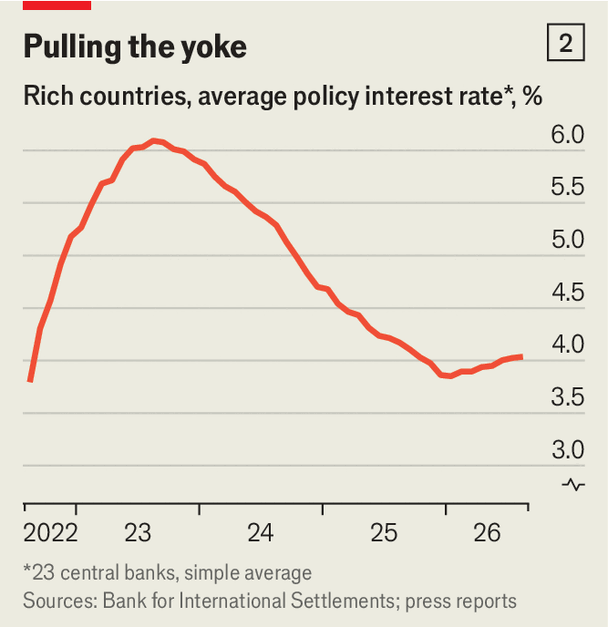
Whatever the future holds, many central banks are in no mood to take chances (see chart 2). Critics have argued that in 2021-22 policymakers dawdled in responding to surging inflation: rate-setters do not want to make the same mistake twice. They “shouldn’t wait” for inflation to become entrenched before responding, Slovenia’s central-bank governor has counseled. Isabel Schnabel, who sits on the ECB’s board, recently warned that waiting until energy costs pass through to pay could once again leave policymakers behind the curve.
A new tightening cycle may, then, just be getting started. UBS, a Swiss bank, reckons that many of the central banks which have not yet started tightening will do so soon. Candidates include Sweden’s, and even Switzerland’s. For all the appearance of a soft landing, the fight against inflation never really ended.
See Less

Meta Ray-Ban glasses face backlash
By Sohail Khan · 3 Oct
California CEO charged in $300M Nvidia GPU case
By Sohail Khan · 3 Oct
Ukraine to target Russian refineries in retaliation
By Sohail Khan · 3 Oct