Beyond the hero’s journey: Why Nolan’s ‘The Odyssey’ is a cinematic triumph for women
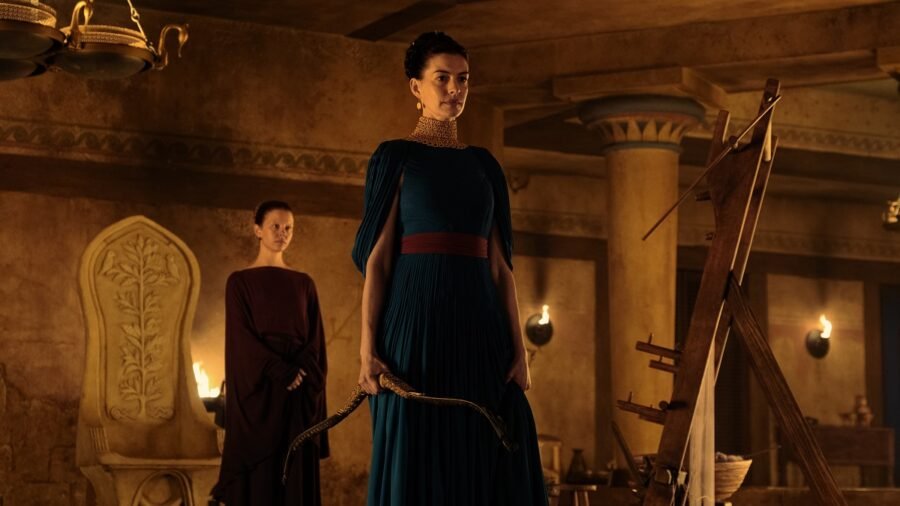
Christopher Nolan’s epic, The Odyssey, has crossed the billion-dollar mark at the box office (worldwide) and is likely to go significantly further. Its recent release in mainland China seems to be going well, indicating that there is room yet to believe that meaningful and aesthetic cinema can also be entertaining and profitable. But what differentiates Nolan’s epic offering from other worthies — mostly movie franchises — that have been hugely successful is the fact that conversations and curiosity around the film only seem to be growing. Nolan’s high-priest status in the cinema is well known, and given the diverse reactions to his latest offering, both flattering and otherwise, he seems to have hit the bull’s eye once more. There’s something in it for everyone.
In India, I watched the film with curiosity because Homer’s epic was part of my curriculum in college. Back then, groaning under the weight of the multiple interpretations one had to refer to, I often wished for a relatable film on the epic to make comprehension easier. After all, with its treasure trove of fantastical events and characters, the classic was ripe for a cinematic telling. But since the scope of the epic was…well…epic, it was a mere pipe dream. Until, of course, Nolan decided to sink his teeth into it.
Advertisement
Ever since its release, Nolan’s film has been criticised for being both too faithful and too divergent from the original. Now, I am hardly a Homerist, but from my brief brush with this epic and having watched the cinematic interpretation, I truly felt that Nolan elevates a saga of heroic adventures and conquests into a more nuanced one, which is in step with the present times. The part that stood out for me was that, although The Odyssey is predominantly a story about a complex hero, the film positions its female characters, even those in smaller roles, outside the conventional pedestals. In doing so, it establishes them as significant individuals with intriguing stories of their own.
For starters, by taking sex out of the equation in Odysseus’s relationships with Circe and Calypso, Nolan gives them more agency than merely depicting them as spurned or cast-away lovers. In Homer’s version, Calypso, the daughter of the titan Atlas, holds Odysseus captive on her island as a lover until Athena petitions her father Zeus that Odysseus must be set free. It is with great reluctance and divine intervention that Calypso frees Odysseus.
In Nolan’s version, Calypso’s entity is fused with the Lotus Eaters (in the original epic, the Lotus Eaters were a tribe Odysseus encounters who ate lotus fruits that made his men forget home and their duties). Here, she is a healer — administering lotus petals to a war veteran suffering from PTSD who washed up wrecked on her shores. Even though she falls in love with him, on realising that he has recovered from his trauma and yearns to go home, she sets him free without manipulation or machination. A far more cerebral version of Calypso, if you will.
Advertisement
In Homer’s work, Odysseus lives with Circe as her lover, on the island for a while before he convinces her to turn his men back into human form. Not so in Nolan’s interpretation. Here, Circe does not have a sparkling palace full of swaying nymphs, playing the stereotypical seductress. Instead, she is a demure but self-sufficient woman living by herself in spartan surroundings. And her dark secret — turning Odysseus’s men into pigs — serves as a thematic mirror to show him the greed and animalism of his men, and perhaps his too.
Back in Ithaca, Odysseus’s wife Penelope’s decision not to acquiesce to Telemachus’s assertion of leaving important decisions to him, and handling the situation with a ruse of weaving the shroud instead, is rather inspired, with a cunning that matches Odysseus’s own.
Although even the older texts highlight Penelope’s smarts in warding off suitors by weaving the burial shroud of Laertes, her presence is far more muted.
In Homer’s version, Telemachus, though younger, has the upper hand. Being the heir and Odysseus’ successor, he steps in as the head of the household. He even orders his mother, Penelope, to go to her room and leave matters of the kingdom to the men. In Nolan’s film, we get to hear from the lady herself about what she thinks on the matter. A strong voice, Penelope’s is the one which rings above all else — her stoic heroism, a sharp contrast to the legendary tales of heroism about Odysseus. Penelope’s unbridled fury about her strategic, understated leadership being dismissed by Telemachus is when we finally understand what Penelope has been fighting off, without an army.
While we hear much about Zeus’s law, the perils of disobeying it and incurring his wrath, Nolan actually also makes a larger point about the immorality of strategic deceit and the ravages of war. As Odysseus and his men scramble out of the Trojan horse and destroy Athena’s temple, the single shot of the decapitation of Athena’s statue before it falls and shatters is the ultimate humiliation of the Gods and an act of treachery by the Greeks.
The tragedy is heightened in the moment when a young priestess (played by Zendaya) is killed by Greek soldiers. That moment and everything that follows afterwards seems like a veiled hint at the fate of men who disrespect and defile women and disregard female authority. Perhaps it is to assert the idea of karmic consequences that in Nolan’s film we see Athena more as a phantom presence than the guiding deity that she is in Homer’s epic.
Helen of Troy, in Nolan’s The Odyssey, is a departure from the classic depiction of her. For starters, the “face that launched a thousand ships” is now embellished with a scar. Helen speaks her mind, expressing regret for the war she caused and calling out the geopolitics at play in the unstinted support for Menelaus and his brother Agamemnon in their war against Troy. The casting of actress Lupita Nyong’o as Helen of Troy generated much heat. Nolan’s thoughtful casting choice, however, shatters the narrow stereotypes of beauty.
And last but certainly not least, one of the coolest things about The Odyssey is that Canadian stunt performer and actress Devyn Dalton, a woman, stood in for the buff Matt Damon, as his body and stunt double. Particularly striking is the scene where Odysseus comes face to face with the humongous man-eating Laestrygonians. Damon himself acknowledged Dalton’s physique when he said, “she has the greatest arms I have ever seen.”
Indeed, Nolan’s film is a hat tip to women in more ways than one — both covert and overt.
The writer is Chief Operating Officer, Screen Academy

The science of Gaganyaan parachutes | Explained
By Sohail Khan · 22 Sep
40 years ago September 22, 1986: Barnala hits out at Badal group
By Sohail Khan · 22 Sep
Universities as labs of entrepreneurship
By Sohail Khan · 22 Sep