Why edible oils are bearing the brunt of food inflation
Story continues below.
Subscribe to see fewer ads.
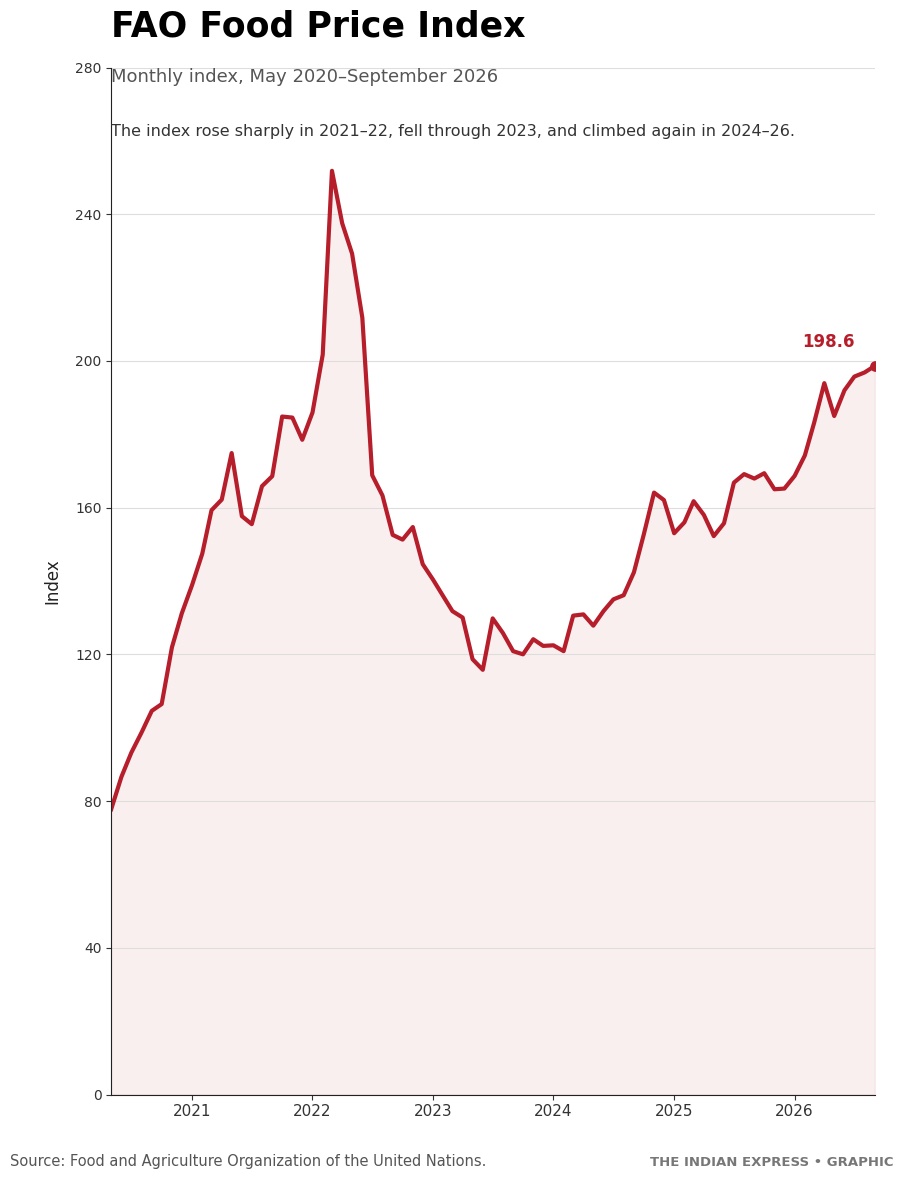 FAO food price index.
Blending mandates
Vegetable oils – whether palm, soyabean or rapeseed – can be converted into Fatty Acid Methyl Esters (FAME) through a chemical process called transesterification. It involves reacting triglycerides (which make up 95-98% of the fat content in vegetable oils) with methanol (methyl alcohol) in the presence of a catalyst.
FAME is basically vegetable oil-based biodiesel, which can substitute or be blended with regular diesel derived from crude petroleum oil. That is similar to ethanol – produced from sugarcane molasses and juice or rice, maize and other starch-containing cereal grains – that can be blended with petrol.
According to one estimate made at the Solvent Extractors’ Association of India’s ‘Globoil India 2026’ conference in Mumbai last week, about 25% of the world’s production of soyabean oil, 28% of palm oil and 29% of rapeseed oil goes as feedstock for making biodiesel, i.e. FAME.
Story continues below this ad
That is reinforced by national biofuel mandates enforced by governments. These require oil marketing companies to blend a specified minimum percentage or volume of biofuels into fossil transportation products such as petrol, diesel and aviation turbine fuel (ATF). Just as all petrol sold in India has to contain at least 20% ethanol, Indonesia and Malaysia have mandates for the blending of palm oil-based FAME in diesel.
Indonesia introduced B20 diesel, with 20% FAME content, on a limited scale in 2016. The B20 blend was made mandatory nationwide in September 2018 and further upgraded to B30 in January 2020, B35 in August 2023 and B40 from January 2025. In July 2026, the Indonesian government raised the blend mandate to B50, with a three-month transition period.
Malaysia has a less ambitious biofuel blend programme, with B10 diesel being made compulsory nationwide from September 2019 and a phased rollout of B15 beginning in June 2026.
The United States is expected to produce 14.94 million tonnes (mt) of soyabean oil in 2026-27 (October-September), out of which 8.07 mt or 54% would be directed towards biofuels. The European Union will, likewise, see 6.1 mt or 57.2% out of its total 10.67 mt rapeseed oil output being diverted for biodiesel and bio-ATF.
The impact
Story continues below this ad
Eddy Martono, chairman of Indonesian Palm Oil Association (better known as GAPKI), projects the consumption of his country’s palm oil for the production of biodiesel at 14.7 mt in 2026 and 17.4 mt in 2027. That’s up from 12.7 mt in 2025.
Moving from B40 to B50 alone will, thus, absorb an additional 4.7 mt of Indonesian palm oil locally, leaving that much less for exports. This could potentially hurt countries like India, which is likely to import roughly 8 mt of palm oil in 2025-26 (November-October), largely from Indonesia and Malaysia.
“For Indonesia, biodiesel not only creates extra domestic demand for palm oil, reducing reliance on the export market, but also helps bring down its energy import bill,” an industry source pointed out.
The incentive to divert palm or any other vegetable oil for biodiesel is all the more in today’s environment of elevated global petroleum prices. The longer Brent crude stays above $100 per barrel, thanks to the intensifying West Asia conflict and tightening restrictions on Russian energy flows, the more the likelihood of such “food-to-fuel” diversion.
War and weather
Story continues below this ad
Indonesia’s aggressive biofuel mandate – making it the world’s first country to implement 50% blending in diesel – comes in an El Niño year.
El Niño, already in a “very strong” phase, is anticipated to peak during October-December and last through March-April next year. Its actual effect on palm oil production would, however, come with a lag of 8-12 months. Oil palm trees typically abort female flowers and young fruit bunches in response to water stress, which then takes time to visibly affect yields.
GAPKI’s Martono, for now, reckons Indonesia’s overall palm oil output to dip from 58.5 mt in 2026 to 56.6 mt next year. With higher domestic consumption on the back of biodiesel conversion, the world’s largest palm oil producer’s exports may come down from 32.3 mt in 2025 to 26.5 mt in 2027 (see table).
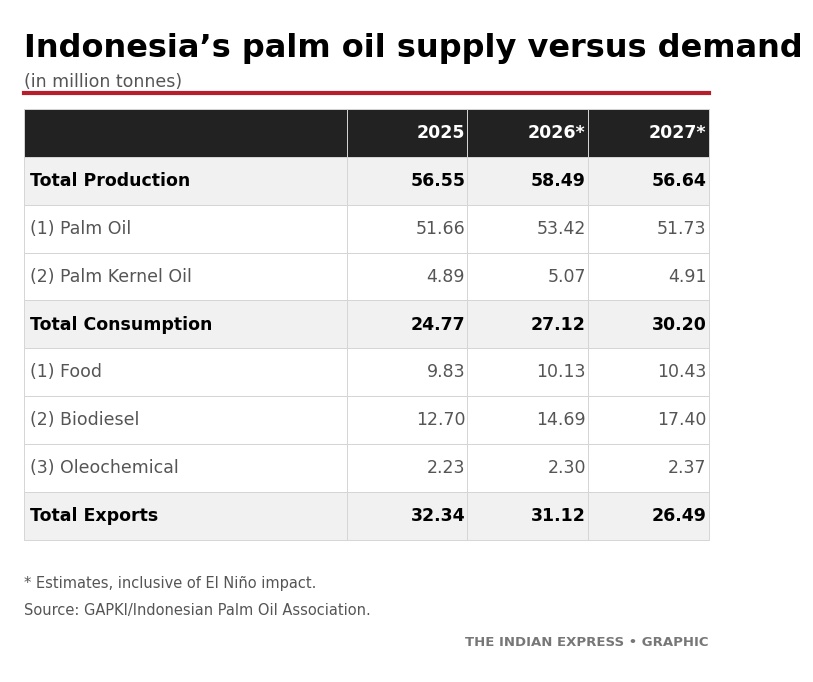 Indonesia palm oil supply demand.
But it isn’t just palm oil.
Story continues below this ad
Russia and Ukraine are harvesting bigger sunflowerseed crops in 2026-27 (21 mt and 13 mt respectively) than the previous year’s levels (17.5 mt and 10.7 mt). Their respective oil production is also slated to go up from 6.9 mt to 7.8 mt and 4.5 mt to 5.4 mt.
For the world’s two leading sunflower producers, though, the constraint is logistical – arising from the two belligerents striking at each other’s port infrastructure and storage terminals. Navigation through the Sea of Azov has stopped since July 10, while operations at Black Sea ports are suspended. Alternative routes, through ports on the Baltic, Caspian and Far East seas or overland rail links, are costly and overloaded.
“We have a strange situation where the producers are eager to sell their ample supplies and importers want to buy, but both are helpless in the face of war,” the earlier-quoted industry source noted.
For India, El Niño could bring down domestic edible oil production.
Story continues below this ad
“Our current estimate for 2026-27 is 9.2 mt, as against 9.7 mt in 2025-26. Imports will correspondingly rise from 16.8 mt to a new record of 17.2 mt. The latter would mainly comprise 8.2 mt of palm, 5 mt of soyabean, 3.5 mt of sunflower oil,” said Nirav Desai, managing partner at GGN International, an Indore and Rajkot-based vegetable oil broking house-cum-research firm.

Nirmala Sitharaman writes: Next-Gen GST & India’s next phase of growth
By Sohail Khan · 5 Oct
The right to loiter
By Sohail Khan · 5 Oct
40 years ago October 5, 1986: P T Usha leads winning spree
By Sohail Khan · 5 Oct
Leave a Reply