Who modified what?: Supreme Court seeks ECI records on Form 6 change
Story continues below.
Subscribe to see fewer ads.
The ECI was responding to the findings of an investigation by published on September 23 that two Election Commissioners in the three-member ECI objected on record 14 times in 10 months to steps taken by the Commission under Chief Election Commissioner Gyanesh Kumar — from keeping them in the dark to adding new voters and deleting names.
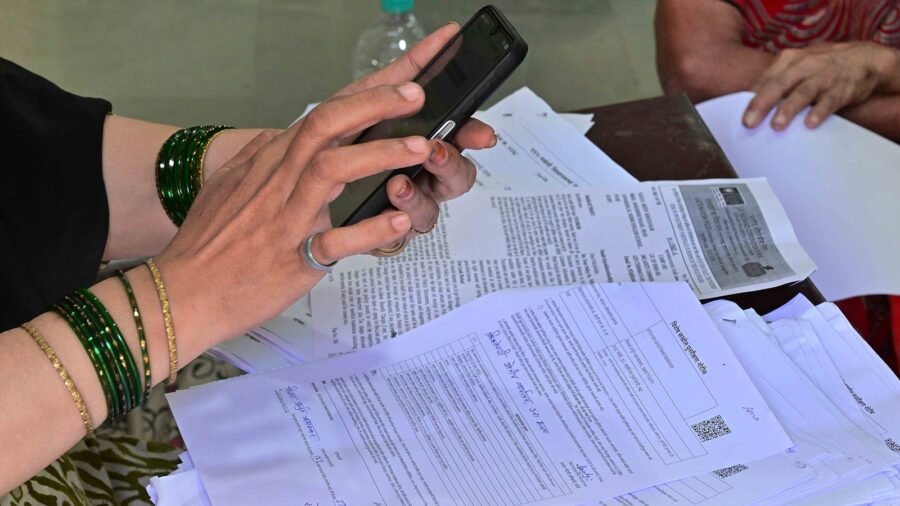
had first reported in July that the online Form 6 on the ECI’s ECINet portal has started asking applicants whether they, or their parents or grandparents, were on the electoral roll of the last SIR — and that the form could not be submitted without an answer.
On September 23, this newspaper reported that Election Commissioner Vivek Joshi had recorded on May 16 that the form “cannot be altered without making amendments in the Registration of Electors Rules, 1960”, and his colleague Sukhbir Singh Sandhu concurred on May 19 — the change in the portal went ahead regardless.
On Monday, appearing for petitioner Shailendra Mani Tripathi, Senior Advocate Menaka Guruswamy told the bench: “Let me give you an illustration…since it pertains to most recently, for instance, Delhi. Let us see how the SIR was conducted in Delhi. Form 6 has two new conditions added. Those Forms 6 were circulated. Neither the petitioner is now allowed to be on the roll. I got a notice also…based on this new Form 6, which cannot, under the schedule, be modified.”
Story continues below this ad
ExplainedForm in focus
This year, the ECI added a declaration to the online Form 6, for new voters, which requires applicants to answer if they or their parents/ grandparents were on the rolls of the previous SIR. Form 6 is prescribed under the Registration of Electors Rules, 1960, and only the Government can change it by amending the rules — a point two Election Commissioners flagged to the CEC.
The CJI said: “Let’s be very clear. The modified Form 6 has not been approved by us… Let us also be clear that when the record will be produced, we will like to see who has modified what.” The reference was to a related plea by Patna-resident Rakesh Kumar Singh who sought the summoning of original records of the ECI in this regard.
Referring to investigation, Tripathi’s plea raised “unprecedented Constitutional fractures and illegalities committed within the Election Commission of India under Chief Election Commissioner Gyanesh Kumar as exposed by documentary records published”. The plea sought “probe by an independent, high-powered judicial inquiry commission or a special investigation team headed by a retired judge of the Supreme Court” into the CEC’s actions.
“These illegal acts include: Unilateral & Illegal Alteration of Statutory Form 6… Centralisation and Usurpation of Statutory Powers: Depriving decentralised Electoral Registration Officers (EROs) of their statutory authority under Section 13B, 22, and 23 of the Representation of the People Act, 1950, and centralizing electoral roll management under the Director General of IT (DG-IT) in Delhi,” the petition said.
The plea also listed “disenfranchisement due to software failures”; “unauthorised subversion in West Bengal” by “filing over 16.10 lakh unauthorised appeals in the name of the ECI to purge citizens restored by 700 Judicial Officers, without the knowledge, authorization, or sanction of the other two Election Commissioners or the Chief Electoral Officer (CEO) of West Bengal”.
Story continues below this ad
It raised the issues of “bureaucratic usurpation and subversion of oversight” and “subversion of multi-member decision making”.
The plea contended that “defying this binding majority, respondent number 3 (CEC Gyanesh Kumar), acting in concert with respondent number 6 (DG-IT), altered Form 6 digitally on the ECINet portal in July 2026”.
Referencing investigation, the plea said that on “August 13, 2026, Commissioner Sandhu formally recorded that this alteration was ‘unauthorised and illegal’ and was causing arbitrary harassment to young, eligible first-time electors, ordering its immediate withdrawal. Despite this, the unauthorised form was kept live on the portal.”
In May, in its judgement upholding the Bihar SIR, the Supreme Court had said that the ECI had residual powers to formulate appropriate documentation work to meet the needs of a special revision of electoral rolls, provided it was not arbitrary. “Such authority, however, is not unbounded,” the court had said then.
40 years ago October 06, 1986: PM on security measures
By Sohail Khan · 6 Oct
Protect children growing up in the shadow of AI
By Sohail Khan · 6 Oct
In Nobel Prize for medicine, a single cell, a flash of light, a breakthrough
By Sohail Khan · 6 Oct
Leave a Reply