The right to loiter
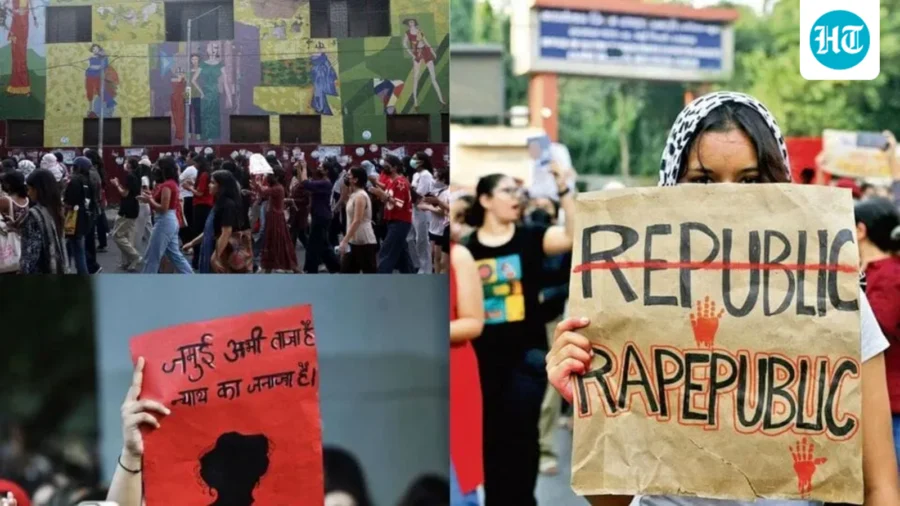
Women want freedom from sexual violence. But they also want the right to safe public spaces.
Published on: Oct 5, 2026, 08:01:04 IST
Prefer HTon Google
Share via
Copy link
The slogans are new, invoking samosas, kachoris, chai and suttas (cigarettes). The message is as old as the nation: Women protesting against sexual assault. But with a added twist of the right to equal public space.
Ek sutta do chai, mard jaati hai hai.
A series of sexual assaults through the month of September has seen the rage and anger of women spill onto the streets starting on September 23, days after a 17-year-old was gang-raped by three men at the Aastha Kunj Park in Delhi. One of the accused men was caught following a shootout by the police at the gates of the Lady Shriram College (LSR), located just two kilometres from the park.
The women’s college, ranked among the top in India, shifted classes online for a day. Reports pointed to basic security lapses at the park including poor lighting, broken boundary walls and unattended entry points—all easily fixable.
Within hours of the crime, police patrolling was beefed up. Delhi’s lieutenant governor Taranjit Singh Sandhu ordered a comprehensive safety audit of all Delhi parks. Entry to public parks, announced the Delhi Development Authority, would be restricted after sunset.
The restrictions on students carried an old message—lock women up for their own safety—and only seemed to infuriate them more. Hundreds of women came out on the street, demanding not just safety but also the right to public space. This is a generation that had seen an earlier generation of women marching against discriminatory hostel rules in the pinjra tod (break the cage) movement. Now the message was not just about protesting rape, but something more fundamental: the right to the city. The right to walk freely in parks or on the street. The right to use public transport without the daily stress of constant vigilance. The right to loiter.
The protests quickly spread, from LSR college to other women’s colleges in south Delhi, then across Delhi university, and from there took wing in cities from Mumbai to Tezpur.
“Women have always protested,” said feminist publisher Urvashi Butalia. “Each time, they expand past issues and build stronger solidarities.”
Come together
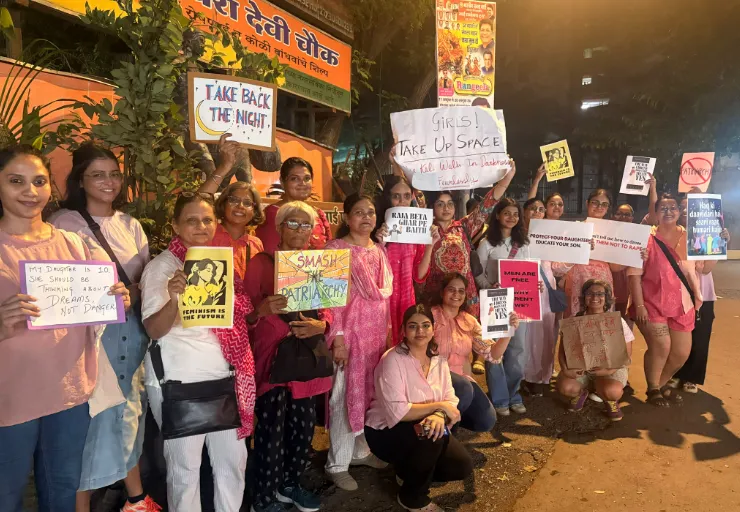
On Friday night, some 200 women, many dressed in pink, met to claim New Delhi as a space where they could move, gather and live freely. The call had been made by Why Loiter, a women-led movement that aims to reclaim public spaces for women, named after the seminal 2011 book by Shilpa Phadke, Sameera Khan and Shilpa Ranade.
Set up by Neha Singh in May 2014 as a “personal project” to take up public spaces, Why Loiter quickly became a larger campaign with other women joining in monthly activites including midnight walks, sleeping in parks and singing in trains.
Now, Why Loiter swung into action by asking women across the country to come out on the streets and claim their independence and freedom by walking on October 2. In 22 cities including Mumbai, Goa, Pune, Nagpur and Bengaluru, the women responded. “This is not a one-off walk,” says Neha. “The idea is to take ownership, initiative and leadership.”
There were three aims. The first, to express solidarity with survivors of sexual assault. The second was to demand better infrastructure including more streetlights, footpaths and toilets. And the third was to assert the right of women to occupy public spaces without being asked to stay home.
“The more women occupy and normalise being in public spaces, the safer they become for all,” said one of the organisers.
“We are being constantly told that the only way to stay safe is by being invisible,” said Tithiya Sharma, social entrepreneur and organiser of the group, Gather Sisters, who was there at Friday night’s walk. “We need to push back against this narrative. We were raised by our parents to believe in education and freedom.”
What women need are safe spaces to gather and meet; to be counted and know they matter at all times and not just when a big incident or crime takes place, Tithiya continued. Many who marched wore masks to conceal their identities and had been explicitly told by their employers that “company policy” disallowed them from taking part in public protests. Police took pictures of the women anyway and nobody knows why or in which database these photographs will end up. But the march continued.
In Mumbai, Aafreen Ali, an anchor, author and activist, spoke about why she participated in two protests, a solidarity walk from Churchgate to Charni Road and, the other, a hangout at Juhu Beach where women came together to play games and sing songs. “It felt warm and safe to share space with other women, to share each other’s suffering. I have been in so many rooms where the discussion turns to women, and everyone has been violated,” she said.
For women, being out in public very often comes with a purpose—to buy groceries, go to tuition classes, drop a kid off at school. But the idea of women just being there, loitering on a park bench, drinking tea at a stall still remains alien. To seek privacy and space with a friend, to dress a certain way, jeans for instance, even to just ride a bike, is to invite trouble.
The DDA audit ordered by Delhi’s lieutenant governor tells you about the priority given to safety. Just 16 of the 736 DDA parks in Delhi have CCTVs that work; 190 of these parks are classified as “high risk” and 520 have been flagged for additional lighting. The problem it is clear is the lack of safety features, for anyone, but more so for women. The problem isn’t women’s presence.
Get Current Updates on India News, Elections 2024, Lok sabha election 2024 voting live , Karnataka election 2024 live in Bengaluru , Election 2024 Date along with Latest News and Top Headlines from India and around the world.
See Less

Nirmala Sitharaman writes: Next-Gen GST & India’s next phase of growth
By Sohail Khan · 5 Oct
40 years ago October 5, 1986: P T Usha leads winning spree
By Sohail Khan · 5 Oct
Why edible oils are bearing the brunt of food inflation
By Sohail Khan · 5 Oct
Leave a Reply