Spending on AI Is Becoming Almost Impossible for Businesses to Budget
AI use is measured in tokens, but the models’ use of tokens at any given task can be unpredictable.
Published on: Oct 5, 2026, 08:32:21 IST
Prefer HTon Google
Share via
Copy link
First, there was #tokenmaxxing, whereby American businesses encouraged their workers to use as much AI as possible. Then came the bill.
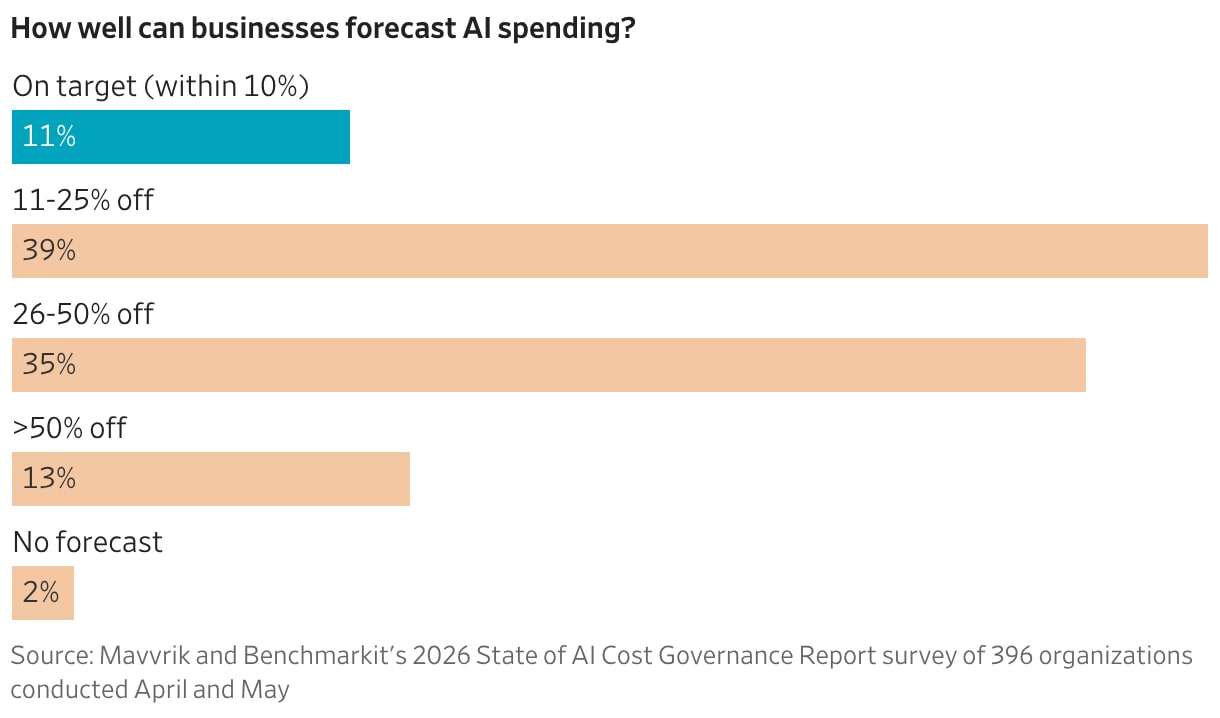
Companies started to realize they need to be more careful about counting their tokens, the units that measure AI use. And that’s hard to do: A recent study found that only 11% of nearly 400 businesses surveyed were able to accurately forecast AI spending.
Unlike traditional software, AI behaves more like a human worker: It takes action, makes decisions, sometimes even makes mistakes—all on the clock.
While more-advanced models tend to cost more per token, they can sometimes perform tasks more efficiently, leading to lower overall costs. Likewise, asking a “cheap” model to do something it isn’t suited to handle could cause a token run-up.
Researchers from Stanford University, Carnegie Mellon University, and the University of California, Berkeley, as well as Microsoft Research put this to the test earlier this year, running models through more than 6,800 tasks spanning math, programming, science and other areas. In 32% of cases, lower-priced models actually cost more than higher-priced models.
“The practical takeaway is clear,” said Lingjiao Chen, one of the researchers. “Price alone should not be used to infer which model is actually cheaper.”
When cheap gets expensive
Here’s an example of the same prompt presented to two Google models, the Gemini 3.1 Pro—generally used for tasks that require reasoning and judgment—and the less expensive, lighter, speedier Gemini 3 Flash.
The pricier Pro model finished in 85 steps, whereas the less expensive Flash model went through nearly 1,000 steps…then failed.
The less expensive model failed after running up $14 worth of token use, while the pricier one succeeded for just $1. While this result could have been an anomaly, it is something that can happen in regular model use.
Same model, different results
Even the same model might use a different number of tokens each time it completes a task.
Suppose you pay a lawn service $20 an hour to mow. The first week, it takes two hours and costs $40. A week later, the job takes eight hours and costs $160. On week three, the job takes five hours, but only half your lawn is trimmed.
Here’s an example of that, from the researchers’ data. We selected these two prompts to demonstrate the variability of results.
Here you see two prompts—computer-programming requests—given to models from leading AI labs at Anthropic, Google and OpenAI. From each lab, there’s both a fast model and a deeper reasoning model.Scroll to continue ↓
__________________
Each model received the same prompt five times—and it cost a different amount each time.
__________________
In one instance, a quick-response model ran up an inconsistently high cost.
__________________
Even zoomed into the lower-cost end of the pricing spectrum, the results varied widely.
__________________
The full picture shows pricing variability, not only among models but within a given model’s output.
__________________
And even these unsuccessful runs—when the model didn’t return the anticipated correct solution—used up tokens and cost money.
__________________
Google, Anthropic and OpenAI—whose models researchers used for this testing—have since released new models that perform better in industry benchmarks.
“Some prompt-level fluctuation is inherent to AI, and our testing shows this averages out across a high volume of real-world, diverse workloads,” said a Google spokeswoman in a statement. “Total costs depend on many factors for a given task,” she added, “which can make it hard to forecast new and evolving technology with precision.” She said the company offers customers more control via spending caps and flexible pricing.
As more companies add AI to their daily workflows, they will also need strategies to manage their use, such as training employees on which model to use for a particular task. Otherwise, they could end up with IT bills that come out of a black box.
News Corp, owner of The Wall Street Journal, has a content-licensing partnership with OpenAI.
Write to Stephanie Stamm at stephanie.stamm@wsj.com
Track live Stock Market Today updates and check your NSE IPO Allotment Status Today. Stay informed with the latest business news like N Chandrasekaran, petrol and diesel prices, gold and silver rates, income tax updates, and major economic developments across India and globally.
See Less

Sensex and Nifty open higher after longest weekly decline in 25 years
By Sohail Khan · 5 Oct
Flydubai attack: Al Qaeda-linked mag calls for more
By Sohail Khan · 5 Oct
Marico bets on premium demand as it sees strong Q2
By Sohail Khan · 5 Oct
Leave a Reply