SC orders random checking, seizing vehicles if e-challan unpaid as outstanding traffic fines add up to ₹49,194.05 crore
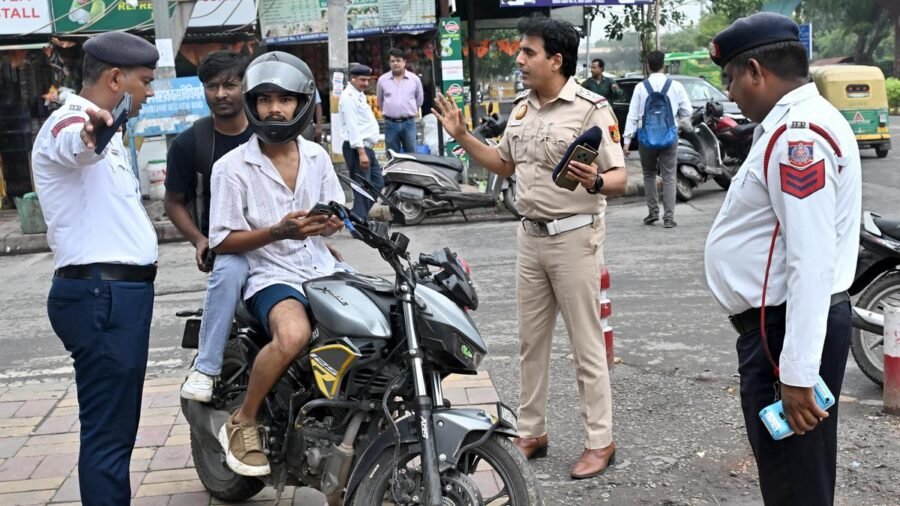
The Supreme Court has been informed that outstanding traffic fines across India amount to about ₹49,194.05 crore. These include registration renewals, fitness and pollution-under-control certificates, ownership transfers, and driving licence renewals.
While some of us do get caught for traffic offences and end up paying fines ranging from ₹100 to ₹10,000 (drunk driving in Karnataka), but who knew that the amount of unpaid fines across India adds up to ₹49,194.05 crore.
For context, the estimated cost of Phase 1 of the Ganga Expressway, spanning 594 km, was ₹36,230 crore. The Ganga Expressway is a six-lane greenfield highway in Uttar Pradesh that was inaugurated by Prime Minister Narendra Modi on April 29, 2026. It connects Bijoli village in Meerut to Judapur Dandu village near Prayagraj. Major portions of the highway were funded by debt.
Paying all the traffic fines amounting to ₹49,194.05 crore would not fund the Ganga Expressway project, but it gives an idea of the challenge facing traffic police across India. Such a huge amount cannot be ignored. Traffic police will have to find ways to collect this money.
What Supreme Court stated
The Supreme Court has directed States and Union Territories to block a range of online and vehicle-related services for motorists with outstanding traffic fines.
A Bench of Justices J.B. Pardiwala and K.V. Viswanathan directed that vehicles with unpaid e-challans be blacklisted on the central Parivahan portal, effectively preventing their sale or transfer until the dues are cleared. In cases involving multiple traffic violations, authorities have also been directed to withhold driving licence renewals and take steps to suspend existing licences.
“What we want to convey in simple words is that the authorities need to work at the ground level, having regard to the ground realities… We also direct that let there be random checking of vehicles, and if it is found that the e-challan issued has not been abided or honoured, necessary steps shall be taken to impound the vehicle itself,” the bench said, in its September 28 order made public on October 1.
Unpaid traffic fines add up to ₹49,194.05 crore
We take a look at how this figure stacks up against expenses incurred on various projects across India.
| Highway | Estimated cost | Length |
| Delhi–Mumbai Expressway | ₹1 lakh crore | 1,386 km |
| Samruddhi Mahamarg | ₹55,000 crore | 701 km |
| Surat–Chennai Expressway | ₹50,000 crore | 1,271 km |
| Delhi–Amritsar–Katra Expressway | ₹40,000 crore | 670 km |
| Ganga Expressway (Phase 1) | ₹36,230 crore | 594 km |
| Varanasi–Kolkata Expressway | ₹28,500 crore | 610 km |
| Amritsar–Jamnagar Expressway | ₹26,000 crore | 1,257 km |
| Raipur–Visakhapatnam Expressway | ₹20,000 crore | 464 km |
| Bengaluru–Chennai Expressway | ₹17,930 crore | 262 km |
| Chardham Highway Project | ₹12,000 crore | 900 km |
List States in India that have annual budget less than ₹49,194.05 crore
| State | Budget |
| Sikkim | ₹16,196 crore |
| Mizoram | ₹17,469 crore |
| Meghalaya | ₹32,023 crore |
| Manipur | ₹32,339 crore |
| Nagaland | ₹23,000 crore |
| Tripura | ₹23,000 crore |
| Goa | ₹25,000–₹30,000 crore |
| Arunachal Pradesh | ₹36,607 crore |
| Figures are approximate |
Unpaid traffic fines of ₹49,194.05 crore versus Annual Budget
| Organisation | Annual Budget | Year |
| Chennai corporation | ₹8,900.34 crore | 2026-27 |
| Bengaluru corporation | ₹20,217.66 | 2026-27 |
| Mumbai corporation | ₹80,952.56 crore | 2026-27 |
| Tamil Nadu police | ₹12,714 crore | 2025-26 |
| Karnataka police | ₹12,547 crore | 2025-26 |
| Maharashtra police | ₹33,700 crore | 2025-26 |
Government vehicles owe over ₹19 crore in Karnataka
In Karnataka, data furnished by the Home Department in September revealed that 82,208 traffic violation cases were registered against government vehicles over the past three-and-a-half years. Of these, fines amounting to ₹19,23,72,500 remain unpaid, according to KSPCA member Mohan Kumar Danappa. The Police Department vehicles alone accounted for 3,366 traffic violation cases during the period.
The repeated violations by police and other government vehicles have drawn criticism on social media, particularly as police personnel routinely enforce traffic rules and collect fines from the public.
In his letter, Mr. Danappa alleged that the failure of the departments concerned to recover the outstanding amount reflected negligence. He stressed that the Police Department, being a disciplined force, responsible for traffic regulation, law and order and crime prevention, must set an example by adhering to traffic rules.
Special e-challan call centres in Tamil Nadu
In Tamil Nadu, the Greater Chennai Traffic Police set up a special e-challan call centres to help motorists check and settle pending traffic violation fines.
The call centres, which were initially scheduled to function from September 21 to September 30, will now operate daily from 9 a.m. to 7 p.m. up to October 15, police stated.
The centres will help motorists regarding pending e-challans registered against them or their vehicles through systems, including Automatic Number Plate Recognition (ANPR) cameras and Traffic Regulation Observed Zone.
Staff at the centres will send bulk SMS alerts and provide details about pending challans, applicable fines, and payment procedures to motorists making enquiries in person or over the phone.
3 out 4 traffic challans unpaid in Hyderabad
In Hyderabad in Telangana, at the end of 2025, more than three out of every four challans were unpaid. Over 99.22 lakh of the 1.29 crore challans issued by Hyderabad’s tri-commissionerates (Hyderabad, Cyberabad, and Rachakonda) were unpaid.
Another interesting statistic in Cyberabad was the list of repeat offenders: 65,917 vehicles had 10 or more challans each.
Across the three commissionerates, a clear pattern emerged: two-wheelers accounted for the bulk of traffic violations, including wrong-side driving, speeding, riding without helmet, and reckless manoeuvres.

What is the ‘Gem Granites’ Veeramani POCSO Act case all about? | Explained
By Sohail Khan · 2 Oct
A.P. govt. removes 51 doctors from services for remaining absent from duties
By Sohail Khan · 2 Oct

Leave a Reply