Rewilding great Indian bustards: The project and the challenges ahead
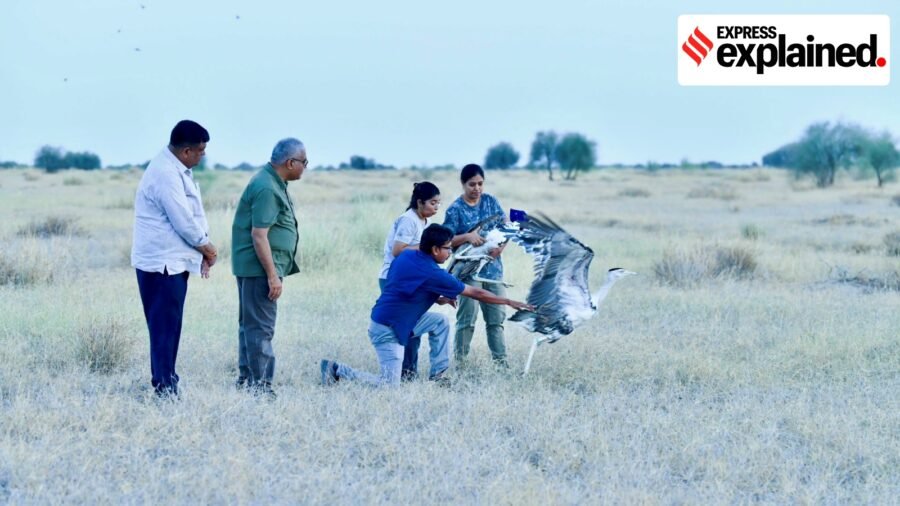
But a range of issues resulted in its decline — hunting, poaching of eggs, gradual conversion of open habitats into croplands and mining areas and, more recently, deaths due to collisions with renewable energy power lines. GIBs’ poor frontal vision, combined with their heavy body, makes it difficult for them to detect or avoid such infrastructure.
 One of the two GIBs released into the wild on Sunday.
From an estimated 1,260-1,400 in the early 1970s, the wild GIB population has now plummeted to only around 150, of which around 130 (+/-20) are in Rajasthan. The rest are in Gujarat, Maharashtra, Karnataka, Telangana and Andhra Pradesh — facing the risk of local extinction.
To counter their decline, the Centre and the Rajasthan government launched a long-term bustard and lesser florican project in 2012-13. This project was expanded from 2014 with funding support to start a conservation breeding program.
Story continues below this ad
Beginning 2019, wild GIB eggs were collected from Desert National Park and surrounding areas, incubated artificially at two centres (in Rajasthan’s Sam and Ramdevra) and hand-reared. These hand-reared birds mated at these centres, giving birth to 98 birds as of now.
Of these, two were released Sunday and 11 more have been earmarked for wild release. The others remain at the centres for captive reproduction.
What does rewilding entail?
Before initiating the rewilding process, a rewilding aviary was set up at the Ramdevra Center while a soft release facility was developed by the Wildlife Institute of India inside Desert National Park.
Story continues below this ad
Unlike the hand-reared birds that were used to humans, chicks aged between three and four months were released in these facilities so that they could move freely and adapt to the natural environment without human imprinting.
Scientists associated with the project said the birds have been fitted with transmitters. These devices will send alerts thrice a day on their coordinates and movement pattern. Teams will also monitor them from afar.
Challenges in long-term recovery
The beginning of the rewilding phase, while crucial, is a challenging experiment. The released birds will face a challenge to their survival. Enclosures within Desert National Park were picked because they comprised grasslands as well as stretches free of either human or technological interruptions.
While this is an experiment in Rajasthan, similar experiments would have to be carried out in range states such as Maharashtra, Madhya Pradesh, Karnataka and Andhra Pradesh, albeit only after habitat improvements. “We can learn from the Rajasthan experience, and if this is successful, then Gujarat may do a similar pilot. However, restoration and protection of grasslands is crucial for the revival of bustards outside Rajasthan,” said Gobind Sagar Bhardwaj, Director, Wildlife Institute of India.
Story continues below this ad
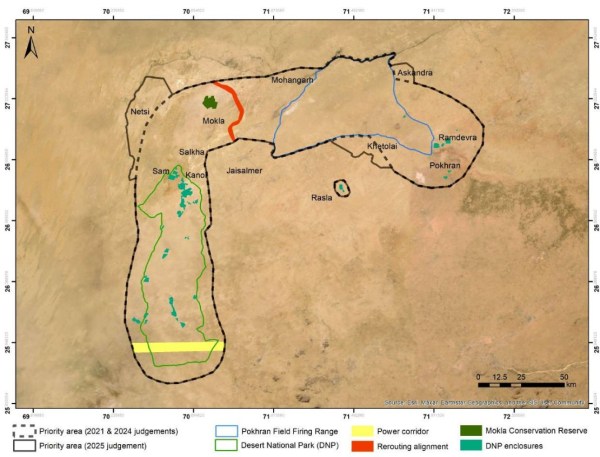 Demarcated ‘priority areas’ for the great Indian bustard. (Wildlife Institute of India)
Unlike forested areas across India’s states, grassland protection has always been challenging as they are not traditionally considered protected areas in public perception. Bharadwaj said this makes them vulnerable to land-use conversion and degradation, which consequently affects the livelihoods of pastoralists and those who rear livestock.
The “afforestation” of grasslands was red-flagged by Asad Rahmani, one of India’s foremost bustard experts and former director of Bombay Natural History Society, in the NGO’s famous Hornbill magazine back in 2008. Rahmani wrote: “Ironically, one of the biggest threats to grasslands is not from the graziers, but from the forest department. To live up to their name, officials of the forest department consider their solemn duty to convert every grassland (and even wetlands) into a forest.”
He noted that from Gujarat to Andhra Pradesh, it was seen that forest officers decided to “improve habitats” by planting trees or creating waterholes in bustard habitats.
Threats to GIB revival
At the conclusion of a landmark case seeking protection of GIBs, the Supreme Court had, accepting the recommendations of an expert panel, ordered some broad protection measures for GIBs and their habitats in Rajasthan and Gujarat.
Story continues below this ad
It demarcated “priority areas” for the bird (14,013 sq km in Rajasthan and 740 sq km in Gujarat) and ordered that 80 km of power lines in Rajasthan should be buried underground. This has to be completed between 2027 and 2028. It also ordered the creation of “powerline corridors” that will accommodate re-routed overhead lines.
Experts have warned that rewilding will not be sustainable if these power lines cannot be buried underground soon. Limestone mining is yet another issue that threatens to affect the open and flat areas that Bustards need. The Supreme Court did not order specific measures against mining, and mine operations are proposed in the northern side of DNP, where the birds were released.

Higher yields in US test India’s macro resilience
By Sohail Khan · 6 Oct
Christa Pike case exposes the myth of ‘humane’ execution
By Sohail Khan · 6 Oct
What the 2026 Physics Nobel winner has done: Capturing messengers from space in ice
By Sohail Khan · 6 Oct
Leave a Reply