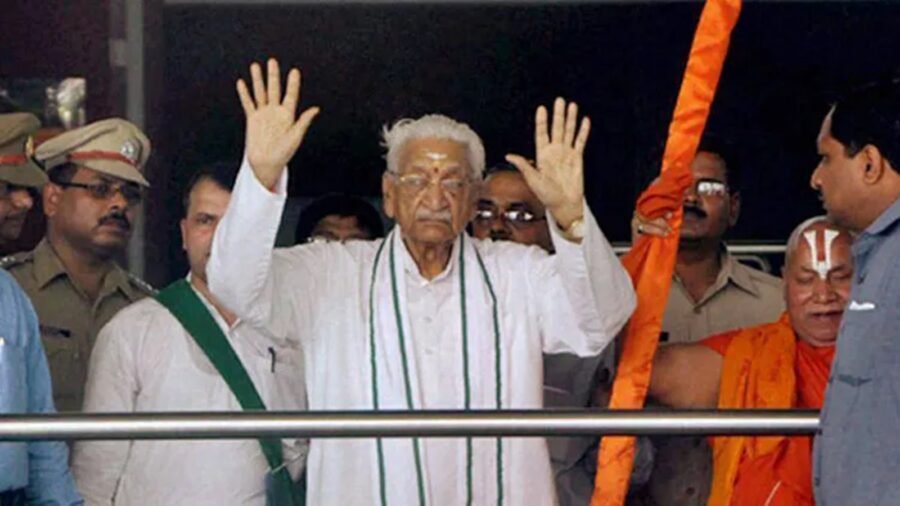
Remembering Ashok Singhal, karmayogi who worked with diligence and detachment
Advertisement
Ashok ji was exceptionally talented student, born into a distinguished and accomplished family. One of his brothers served in the Indian Police Service and the other was a successful businessman. Ashok ji himself studied engineering in Metallurgy at Banaras Hindu University. Instead of pursuing a personal career, he chose to dedicate his life to the nation. He was an intensely realised sadhaka like Swami Vivekananda. His spiritual pursuit was centred not on himself, but on society and the nation.
Ashok ji, as a student, came into contact with the Rashtriya Swayamsevak Sangh. He had the privilege of receiving the guidance of professor Rajendra Singh, affectionately known as “Rajju bhaiya” and Bhaurao Deoras. He also received the guidance of Pujya Sri Guruji Golwalkar. The influence of these great men was clearly reflected in his dedication, diligence, determination, management skills, organisational ability and foresight that inspired him to be a Sangh Pracharak.
When Ashok ji was the Prant Pracharak of Delhi Prant, the Meenakshipuram conversion incident raised concern throughout society. Ashok ji was entrusted with organising the Virat Hindu Sammelan in Delhi. Bringing together different sections of society, including Dr Karan Singh as the president, and revered sants from different sects, he successfully turned the plan into reality. Due to this display of impeccable organisational skills, he was given the responsibility of the Vishwa Hindu Parishad, which he took up with the same dedication and diligence.
Advertisement
Untouchability has been a serious social challenge before Hindu society for centuries and without ending it the vision of a harmonious society cannot be realised. Going beyond symbolic gestures such as community meals, he urged revered sants to convey to Hindu society that untouchability has not been in tune with the fundamentals of Hindu dharma by visiting and staying at Scheduled Caste community settlements. Shri Kameshwar Chaupal laying the foundation stone of the Ram Janmabhoomi Temple on November 9, 1989, when revered sants and dharmacharyas were present on the occasion, or acharyas having meal at the Dom Raja’s home in Varanasi, were important messages of social harmony. It strengthened the belief that social discrimination could be ended to build a harmonious Hindu society.
The Ram Janmabhoomi movement was one of the most widespread socio-religious movements of modern Bharat. Programmes such as the Ram-Janki Rath Yatra, Shila Pujan, Charan-Paduka Pujan and Ramjyoti generated widespread public awakening across the country. Ashok ji played an important role. Even in difficult circumstances, his faith remained a source of inspiration for the karyakartas. He firmly believed: “This is the work of Ram ji. Ram ji Himself will take care of this work.” The Mandir was not completed during his lifetime, but the movement to which he had provided direction, organisation and energy for decades reached its culmination after his demise, until the Pran Pratishtha of Shri Ram Lalla happened on January 22, 2024.
Ashok ji’s sphere of influence extended far beyond the Ram Janmabhoomi movement. His initiatives and guidance were notable in several areas, including the protection of Ram Setu, the Amarnath Yatra, research on cow-based products and the conservation of cattle, social harmony, connecting the intellectual class with Hindu thought. His working style reflected a remarkable combination of scientific outlook, organisational ability, adhyatmik and national conscience. The greatest characteristic of his personality was that he never stopped after achieving a goal. As soon as one goal was achieved, he moved towards the next.
For him, organisation was the means, society was the end, and service to the nation was the purpose of life. He gave up the possibilities of a personal life and chose national service. He attained fame, but remained detached from it. He provided leadership, but never sought credit for himself. He struggled, but never for personal gain. That is why the life of Ashok Singhal is not merely the story of an individual. It is an inspiring chapter of dedication, inner pursuit, organisation and karmayoga.
The writer is Sarkaryavah, Rashtriya Swayamsevak Sangh

40 years ago October 5, 1986: P T Usha leads winning spree
By Sohail Khan · 5 Oct
Why edible oils are bearing the brunt of food inflation
By Sohail Khan · 5 Oct
India and Canada can create human capital for the future
By Sohail Khan · 5 Oct
Leave a Reply