Palmonas’ offline push; IndiaAI’s GPU crunch

Benchmarks
Nifty22,620.45-95.75
FEATURED FUNDS★★★★★
Motilal Oswal Midcap Fund Direct-Growth
5Y Return
20.13 %
Invest Now
Enter search text:
Business News›Tech›Newsletters›Morning Dispatch›Palmonas' offline push; IndiaAI's GPU crunch
Explore other editions
| Morning Dispatch |
Palmonas' offline push; IndiaAI's GPU crunch
Want this newsletter delivered to your inbox?
 Thank you for subscribing to Morning DispatchWe'll soon meet in your inbox.
Happy Thursday! Demi-fine jewellery brand Palmonas is betting on offline stores, cofounder Pallavi Mohadikar said. This and more in today’s ETtech Morning Dispatch.
Also in the letter:
■ India’s E2W market grows
■ Simple Energy’s fundraise
■ Apple Pay launched in India
ET Startup Awards 2026: Palmonas leans on offline retail expansion as branded jewellery market gets crowded

Demi-fine jewellery brand Palmonas is using its expanding offline store network and high repeat-purchase rates to compete with both legacy jewellers and a wave of new entrants, cofounder Pallavi Mohadikar told ET.
Mohadikar was named joint winner in the ‘Woman Ahead’ category at the ET Startup Awards 2026, sharing the honour with Pallavi Shrivastava, founder of supply-chain financing startup Progcap.
Offline as a growth lever: Palmonas currently operates 105 stores and expects to end the fiscal year with about 160. Mohadikar said repeat purchase rates are 46% in offline stores versus 32% online, and average order values are significantly higher in physical outlets.
“The top agenda is lowering marketing costs as a percentage of revenue. That happens as your retail presence grows and you get more repeat customers organically,” she said.
Financial surge: Founded in 2021 by Mohadikar and Amol Patwari, with actor Shraddha Kapoor joining as a cofounder in 2024, the company has raised $47 million from Xponentia Capital and Vertex Growth Fund and is valued at over $200 million.
In FY26, Palmonas’ revenue was up by more than five times to Rs 230 crore from Rs 39 crore in FY25. Its net profit stood at Rs 11 crore, up from Rs 7.8 crore in FY25.
IndiaAI Mission likely to reset after GPU glitch

The government is recalibrating the IndiaAI Mission as critical compute components, especially GPUs, face severe supply constraints and sharply higher costs, people in the know told us.
Driving the news: Since the programme’s launch in March 2024, GPU and memory prices have more than doubled in many cases, disrupting procurement plans under the Rs 10,372-crore mission.
IndiaAI currently has access to about 30,000 GPUs against a total commitment of 45,000. Several empanelled cloud providers have been unable to deliver pledged capacity due to market pressures. A senior official said the ministry is issuing fresh bids, pressing companies to meet commitments and, in a strategic shift, moving to own some compute directly.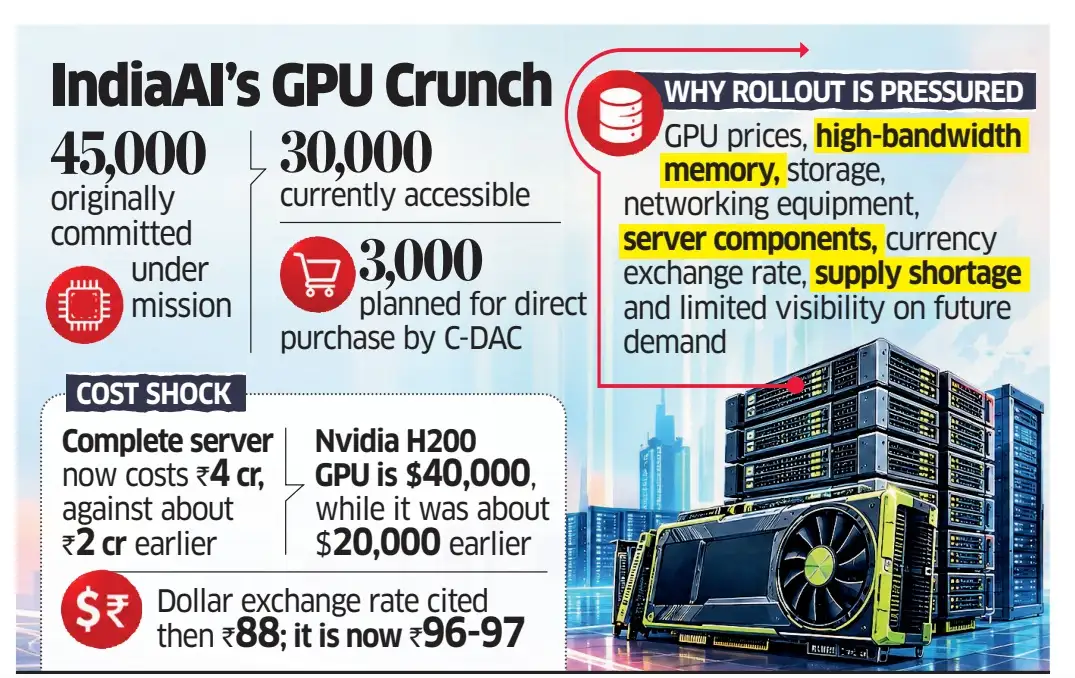
Yes, and: In a shift from its earlier strategy of not owning compute, it also plans to buy 3,000 GPUs through the Centre for Development of Advanced Computing (C-DAC). The capacity will be used by the government and will be made available to startups and researchers.
Cost pressure: Industry insiders reported steep cost increases across the stack:
- Nvidia’s H200 GPU price has risen from about $20,000 to over $40,000.
- A typical AI server that cost around Rs 2 crore a year ago now costs about Rs 4 crore.
- Currency movement (from about Rs 88 to Rs 96-97 per dollar) has added roughly 10% to costs for some consortia.
Verbatim: “We have some agreed rates, and those agreed rates are up to a point,” an official said. “Now we are actually trying to build our own compute, and also on a longer-term basis, contract compute. So for that, we are doing some more bids.”
Also Read: Govt eyes Rs 20,000 crore fund to power up frontier AI and compute ecosystem
Electric 2-wheeler sales cross 15 lakh in just nine months as adoption rockets
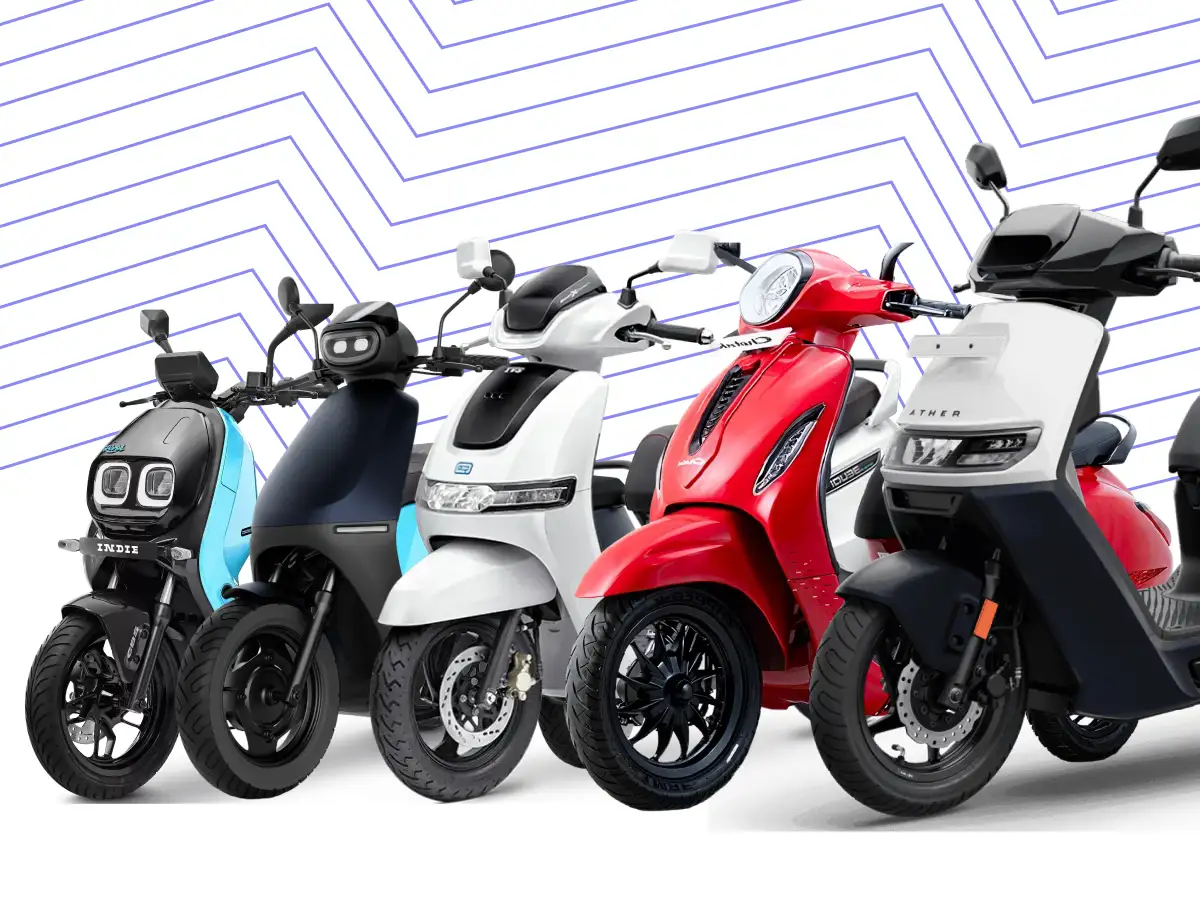
India’s electric two-wheeler market is growing at a rapid clip, with registrations jumping 62% year-on-year to 15.61 lakh units in the first nine months of 2026, from 9.61 lakh units in the same period last year.
Number-wise: The nine-month tally has already surpassed the 13.42 lakh units registered through the whole of 2025. In September alone, registrations rose 7.7% month-on-month to 1.97 lakh units, according to Vahan data, a proxy for sales.
Incumbents pull ahead: Established automakers are steadily taking a larger share of the market, with TVS Motor, Bajaj Auto, Ather Energy and Hero MotoCorp together accounting for about 76% of registrations so far this year. TVS and Bajaj alone accounted for nearly half of September registrations.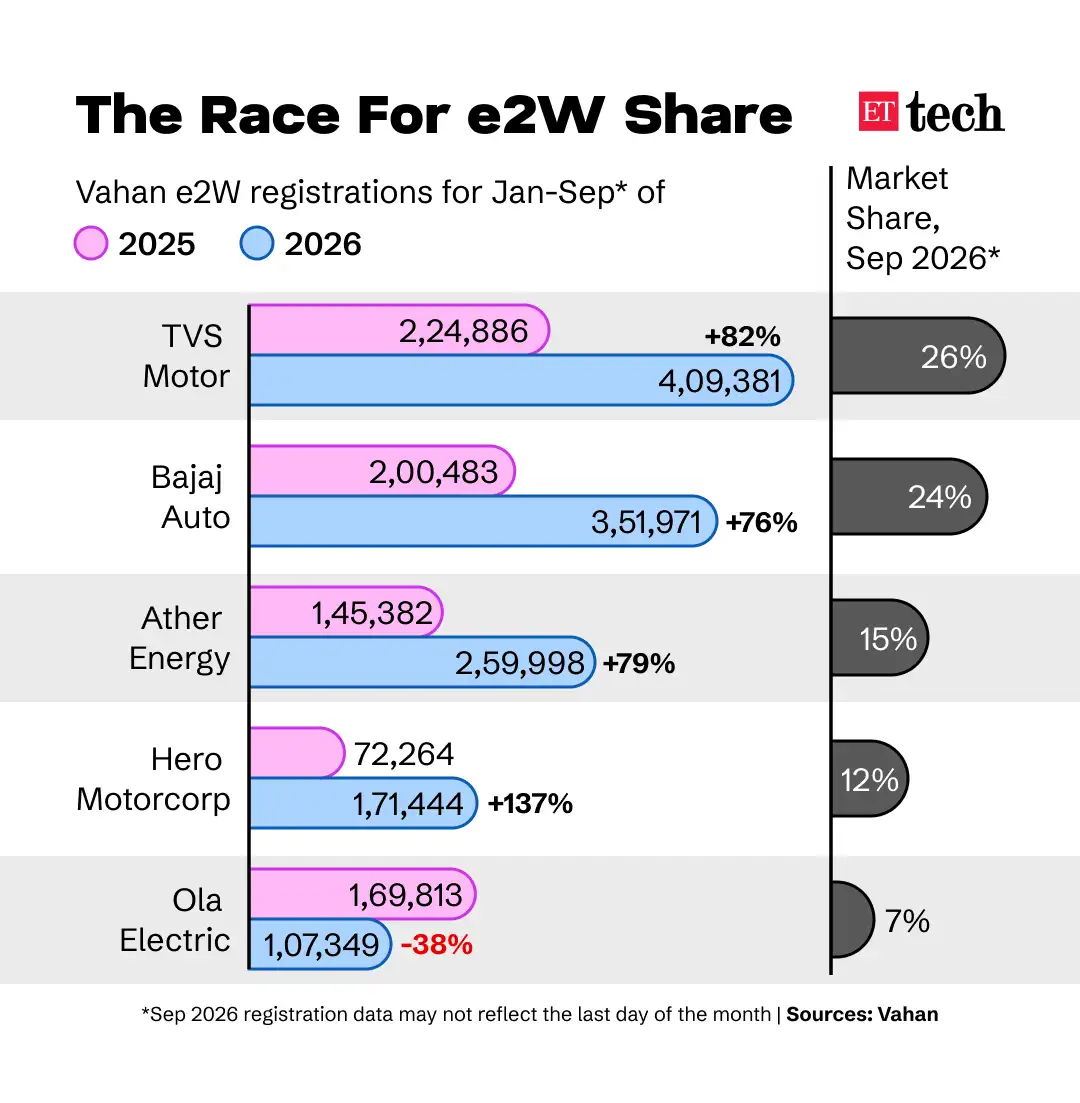
Yes, and: Newer players are still expanding, although from a smaller base. River Mobility’s share has nearly doubled from 1.27% in 2025 to 2.46% so far this year, while Ultraviolette and Oben Electric have also gained ground.
Funding up: The intensifying competition is also fuelling a fresh fundraising cycle. Ola Electric, Ather, River, Simple Energy, Bounce, Oben, Ultraviolette and Matter have all sought additional capital in recent months to expand production, distribution and product portfolios as the market increasingly moves into the mass-market scooter segment.
Other Top Stories By Our Reporters
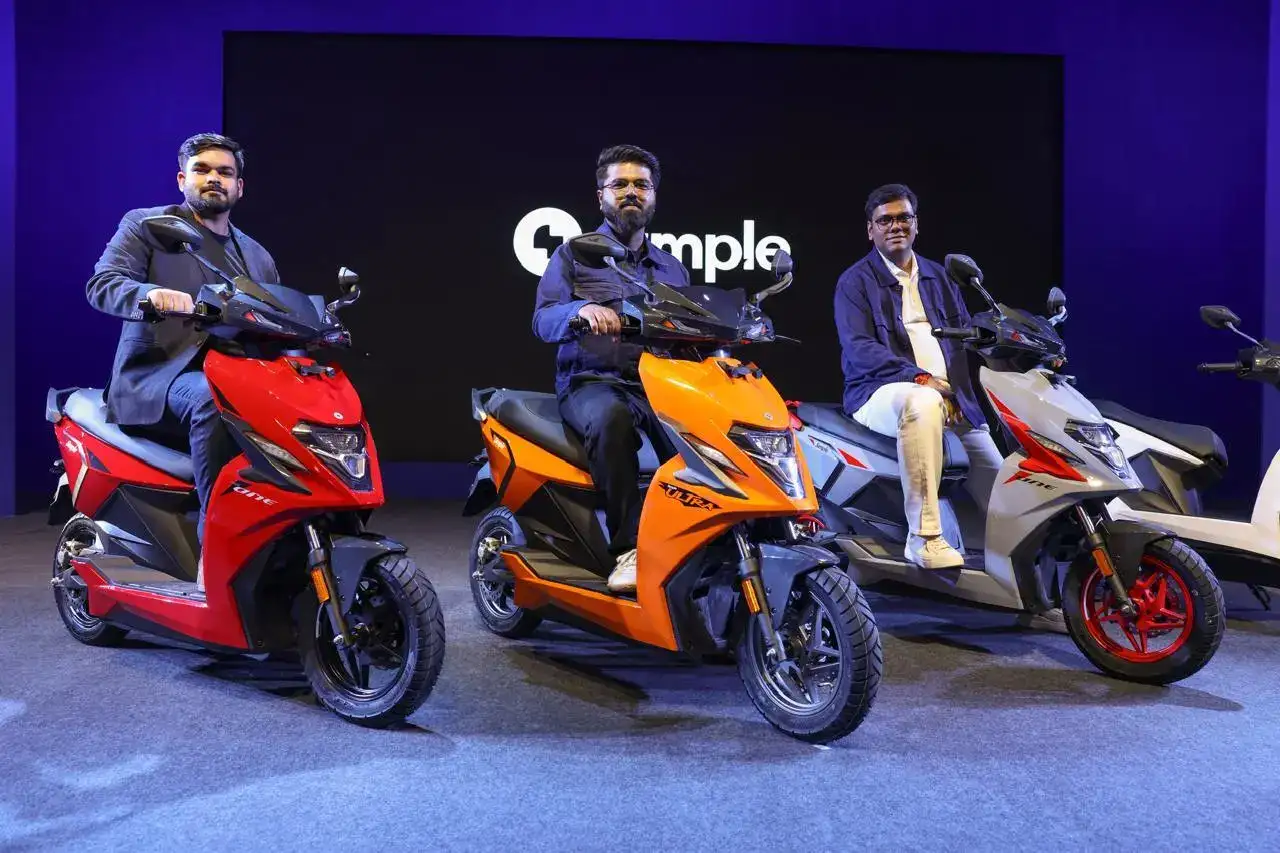
Shreshth Mishra, Suhas Rajkumar and Ankit Gupta, cofounders, Simple Energy
Simple Energy raises $180 million: Bengaluru-based electric two-wheeler maker Simple Energy has raised Rs 1,750 crore ($180 million) in its largest funding round to date. It plans to use the capital to increase production capacity and expand its retail footprint, aiming to become one of the country’s top five electric two-wheeler makers.
Apple Pay launches in India: Apple launched its payments service in India on Wednesday, allowing customers to pay using their Apple devices after years of preparations to enter a market dominated by the Unified Payments Interface (UPI).
SatLEO to launch India’s first thermal payload: IN-SPACe-incubated spacetech startup SatLeo Labs is set to launch TAPAS-1, its first commercial thermal-imaging payload, aboard SpaceX’s Falcon 9 as part of the Transporter-18 rideshare mission on October 1.
Global Picks We Are Reading
■ How AI is really changing jobs (FT)
■ AI companies want to embed safety evaluators, but countries need their own (Rest of World)
■ Black Twitter is thriving—on Threads (Wired)
Explore other editions
Want this newsletter delivered to your inbox?
Thank you for subscribing to Morning Dispatch
We'll soon meet in your inbox.


Enter search text:

Noel and Neville Tata move to shield Tata Trusts as company row heats up
By Sohail Khan · 1 Oct
Sensex, Nifty open lower as foreign outflows weigh on investor sentiment
By Sohail Khan · 1 Oct
Google Fitbit Air launched in India; check price
By Sohail Khan · 1 Oct
Leave a Reply