Oh, another India-Pakistan mismatch
Synopsis
India and Pakistan will compete in the gold medal match at the Asian Games men's T20 competition. This matchup marks their first encounter in this specific format, which adds to its significance. Unlike Pakistan, India is fielding a strong team for this event, showcasing their depth in talent. Past results indicate India has dominated previous encounters, leading with a record of 14 wins out of 17 matches.
The dust hasn’t quite settled on the International Cricket Council’s announcement that India and Pakistan will meet at the Wanderers in Johannesburg on a Sunday to headline next year’s 50-over World Cup. Of course, the tournament structure means the two Asian rivals could meet again down the road.
This has become an all-too-familiar story in global cricket tournaments. However, a first is being ticked off in Nisshin, Japan, as India and Pakistan face off for the gold medal in the Asian Games men’s T20 competition.
Also Read: India-Pakistan Asian Games final brings handshake question back into focus
These two teams have never met in such a framework.
What is interesting is that Pakistan’s team is not their main one. Typically, cricket boards save centrally contracted players for fixtures that matter within the cricket ecosystem.
Tournaments such as the CWG and the Asian Games fall outside the cricket boards’ remit, instead falling to bodies under the Olympic association.
That is why the Sri Lanka team that was bowled out for only 45 in their semifinal against India comprised players who wouldn’t be first choice if the board picked its strongest team. Pakistan are in the same boat, but India have bucked the trend.
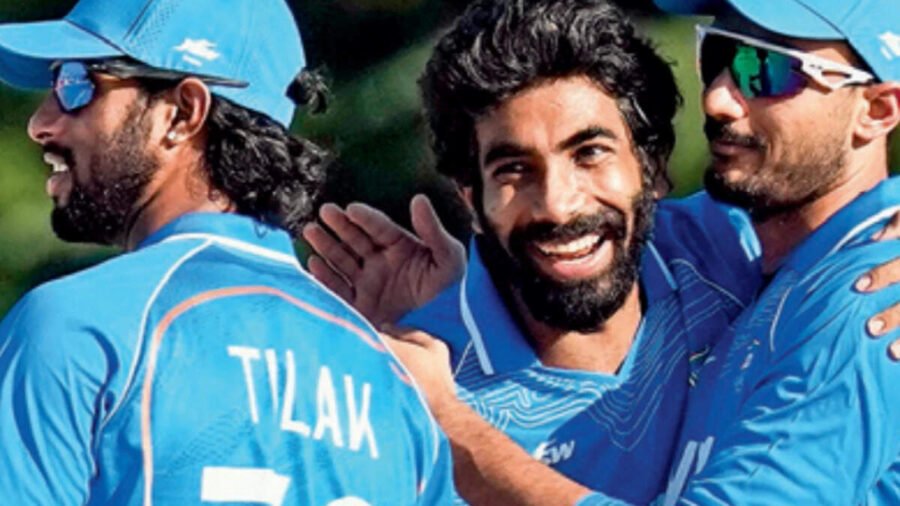
India’s T20 International team at the Asian Games is as strong as it can get. It may not seem that way, with another team comfortably chasing down 400-plus against the West Indies in one-day internationals at home. But while Virat Kohli and Rohit Sharma bring all the excitement and eyeballs, they are no longer part of the shortest format.
India have such a strong complement of players to choose from that their challenge is finding the best playing eleven. In the semifinal, they brought Vaibhav Sooryavanshi in at the top of the order to partner Abhishek Sharma, which meant Sanju Samson had to drop to No 3. In that game, India also deployed just one frontline fast bowler in Jasprit Bumrah.
The pitch on which India will play the final was heavily skewed towards spin. This means that Arshdeep Singh may have to sit out once more. There was turn, of the sharp kind, and variable bounce. While the odd arm ball from left-arm spinners skidded through, wicketkeepers were sometimes called upon to gather the ball above the head when it kicked from a good length. Add to this the lattice-like cracks that make for a jigsaw look, which were not just cosmetic but made the ball jag, and you have a recipe for batsmen having to be always watchful.
Also Read: ACC president Mohsin Naqvi to miss India-Pakistan Asian Games final
India’s spinners—Axar Patel, Ravi Bishnoi and Washington Sundar—attack the stumps, making life even harder for Pakistan’s second-string batsmen. It’s not as though their first team has had much joy against India: In 17 matches, India boast a 14-3 record, with the last six clashes going against Pakistan.
What India will have to watch out for is being on autopilot. In regular T20 conditions, usually flat tracks with the ball coming onto the bat nicely, the Indian team’s overall strength and firepower would not have much difficulty overcoming Pakistan.
But when the conditions are like those in Japan, the best-laid plans have to be tempered with situational awareness. Ishan Kishan provided a perfect template in the semifinal after some of the batsmen who came before him perished trying to play shots that the pitch did not allow for. India have the edge here too, for they were in a real spot against Japan in the five-over shootout that they played before the Asian Games. India were too good in the end, but there were some anxious moments.
On the day, especially when they are batting, India need to play the ball, and not the opposition or the occasion. If they back themselves to slow the game down to one ball at a time, glory will chase them.
(Disclaimer: The opinions expressed in this column are that of the writer. The facts and opinions expressed here do not reflect the views of www.economictimes.com.)
Add 

(Catch all the Business News, Breaking News, and Latest News Updates on The .)
…more
Elevate your knowledge and leadership skills at a cost cheaper than your daily tea.
-
A for apple, Y for yak and, for the first time, a price next to it. Will this change the non-agri part of the rural economy? -
The biggest assumption: From $600 billion to $2 trillion -
Six months after oil spiked, why are markets reacting so sharply now? -
Oil, money, and the shifting global order -
Gold paradox: Why India, a refining giant, is not a big bullion exporter -
A refinery is not a laptop: Why America's diesel problem can't be switched off -
Everyone asks who will fund AI. Few ask who pays if it burns -
How Irdai’s big reset can change insurance landscape, customer choice -
Can Fly91’s flightpath for India’s smallest airline defy the doomy past? -
Smugglonomics: Geckos, dry dates, human hair – what makes something worth smuggling?

Nasdaq rises 1%, Dow, S&P close higher as weak jobs data tempers rate hike bets
By Sohail Khan · 3 Oct
In Graphics: How the cost of Iran war piled up
By Sohail Khan · 3 Oct
L&T may sell minority stake in its clean energy arm
By Sohail Khan · 3 Oct
Leave a Reply