Of The Oil Paradoxes Facing Both India As Well As The USA
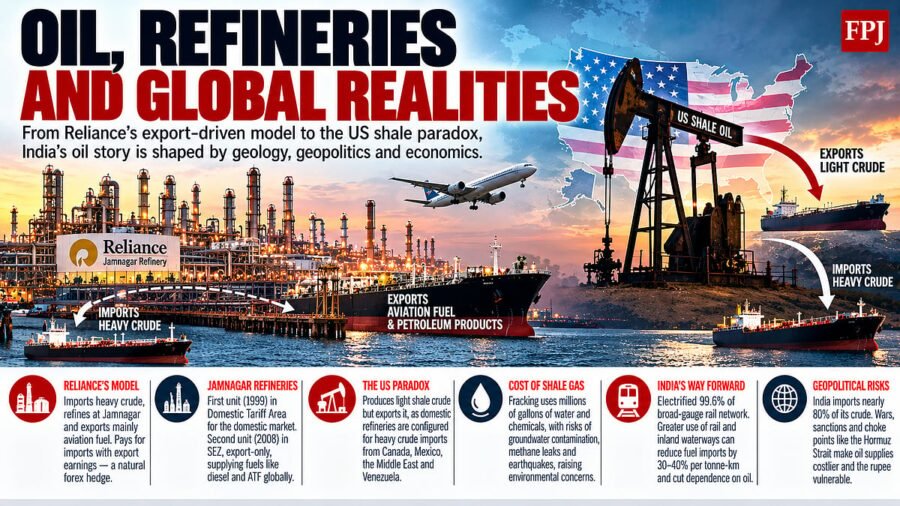
India's dependence on imported crude leaves its economy exposed to geopolitical risks, columnist S Murlidharan argues. Citing Reliance's refining and export model, he says India faces constraints in conventional and shale extraction. He advocates greater use of electrified railways, inland waterways and electric vehicles to cut fossil-fuel consumption and lower the country's oil import bill.
Of The Oil Paradoxes Facing Both India As Well As The USA | AI
Reliance, India’s largest forex earner, imports heavy crude oil and exports mostly aviation fuel after refining the imported crude in its giant refineries in Jamnagar. With nature being niggardly in bestowing India with oil reserves, the country imports nearly 80% of the crude. While the public sector refineries cater to the domestic demand, Reliance ships a sizeable part of its petroleum products abroad without having to worry about hedging its foreign exchange risks—it pays for its imports with the export earnings, which is technically known in the forex lingo as a natural hedge. Its state-of-the-art refineries are paying it rich dividends. Reliance promoters understood the oil business only too well—access to crude is not enough; it takes refineries to make the crude usable and saleable.
The US paradox is equally interesting but a lot more involved and complicated. It has ample crude oil production from its shale extraction fields but is exported to refineries abroad, mainly in Asia and the Middle East, where refineries are equipped to refine light or sweet crude. The refineries in the US, built decades ago, are equipped only to refine imported heavy, high-sulphur crude from places like Canada, Mexico, the Middle East, and, lately, Venezuela in its backyard. The access to bountiful Venezuelan crude, gained recently in copious quantities, will keep the US refineries going, earning enormous export earnings.
Shale gas technology is also known as horizontal drilling or fracking, unlike the deep drilling involved in conventional extraction of crude both onshore and offshore. It costs a lot more in terms of millions of gallons of water and chemical additives per well required, straining local water supplies. Groundwater contamination risks, methane leaks, and localised seismic activity (earthquakes) also raise environmental concerns. BTW, high carbon footprints and massive water consumption driven by data centres and cooling systems are also the downsides of AI, whose sceptics are growing by the day. In other words, shale gas and AI face similar hurdles that are by no means superficial. Both guzzle enormous amounts of power, necessitating fresh investments in power generation in the US.
Regarding the twin conflicting and alternative options of horizontal and deep drilling in the US, the dilemma is resolved by the dawning realisation that instead of paying high costs to retool existing refineries, it makes greater economic sense to export a large amount of its own light crude to international markets (such as Asia) while continuing to import the heavy crude needed for its refineries. Furthermore, moving oil across the vast US landscape via pipelines can be logistically difficult or restricted by laws like the Jones Act, making regional imports more efficient for certain coastal areas. Nevertheless, to novices’ minds, the export of crude alongside its imports strikes as odd.
`;
Reliance, too, has played its oil cards well. It has two giant refineries in Jamnagar. The older, first unit, built in 1999, operates in the Domestic Tariff Area (DTA) and primarily caters to the domestic market. The newer unit, built in 2008, operates as an export-only Special Economic Zone (SEZ) unit, sending fuels like diesel and ATF to international markets. So, the criticism that Reliance ignores the domestic market in search of export earnings is not well founded. Reliance sources its crude requirements from countries like Iraq and Saudi Arabia, supplying a significant baseline portion of the crude processed at the Jamnagar Refinery complex in Gujarat under long-term deals. The Reliance oil strategy is of a piece with Japan’s of importing only to export after value addition.
The US accounts for 89% of the global shale gas production. Other producers are Canada, Argentina, and China. India does not produce shale gas on a commercial scale due to a combination of severe water scarcity, complex geology, high costs, and regulatory hurdles. Shale gas extraction relies on hydraulic fracturing (or fracking, a technique that shoots millions of gallons of water, sand, and chemicals deep into the rock to release gas). Many shale-rich basins in India sit in dry areas that already struggle with severe water shortages and heavy demands from farming. Using millions of litres of fresh water per well risks draining local groundwater and polluting underground aquifers. In short, India suffers from a double whammy—both deep drilling and horizontal drilling circumscribed and discouraged by nature.
Oil is thus our soft underbelly. Its gargantuan imports render our currency weak. Geopolitics, like the ongoing US-Iran war, catches India in the crosshairs. It makes logistical sense for India to import crude from its neighbourhood, namely the Middle East and Russia, but it will have to contend with the threat of US sanctions if it opts for much larger imports from Russia and Iran. A war-torn Middle East is facing blockades on the Hormuz Straits. Importing from Venezuela and the US is costlier due to extra freight and insurance payable for the much longer distance and time.
Indian Railways has electrified 99.6% of its broad-gauge network, covering over 70,000 route kilometres (RKM), thus easing the burden of excessive dependence on fossil fuels to that extent. Electric cars and scooters are also gaining acceptance gradually despite their higher costs. On long-haul routes exceeding 1,000 km, sea and river transport can be 30% to 40% cheaper per tonne-kilometre than traditional road transport. The current modal share of Inland Water Transport (IWT) in India's freight movement is approximately 2%, with a government target to raise it to 5%. Much more, including saving import bills on fossil fuels, can be achieved by making rail and water transport more common. Air travel is the most expensive fuel guzzler, calling for its gradual displacement through faster and more comfortable rail travel.
S Murlidharan is a freelance columnist and writes on economics, business, legal and taxation issues.

Add As a
Trusted Source 




Leave a Reply