No ITR, Rs 2.31 cr purchase: Dubai NRI wins tax case

Synopsis
Mrs Chudamasa’s counsel argued that the AO had erred in treating Rs 2,31,20,000 as investment made during financial year 2017-18. He submitted that the actual payments during the year aggregated to Rs 1.85 crore, comprising Rs 1.73 crore paid to the builder and Rs 11.86 lakh towards registration charges and legal expenses. Read on to know on what grounds did she win in ITAT Mumbai.

Mrs Chudamasa, a Dubai-based NRI, did not file her income tax return for the assessment year 2017-18. However, the Income Tax Department found out that she had purchased a property worth Rs 2.31 crore during FY 2017-18 and issued a notice under section 148 in April 2022.
Because she did not file her ITR even after the notice, the Assessing Officer issued 2 more notices in August and November 2023. Receiving no response, the AO completed the assessment ex parte and brought the entire Rs 2.32 crore to tax under section 69.
The NRI lady filed an appeal before the CIT(A) in the case, wherein it was contended that she was a non-resident, residing and employed in Dubai, and that the property had been purchased jointly with her spouse. So, her appeal was dismissed for lack of evidence.
Mrs Chudamasa then approached ITAT Mumbai; however, the appeal was late by 148 days.
ALSO READ | Man left BMW on highway after puncture, found it burnt next morning; insurer denied Rs 70 lakh claim; he fights back and wins claim money with 7% interest
Not only did the Income Tax Appellate Tribunal (ITAT) condone the delay, but it also ruled in her favour, quashing the entire tax demand (based on the Rs. 2.31 crore addition). How? Read on to know how the Dubai-based NRI won this case.
How did the NRI win the case despite no ITR and Rs 2.31 crore property purchase?
The assessee won the case on purely procedural and jurisdictional grounds, Ritika Nayyar, Partner, Singhania & Co., told ET Wealth Online.
Before delving into how she won, it is important to look at the brief facts of the case. Vandana Vijay Kumar Chudamasa (the assessee) moved to Dubai in August 2014 for work. Her spouse had also shifted in October 2014 and had been employed there since April 2015.
After receiving the first notice under section 148A(b), Mrs Chudamasa engaged a CA to represent her. Since she and her spouse were in Dubai and were not conversant with the income-tax proceedings, they remained dependent on their CA.
Her present counsel argued that the earlier engaged professional continued to assure Mrs Chudamasa that the proceedings were being attended to. This resulted in the ex parte assessment order passed by the AO. They alleged that the earlier counsel neither filed an appeal before the Tribunal nor advised the assessee about a further remedy.
It was just a few months back in 2026 that the family hired a new counsel, who filed objections before the Dispute Resolution Panel in April 2026.
Why did ITAT Mumbai condone the delay?
Her prayer for condonation of delay was first opposed by the DR, who submitted that residence outside India did not constitute sufficient cause as physical presence in India was not necessary for filing the appeal. It was also submitted that the lady had not furnished the relevant evidence even before the CIT(A).
ALSO READ | Homebuyer paid Rs 1.73 crore for a flat in Gurgaon, builder delayed project and alleged that he booked unit for commercial gain; he fought and won the money back with 12% interest
However, ITAT Mumbai cited Section 253(5), under which the Tribunal may admit an appeal after the expiry of the prescribed period if it is satisfied that there was sufficient cause for not presenting the appeal within that period. In the present case, ITAT said, the explanation is not confined to the assessee’s residence outside India.
“The substance of the explanation is that the assessee, being employed and residing in Dubai, entrusted the tax proceedings to a professional adviser and continued to rely upon his assurances,” ITAT Mumbai stated.
It highlighted that “the delay of 148 days is also not so excessive that the explanation should be rejected merely on its length.”
Considering the cumulative effect of the NRI's residence outside India, her dependence upon the professional adviser, the earlier counsel’s admitted involvement in the first appellate proceedings, and the steps taken thereafter, ITAT condoned the 148-day delay.
On what grounds did she win in getting the entire tax demand removed?
What played the biggest role here was the duration in issuing the notice and the authority who approved it. A notice under section 148 was issued to Mrs Chudamasa on April 2, 2022, with the approval of the Principal Commissioner of Income-tax, Bengaluru-3.
However, her counsel contended that 3 years from the end of AY 2018-19 expired on March 31, 2022. Therefore, on April 2, 2022, the authority competent to accord approval was the authority specified under section 151(ii), namely, the Principal Chief Commissioner or Principal Director General.
Hence, approval by the Principal Commissioner was consequently without statutory authority.
Nayyar explained that since the approval was not taken from an appropriately designated authority, the statutory requirement was not met.”
The Tribunal therefore held the reassessment proceedings to be invalid and quashed the tax demand without going into the merits of the financial evidence. It underlined that the Principal Commissioner of Income-tax, Bengaluru-3, who granted approval, was not the specified authority.
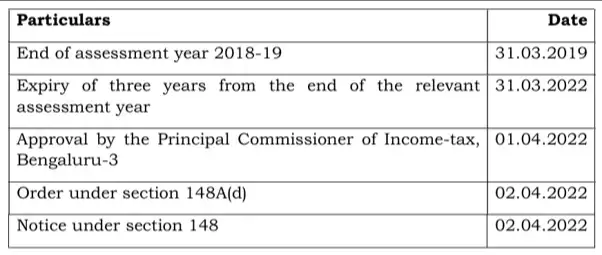
Since the order under section 148A(d) and notice under section 148 were issued without approval from the competent specified authority, ITAT Mumbai declared the notice under section 148 invalid.
What about the Rs 2.31 crore addition to tax?
Mrs Chudamasa’s counsel argued that the AO had erred in treating Rs 2,31,20,000 as investment made during financial year 2017-18. He submitted that the actual payments during the year aggregated to Rs 1.85 crore, comprising Rs 1.73 crore paid to the builder and Rs 11.86 lakh towards registration charges and legal expenses.
Moreover, the amount was funded by a housing loan of Rs 1,60,83,807, contribution of Rs 1 lakh by the assessee’s spouse and Rs 23,30,720 by Mrs Chudamasa herself.
Therefore, the tax demand was also quashed since the assessment was declared void. The tribunal left the question of whether the Rs 2.31 crore addition was justified on facts (loan, spouse's contribution, her own funds, etc.) open as "academic".
Nayyar told ET Wealth Online that if the required approval had been obtained from the appropriate senior authority, the outcome would have been decided on the merits of the case. “If the assessee’s explanation and supporting documents were not accepted, the entire property investment could have been treated as unexplained income and taxed at the applicable higher rates, with consequential interest and possible penalty proceedings.”
However, if the evidence was accepted, substantiating that the property was funded through genuine sources, there would have been no additional tax liability on this account and, consequently, no penalty on such addition.
What is the implication of this order for the taxpayers?
This order reinforces that reassessment proceedings have to strictly follow the safeguards prescribed under the law. Where a reassessment is initiated beyond the prescribed period, obtaining approval from the correct statutory authority is not a mere formality.
For taxpayers, this highlights the importance of checking the jurisdictional and procedural aspects of a reassessment, apart from contesting the underlying tax addition on merits, said Nayyar.
(Join our ETWealth WhatsApp channel for all the latest updates)
Add 

(Catch all the Personal Finance News, Breaking News, Budget 2025 Events and Latest News Updates on The .)
…more

Trump says Iran was weeks from nuclear weapon
By Sohail Khan · 2 Oct
Flydubai’s Omani pilot was indocrinated Islamist
By Sohail Khan · 2 Oct
How Tennessee’s 1st female execution in 200 yrs failed
By Sohail Khan · 2 Oct
Leave a Reply