‘No amount of whataboutery can justify mass disenfranchisement’: Justice Ujjal Bhuyan amid SIR row
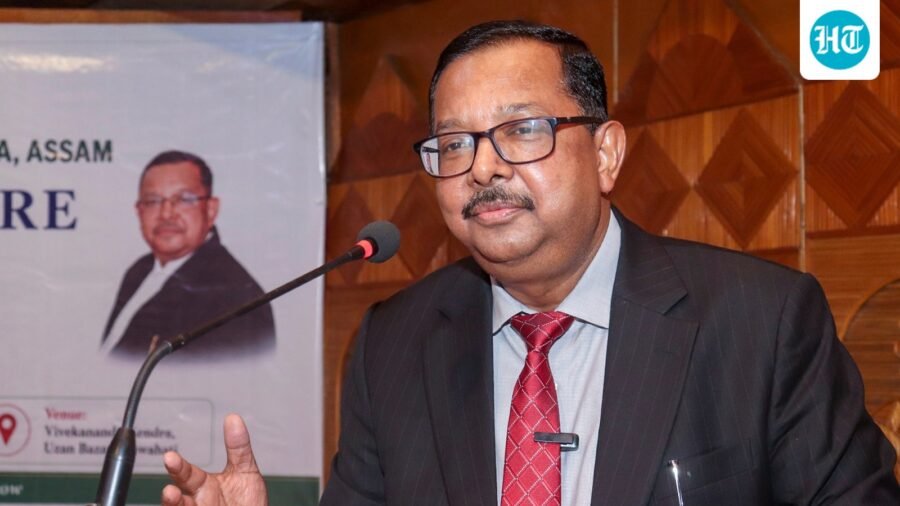
Justice Ujjal Bhuyan called mass disenfranchisement “intrinsically arbitrary” and warned against any administrative action undermining the right to vote.
Published on: Oct 4, 2026, 18:59:37 IST
Prefer HTon Google
Share via
Copy link
Any exercise that leads to the disenfranchisement of millions of Indian citizens, making them “second class citizens in their own country” by denying them the right to vote, is “intrinsically arbitrary”, Supreme Court judge Ujjal Bhuyan said on Sunday, delivering a scathing constitutional critique of mass voter exclusion amid the controversy over the Election Commission’s special intensive revision (SIR) of electoral rolls.
“No amount of whataboutery can justify it,” said Justice Bhuyan, warning that such a process would strike at the very heart of the Constitution and amount to “a negation of the constitutional order which we have adopted under the Constitution of India”.
The Constitution, he underlined, does not envisage two classes of citizens — those with voting rights and those without them.
The judge’s remarks at the valedictory address of the 19th NALSAR-Justice BR Sawhney Memorial Moot Court Competition in Hyderabad on Sunday come as the SIR exercise faces mounting legal and political scrutiny, with the deletion of lakhs of names from electoral rolls, questions over the grounds for issuing verification notices and a huge backlog of appeals raising concerns over the risk of eligible voters being denied their franchise.
Justice Bhuyan warned against any administrative exercise that undermines the constitutional guarantee of adult suffrage. He argued that the right to vote is not a mere statutory entitlement but a constitutional right integral to citizenship and the democratic order.
“Theoretically, citizenship and franchise are intertwined; one cannot be divorced from the other,” he said.
In Delhi, petitioners have told the court that 47.56 lakh names were excluded from the draft electoral roll published on August 31, while another 33.13 lakh electors were identified for notices on grounds of “no mapping” or “logical discrepancies”. On September 22, a bench headed by Chief Justice of India Surya Kant sought the Election Commission’s response to pleas challenging the process and questioned the basis on which such notices were being issued. Justice Joymalya Bagchi asked the poll panel to examine whether notices were being generated mechanically, while the Chief Justice sought clarity on the meaning of “logical discrepancy”. The Commission assured the court that no voter would be deleted without following the prescribed process.
In West Bengal, the problem has extended beyond exclusion to the ability of affected voters to secure timely relief. The Election Commission informed the Supreme Court in September that 22.21 lakh of the 27.16 lakh electors deleted through adjudication had appealed against their exclusion. Another 16.10 lakh appeals challenged the inclusion of voters, taking the total to 38.31 lakh. More than 37 lakh appeals remained pending, prompting the Commission to propose increasing the number of appellate tribunals from 19 to 42. The Supreme Court is scheduled to take up the matter on October 5.
Against this backdrop, Justice Bhuyan traced the constitutional promise of universal adult franchise to the freedom struggle and the Constituent Assembly’s decision to trust every adult Indian with an equal vote, irrespective of literacy, wealth, property or social standing.
The framers, he said, adopted universal suffrage despite the enormous administrative challenge and widespread illiteracy in the country. The decision was an act of faith in ordinary Indians and marked the first step towards achieving equality in a society deeply divided by caste and economic status.
Invoking BR Ambedkar’s closing speech in the Constituent Assembly, Justice Bhuyan recalled the warning that India would enter a life of contradictions, with political equality coexisting with social and economic inequality. The principle of “one man, one vote and one vote, one value”, he said, was a facet of equality and the very essence of the Constitution.
A billionaire and a rickshaw puller have votes of equal value, he said. So do a socially privileged temple priest and a person compelled to work as a manual scavenger. Universal adult franchise was the Constitution’s transformative promise that every citizen would have an equal voice in choosing those who govern.
Justice Bhuyan located that promise in Articles 325 and 326 of the Constitution. While Article 325 mandates a single general electoral roll for every constituency and bars exclusion on grounds only of religion, race, caste or sex, Article 326 provides for elections to the Lok Sabha and state legislative assemblies on the basis of adult suffrage, subject to constitutionally recognised disqualifications.
The emphasis, he said, was on “every citizen of India”. Unless a citizen is disqualified on grounds recognised under Article 326, the person is entitled to be registered as a voter.
The right to vote, he said, may not have been recognised as a fundamental right, but the Supreme Court has repeatedly acknowledged its constitutional character. Citing the court’s judgments in People’s Union for Civil Liberties v. Union of India and Anoop Baranwal v. Union of India, he said the franchise was central to free and fair elections, which have themselves been recognised as a basic feature of the Constitution.
Importantly, the judge said the constitutional limits on restricting the franchise applied not only to legislation but also to administrative action.
“If this is true for a legislation, it is equally true, if not more, for any administrative exercise,” he said, cautioning against irrational or unreasonable curtailment of the right to vote.
He also invoked the Supreme Court’s judgment in Lal Babu Hussain Vs Electoral Registration Officer (1995) which laid down safeguards for deletion of voters’ names. Except in the case of a dead voter, he said, a name once entered on the electoral roll cannot be deleted without notice and an opportunity of hearing.
The right to vote, he said, cannot be detached from the identity of a citizen. “It will be like taking out the soul from the body,” he said.
Justice Bhuyan ended his address with a warning that left little room for compromise on the constitutional principle at stake.
“Article 326 cannot be tinkered with at all, “No authority can do it; no court can condone it. No one is above the Constitution.”
He invoked constitutional lawyer Nani Palkhivala’s reminder that freedom cannot be inherited through the bloodstream: every generation must defend it if it is to survive.
“And what is the worth of a citizen without her voting right,” he asked.
See Less

Sharmila reiterates demand for CEC Gyanesh Kumar’s resignation
By Sohail Khan · 4 Oct

A.P., Telangana win U-14 boys’ handball title, Karnataka clinch girls’ championship
By Sohail Khan · 4 Oct
Leave a Reply