MMR’s Share Of Real Estate PE Inflows Falls To 9 Per Cent In H1 FY27 As Multi-City Platforms Gain Favour
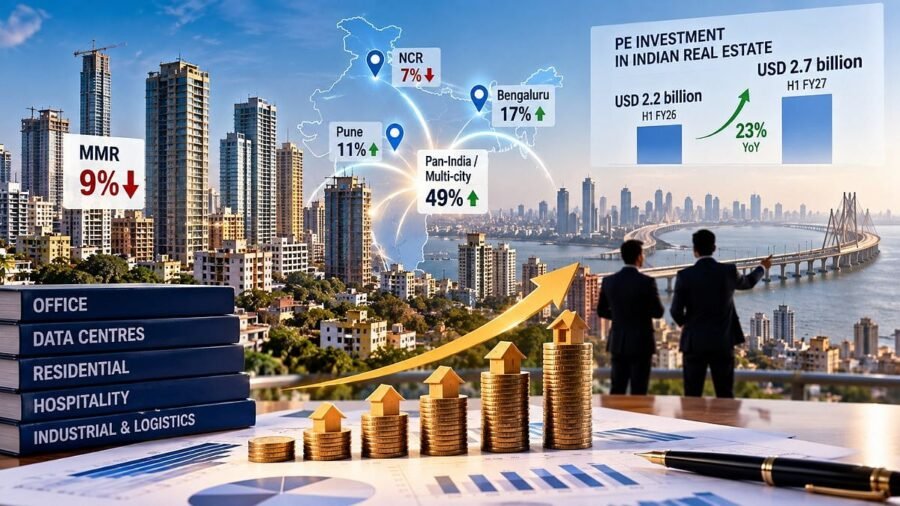
MMR's share of private equity real estate inflows fell to 9% in H1 FY27 from 17% in FY26, even as India's total PE investment rose 23% to USD 2.7 billion. Investors increasingly favoured pan-India and multi-city platforms, which accounted for 49% of inflows, while domestic capital rose sharply to 48%.
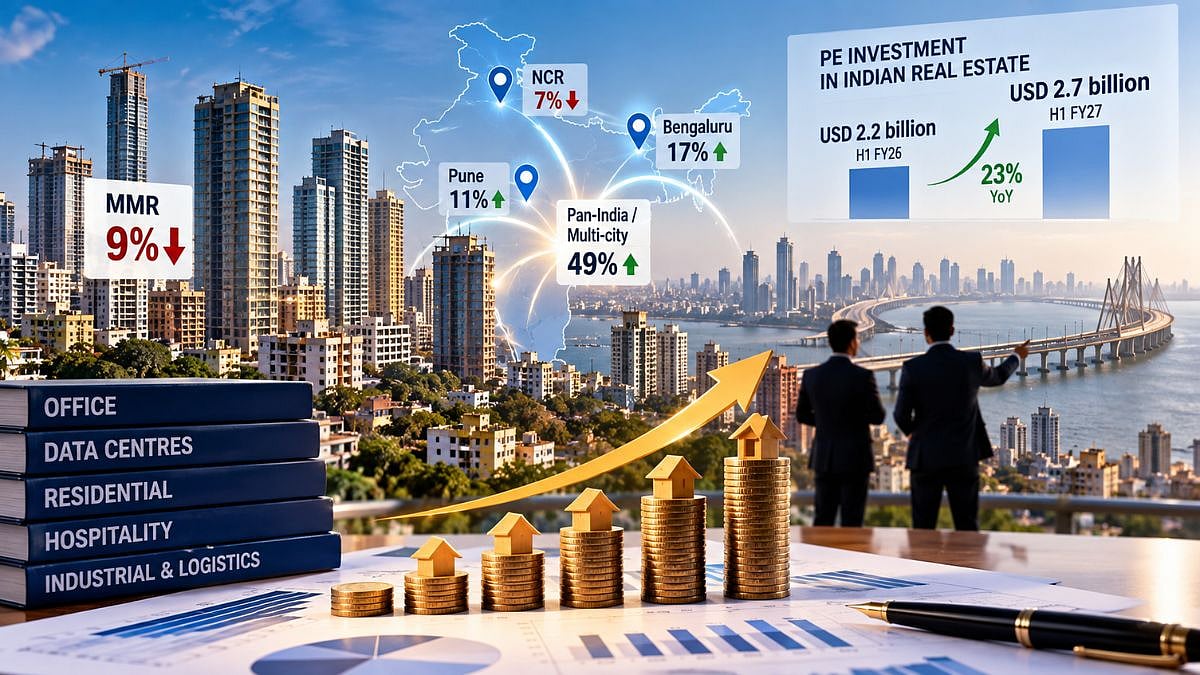
Mumbai Metropolitan Region saw its share of private equity real estate investment decline as investors favoured broader multi-city platforms | AI Generated Representational Image
Mumbai, October 6, 2026: Mumbai Metropolitan Region (MMR) remained among the key destinations for private equity (PE) investment in Indian real estate in the first half of FY27, though its share of overall inflows declined to 9% from 17% in FY26, as investors increasingly shifted towards pan-India and multi-city platforms.
According to the latest FLUX report by ANAROCK, PE investment in Indian real estate rose 23 per cent year-on-year to USD 2.7 billion in H1 FY27 (April-September 2026), compared with USD 2.2 billion in the corresponding period last year. This was the strongest first-half performance since H1 FY23.
Multi-City Platforms Gain Favour
The MMR's share was lower even as the overall investment pool expanded, with pan-India and multi-city transactions accounting for 49% of total PE inflows, sharply up from 18% in FY26.
`;
In comparison, Bengaluru's share rose from 13% to 17%, while Pune's increased from 6% to 11%. NCR's share fell from 23% to 7%. MMR and NCR together accounted for 16% of total inflows in H1 FY27, compared with 40% in FY26.
Domestic Capital Surges
A major shift in the investment landscape was the sharp rise in domestic capital.
Domestic investors deployed around USD 1.3 billion across 24 deals, accounting for 48% of total PE inflows. Their investment was nearly six times the USD 220 million recorded in H1 FY26. In FY25, domestic investors had accounted for only 16% of total PE capital.
Foreign investors, meanwhile, invested around USD 1.43 billion across six transactions, accounting for 52% of inflows and registering a 19% year-on-year increase.
While domestic investors participated in more transactions, foreign investors continued to commit significantly larger amounts per deal.
The report said the rise in domestic capital does not indicate a withdrawal of foreign investors, with the two sources of capital increasingly operating alongside each other.
“The depth of domestic capital is the biggest structural change we are seeing. Real estate AIFs, family offices and domestic institutions now have the scale and conviction to lead large transactions,” said Dr Prashant Thakur, Executive Director and Head – Research & Advisory, ANAROCK Group.
Data Centres See Sharp Rise
Office remained the largest individual asset class, accounting for 35% of PE inflows, marginally lower than 36% in FY26.
However, data centres recorded the sharpest increase, with their share rising to 29% from just 4% in FY26. The growth was driven by large-ticket foreign platform investments.
Hospitality, which had recorded no PE deals in the previous year, accounted for 12% of inflows in H1 FY27. Residential attracted 14% of total PE capital and led in terms of deal count. Nearly 90% of residential investment came through structured debt for project completion. Industrial and logistics accounted for 6%.
Also Watch:
“The first half of FY27 marks a clear turning point for private equity in Indian real estate. Investors are no longer just testing the waters; they are committing larger cheques, taking equity positions, and backing scalable platforms,” said Shobhit Agarwal, CEO, ANAROCK Capital.
To get details on exclusive and budget-friendly property deals in Mumbai & surrounding regions, do visit: https://budgetproperties.in/

Add As a
Trusted Source 




Leave a Reply