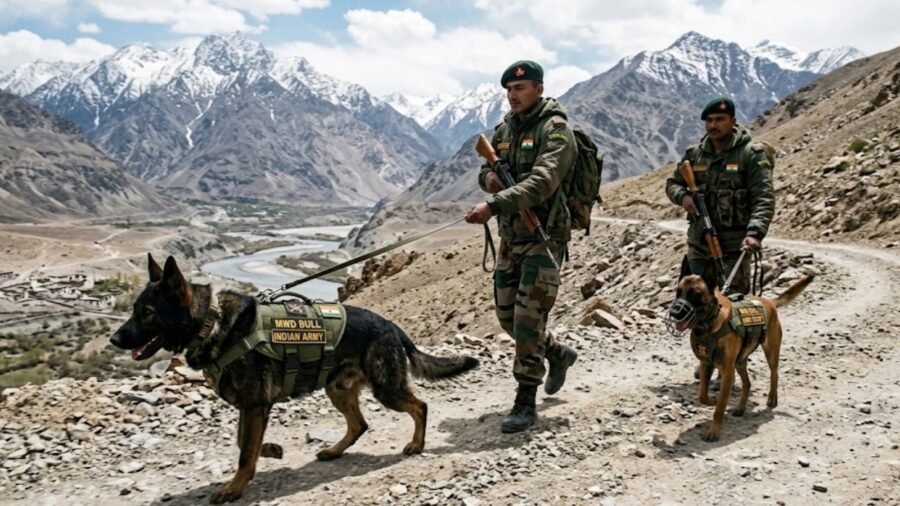
How military dogs are trained to brave Ladakh’s 14,000-ft heights
Story continues below.
Subscribe to see fewer ads.
What makes military dog training different?
Military working dogs are trained to remain focused on a task despite environmental and physical challenges. At high altitude, that capability has to be supported by appropriate acclimatisation, nutrition, rest, monitoring and protective measures, says Dr Vinod Sharma, Director and Head of Veterinary Services, DCC Animal Hospital, Gurugram.
He explains, “Their training at specialised centres such as those associated with the Remount and Veterinary Corps is adapted before they are deployed to high-altitude areas. High-altitude training is different because the dog has to perform its usual detection, tracking or patrol duties while simultaneously adapting to reduced oxygen availability and extreme cold.”
The dogs are therefore not immediately expected to perform strenuous drills after reaching a high-altitude environment. Acclimatisation is gradual and can take weeks, allowing their bodies to adjust to the thinner air.
“Initially, the intensity and duration of exercise are reduced. The workload is then increased progressively as the dog develops better tolerance to the altitude,” Sharma explains.
Story continues below this ad
 What sets the military dogs apart
How do dogs cope with thin air?
At around 14,000 feet, the amount of oxygen available in the air is considerably lower than at sea level. This can affect a dog’s exercise tolerance, resulting in faster fatigue, heavier breathing and slower recovery.
For a military dog, however, simply being able to walk or run at altitude is not enough. It may have to identify a scent, follow a trail or search an area while maintaining concentration.
“Detection and tracking skills themselves do not fundamentally change at altitude. What changes is the physical cost of performing those tasks. Pacing, adequate rest and recovery become much more important,” says Sharma. This is why handlers closely observe the dogs during training and deployment and adjust their work-rest cycles accordingly.
Training dogs to work in extreme cold
Dr Sharma says the paws require particular attention because prolonged exposure to snow, ice and rough terrain can result in paw-pad cracking and other injuries. Protective equipment may be used where necessary, along with regular inspection of the paws and body.
Story continues below this ad
The dogs also need protection from more serious cold-related problems such as frostbite and hypothermia, particularly during prolonged exposure.
What are the biggest health challenges?
“Hypoxia and reduced exercise tolerance are important challenges at high altitude. A dog that is breathing heavily, tiring unusually quickly or taking longer than normal to recover needs to be assessed and its workload adjusted,” Sharma says.
The rugged terrain adds another layer of difficulty. Uneven surfaces and long patrols can put additional stress on the joints, muscles and paws, increasing the possibility of musculoskeletal injuries.
“Unlike controlled training surfaces, mountainous terrain is uneven and unpredictable. Repeated movement over such ground can contribute to muscle, joint and paw strain,” he adds.
Story continues below this ad
Why nutrition and hydration matter
“Nutrition has to be tailored to the workload and environmental conditions. Dogs working in severe cold and at high altitude may require greater energy intake to maintain body condition and performance,” says Sharma.
Hydration is equally important. Dry air, exertion and limited access to water can increase the risk of dehydration. Gastrointestinal problems can also affect a dog’s ability to eat, drink and perform effectively, he adds.

Keeping up with UP: Bureaucrats entering politics – the hits and many misses
By Sohail Khan · 5 Oct
A Dean’s dilemma in India’s AI Economy
By Sohail Khan · 5 Oct
Trisha Krishnan soaks in some morning Vitamin D: know why it is essential in your 40s
By Sohail Khan · 5 Oct
Leave a Reply