Gyanesh Kumar row: Key takeaways from Kerala probe, protests against ECI and SIR
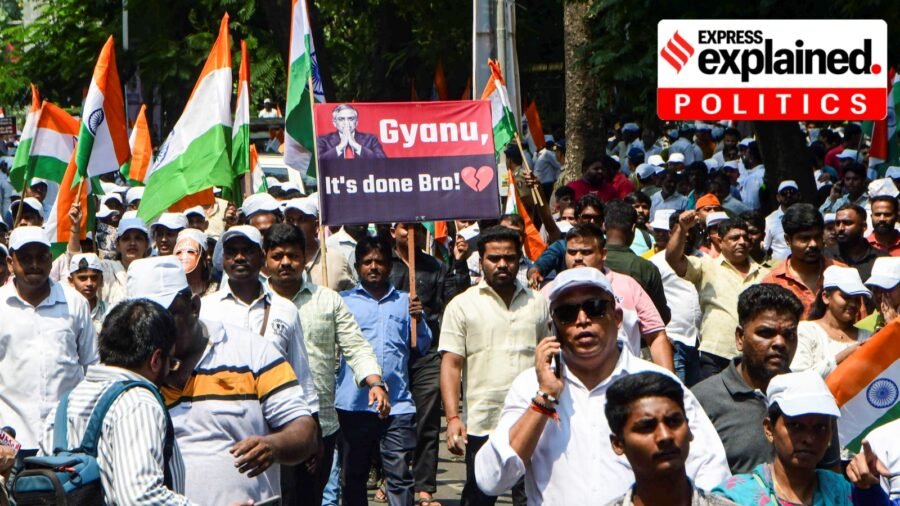
PATI-BEL had undertaken the renovation of a few stretches of major roads in the state at a cost of Rs 216 crore. Construction of the assigned roads got delayed due to alleged laxity in land acquisition from 2001 to 2006, putting pressure on PATI-BEL and project engineer Been.
Kumar’s name had allegedly figured in the suicide note. The Malaysian national had alleged that Kumar sought a bribe for clearing payment for the work. The road project, known as the Kerala State Transport Project, was funded by the World Bank.
A month after Been’s death in November 2006, Kumar was moved out of the PWD by the then CPI(M)-led government. He was eventually posted in the Defence Ministry during the UPA-1 government.
Story continues below this ad
Chennithala, who also handles the Vigilance Department, told the media on Sunday (October 4) that he had received a complaint from Congress leader Malayankeezhu Venugopal that the Vigilance probe held in 2006 had been compromised due to external compulsion. He added that after a discussion with Chief Minister V D Satheesan, he had decided to order a comprehensive probe based on the fresh complaint.
Thackerays reunite again, CJP protests at Mumbai’s Shivaji Park
On Sunday, the opposition parties Shiv Sena (UBT) and Maharashtra Navnirman Sena (MNS) took to Mumbai’s streets in a joint protest march — called the Virat Garjana Morcha — demanding Gyanesh Kumar’s resignation. But in a break from past protests, the rally saw neither party’s flag or symbol on display.
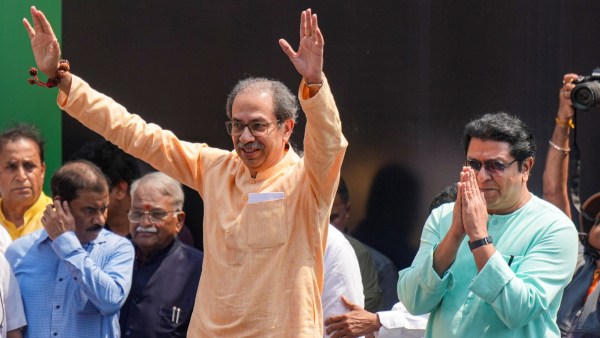 Shiv Sena (UBT) chief Uddhav Thackeray and MNS chief Raj Thackeray during the ‘Virat Garjana Morcha’ rally against Chief Election Commissioner Gyanesh Kumar in Mumbai on October 4, 2026. Photo: PTI/Shashank Parade
Cadres were instructed by their leaders — UBT chief Uddhav Thackeray and MNS’s Raj Thackeray — were told to carry only the tricolour. This was an attempt at an outreach beyond ideological lines to make the agitation more inclusive, built around one agenda: the ECI.
Story continues below this ad
The protest march had two key demands: Kumar’s resignation and the scrapping of the Special Intensive Revision (SIR) of voter lists in Maharashtra. At the concluding meeting of the march, Raj also demanded that electronic voting machines (EVMs) be replaced with ballot papers in elections.
Earlier, Mumbai witnessed protests by the Cockroach Janta Party (CJP), a pressure group founded by activist Abhijeet Dipke, at Shivaji Park on Friday. After the Mumbai Police had denied permission to gather for a protest against the ECI and CEC Kumar, the CJP had announced that it would “do a jail bharo andolan if necessary”.
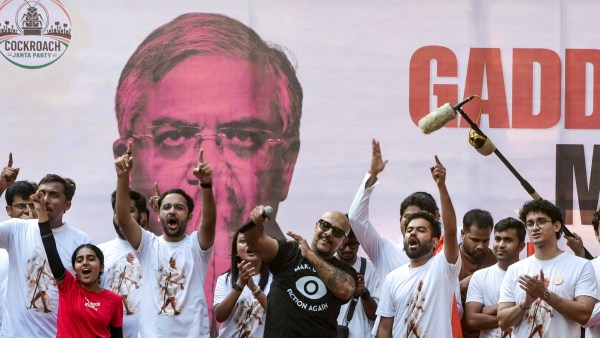 Cockroach Janta Party (CJP) founder Abhijeet Dipke, singer-songwriter Vishal Dadlani, and others during a protest by CJP against CEC Gyanesh Kumar, demanding his resignation, at Shivaji Park, Mumbai, on October 2, 2026. Photo: PTI
In spite of the lack of police permission, the CJP went ahead with its demonstration on Friday and the Mumbai Police — unlike its Delhi counterparts — didn’t use force against the protesters. On the contrast between the approaches of the two forces, reported that the Maharashtra Home Department, a portfolio that CM Devendra Fadnavis himself holds, had directed the police top brass to ensure there is no untoward incident and that gatherings pass off peacefully.
How Delhi Police blocked protests at Jantar Mantar
The Delhi Police blocked protests against the ECI and CEC Kumar at Jantar Mantar for two consecutive days — on Friday and Saturday (October 2 and 3) — and detained hundreds of people.
Story continues below this ad
Around 700 people were detained on Friday, including former Delhi CM Atishi, her Aam Aadmi Party (AAP) colleague and former Delhi minister Saurabh Bharadwaj, activists Neha Bora and Yogendra Yadav, and Left leaders such as Brinda Karat.
Earlier on Thursday (October 1), Delhi Police had refused permission for this protest, prompting criticism over stifling of protests by the authorities. The Delhi Metro on Friday temporarily closed entry and exit at 12 stations in central Delhi, including Rajiv Chowk, Central Secretariat, and Janpath. Internet services were also suspended in and around Jantar Mantar.
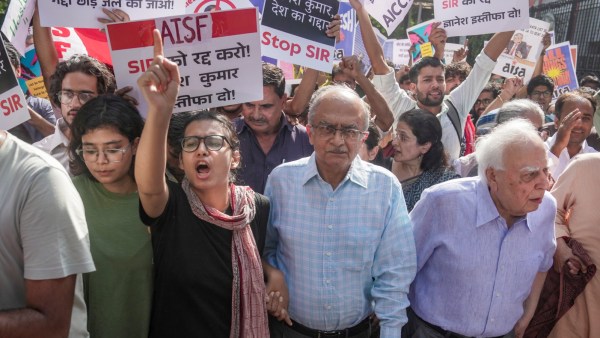 All India Students’ Association (AISA) national president Neha Bora, with advocates Kapil Sibal and Prashant Bhushan, and others, during a protest near Jantar Mantar, New Delhi, on October 3, 2026. Photo: PTI/Karma Bhutia
Over 150 people — including activists Neha Bora and Yogendra Yadav, and senior advocate Prashant Bhushan — were detained on Saturday for allegedly attempting to return to Jantar Mantar a day after being detained during protests demanding CEC Kumar’s resignation.
The same day, Delhi Police acknowledged that it had received complaints from three female journalists, who had accused Delhi Police officers of sexual harassment while covering protests near Jantar Mantar. That evening, several freelance journalists and representatives of news portals had gathered outside the Parliament Street police station, demanding action against the officers involved. The female journalists submitted written complaints at the station before leaving.
Story continues below this ad
“On October 3, during the protest in the New Delhi area, while in a law-and-order situation, allegations of sexual harassment were made by three female journalists against police officers. New Delhi District has received their complaints, and the same have been transferred to the Crime Branch for a fair and impartial enquiry,” the Delhi Police said in a statement.
Opposition rallies together at INDIA bloc meeting
The leaders of the Opposition INDIA bloc on Wednesday (September 30) announced a joint action plan against various alleged poll irregularities and the SIR of electoral rolls. Their planned agitation would include protests across the country, a march by the Opposition MPs to the ECI headquarters, and a mega rally in Delhi on November 1.
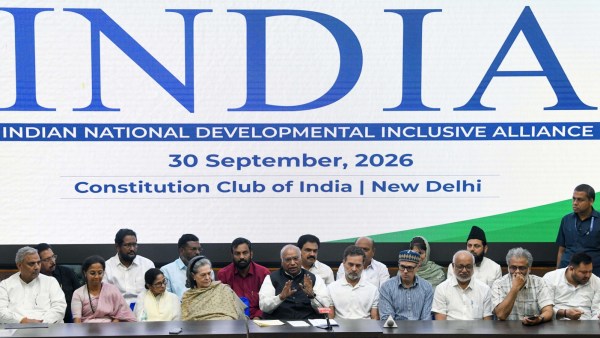 Congress president and Rajya Sabha LoP Mallikarjun Kharge speaks after the INDIA bloc leaders’ meeting at Constitution Club of India, New Delhi, on September 30, 2026. Photo: ANI
These decisions were taken at a three-and-a-half-hour meeting of the grouping in Delhi, which was attended by the leaders of 19 parties and Independent MP Kapil Sibal.
Addressing a joint press conference later, Congress president and Rajya Sabha MP Mallikarjun Kharge said the parties agreed to work together and involve young people and civil society organisations in their campaign.
Story continues below this ad
“Save Democracy marches would be held from October 2 to 8, followed by demonstrations outside district magistrates’ offices, across the country. On October 6, Opposition MPs from both Houses of Parliament would march to the EC’s office in New Delhi,” he said. He added that the Leaders of the Opposition of both Houses would seek an appointment with the President in the second week of October to submit a representation against what he alleged was a “vote chori government”.

China This Week | Rumours about Xi’s health, US jets arrive in Taiwan, and more
By Sohail Khan · 4 Oct
‘No filter’: Tamannaah Bhatia’s advice for dealing with bad skin days
By Sohail Khan · 4 Oct
RBI likely to raise rates: Why inflation, crude and global rates matter
By Sohail Khan · 4 Oct
Leave a Reply