Goyal rejects claims of India’s excess capacity
Benchmarks
Nifty22,421.95-198.5
FEATURED FUNDS★★★★★
Motilal Oswal Midcap Fund Direct-Growth
5Y Return
19.6 %
Invest Now
Enter search text:
Business News›News›Economy›Foreign Trade›Piyush Goyal says India does not have structural excess manufacturing capacity
Read Today's Paper
Piyush Goyal says India does not have structural excess manufacturing capacity
Synopsis
Piyush Goyal said India does not have structural excess manufacturing capacity in sectors identified by the G20, arguing that Indian production caters to both domestic and global demand. Speaking at the G20 Trade Ministers' Meeting in the US, Goyal also stressed WTO rules, supply-chain diversification, forced labour concerns and the need to preserve policy space for developing economies.
 ANI
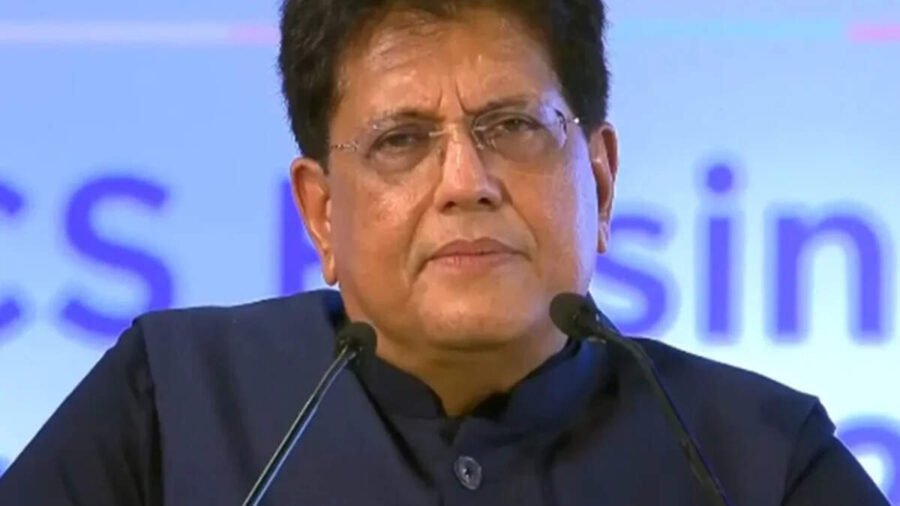
ANICommerce and Industry Minister Piyush Goyal said India does not have structural excess manufacturing capacity in the sectors identified by the G20 Presidency, asserting that the country's manufacturing capacity serves both domestic and global needs.
The US holds the G20 Presidency in 2026.
He also said industrial capacity in itself is not the issue; however, distortions can arise where geographical concentration of production is driven by hidden subsidies and support.
The minister added that diversification of production and supply chains is a legitimate objective, but it cannot be used as a pretext for measures outside WTO (World Trade Organisation) rules or shifting the burden of adjustment onto developing countries, which must retain policy space to industrialise.
"India's manufacturing capacity serves its domestic and global needs and that, in the sectors identified by the G20 Presidency, India does not have structural excess capacity," Goyal said.
India shares the concern of several G20 members that trade-distorting support in some countries leads to dumping and predatory pricing, and it addresses such practices through evidence-based WTO measures, including anti-dumping and countervailing duties, he added.
These remarks are important as the Office of the United States Trade Representative (USTR) launched two separate Section 301 investigations on March 11 and 12, covering 60 economies over concerns related to forced labour and excess industrial capacity.
One probe on forced labour concluded, and a 10 per cent duty was imposed on countries, including India. Final findings on the other probe are awaited.
The US has flagged excess capacity issues in sectors such as steel, textiles, aluminium, automobiles, batteries, cement, chemicals, electronics, energy goods, glass, machine tools, machinery, non-ferrous metals, paper, plastics, processed food and beverages, robotics, satellites, semiconductors, ships, solar modules, and transportation equipment.
"India shares the concern of many members that trade-distorting support in some economies leads to dumping and predatory pricing and addresses it through WTO (World Trade Organisation) measures such as anti-dumping and countervailing duties, based on evidence, which are open to judicial review," the commerce ministry, in a statement, quoted Goyal as saying.
India is the fastest-growing large economy in the world, with a domestic-demand-driven economy serving 1.4 billion people, and is building manufacturing value chains from design to finished goods as a trusted link in global supply chains, he said.
Goyal participated in the concluding day of the G20 Trade Ministers' Meeting in Milwaukee, Wisconsin, and spoke in sessions on structural excess capacity and production, updating the Most-Favoured-Nation principle, ending forced labour in global supply chains, and the closing session.
Speaking on ending forced labour in global supply chains, Goyal said India's commitment to forced labour elimination is absolute and unconditional.
Measures at the border must be based on specific and verifiable evidence rather than presumptions about entire countries, regions or sectors, and must respect due process and WTO rules, he added.
International Labour Organization (ILO) is the competent, universal and tripartite body for labour standards, he said.
India supports the objective of eliminating forced labour and voluntary exchange of good practices among G20 members, provided such cooperation does not involve monitoring of members, create new obligations or result in information being used as a basis for unilateral trade action.
On updating the Most-Favoured-Nation principle, the minister said India's trade with G20 members depends on a transparent, non-discriminatory and rules-based trading system.
Most-Favoured-Nation treatment is a key guarantee of this system, ensuring that the same terms apply to the smallest and largest trader.
He emphasised that consensus remains central to the WTO and that special and differential treatment must be preserved to enable developing countries to catch up with developed economies.
Goyal also called for restoration of the two-tier dispute settlement system.
Add 

(You can now subscribe to our WhatsApp channel)
(You can now subscribe to our WhatsApp channel)
Read More News on
Piyush Goyal G20 meetingIndia manufacturing capacitystructural excess capacityG20 Trade Ministers MeetingIndia US tradeWTO rules IndiaPiyush Goyal excess capacityglobal supply chainsMost Favoured Nation principleWTO dispute settlement system


Enter search text:
Stories you might be interested in

An ‘entertaining’ India vs Brazil football contest
By Sohail Khan · 2 Oct
AI clones turn celeb likeness into a new business
By Sohail Khan · 2 Oct
Pakistan took full advantage of IWT, Saxena says
By Sohail Khan · 2 Oct
Leave a Reply