China This Week | Rumours about Xi’s health, US jets arrive in Taiwan, and more
Another noteworthy event this week was the delivery of two American F-16V fighter jets to Taiwan. The Chinese Communist Party’s (CCP) tabloid, Global Times, commented on the fact that it came years behind schedule. The jets have also come as a major arms sale from Taiwan to the US hangs in the balance.
Story continues below.
Subscribe to see fewer ads.
Finally, we look at a recent Reuters report that used satellite images to find that China is building a full-scale runway at the Antelope Reef in the disputed South China Sea. “Military attaches and security analysts say [it] could be one of China’s most important offshore bases in the region,” the report said.
Here is a closer look at these developments.
1. Why Xi Jinping’s health is often the centre of rumours
The WSJ report cited former US officials involved in planning state visits and analysts, who said that the nature of China’s requests for Xi was unusual.
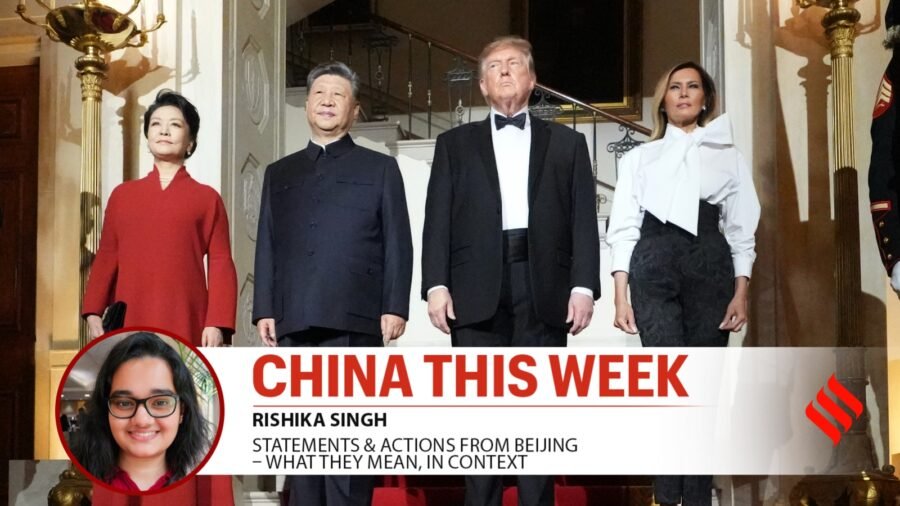
“Chief among the requests was a private room inside the West Wing [of the White House] for Xi to take a break between events, with only his wife, Peng Liyuan, permitted to join him, the people said. No others from the Chinese delegation were allowed to use the ‘hold room,’ as it was called,” the report said.
UPSHOT: Such rumours are not exactly new. In fact, back in 2012, months before Xi was elevated as the general secretary of the CCP — the most powerful position in China — he was not seen in public for a while, sparking speculation over his health.
Story continues below this ad
Xi is not alone, in that many key public figures in China often draw such scrutiny given the lack of transparency in the country’s political and media systems. Information flows are heavily regulated by the government, which, in turn, heightens curiosity among observers. With a leader like Xi, who has concentrated power at the top and bypassed term limitations, China watchers are particularly interested in observing the tiniest body language shifts and movements to understand his health condition, including Xi reportedly clasping his wife’s hand while using the stairs in Washington, SC.
This incident may turn out to be about Xi simply requiring rest given his age and the long-duration flight to the US. The rumours of his supposed ill-health in India were also not found to have a strong basis, at least so far, but are indicative of how China’s political system, in an attempt to project strength and infallibility, can damage those very perceptions.
2. Taiwan gets new jets, with some delays
During Donald Trump’s first presidential term in 2019, the United States approved an $8 billion sale of Lockheed Martin F-16V fighter jets to Taiwan, but issues such as software problems delayed delivery, Reuters reported.
The arrival of the first two of 66 F-16V Block 70s strengthens Taiwan’s defense capabilities and safeguards our skies. We thank the United States for its longstanding support and continued security cooperation.
As President @ChingteLai has said, investing in defense is investing in peace. Taiwan remains committed to defending our homeland and to contributing to regional peace and stability.
— DPP U.S. Mission (@TaiwanDPP_DC) October 2, 2026
The jets were to reach Taiwan between 2023 and 2026, but only two of the 65 F-16V Block 70 jets have been delivered. Commenting on the news, Global Times noted the positive reactions from Taiwan’s ruling Democratic Progressive Party (DPP), calling it “political performance”.
The article spoke of “The DPP’s alarm over the rising prevalence of ‘abandoning Taiwan’ and ‘doubting the US’ sentiments, particularly as China and the US have sought greater strategic stability in their relationship. Under this narrative, the arrival of two F-16Vs in Taiwan has been… cited as proof of continued US support for Taiwan island.”
Story continues below this ad
UPSHOT: The article touches on a subject that has worried some stakeholders in the US of late: the country’s longstanding relationship with Taiwan. While the latest jet delivery may have been approved years ago, its delivery comes when Trump has held off on approving a $14 billion arms sale to Taiwan. Once signed, it would be the biggest such package to date.
Amid the visit, Lyle Morris, Senior Fellow on Foreign Policy and National Security at the US-based Asia Society Policy Institute’s Center for China Analysis, told that Trump’s delay could be an attempt to accommodate China. Xi and the Chinese State have criticised such arms sales as part of the broader objection to any conception of Taiwanese independence.
But Trump’s more recent statements have also diverged from the more assured US support for Taiwan over the past few decades. In that context, it would be understandable why the DPP would see the jets as evidence of US support, and why the CCP would describe it critically.
3. New activity in South China Sea
Reuters reported that a completed base at Antelope Reef would be “China’s most significant military expansion in the South China Sea in a decade, extending the reach of Chinese naval ships and military aircraft in a waterway that is an increasingly militarised arena of competition between Beijing and the United States and its allies over Taiwan.”
Story continues below this ad
It would also help protect the approaches to Hainan Island, where China keeps its nuclear-armed ballistic missile submarines, the report said.
UPSHOT: In the last decade or so of increasingly assertive Chinese foreign policy, the South China Sea has been a major component. Apart from the region’s vast oil and gas resources, it has also become a source of territorial contestation, with claims upto various points made by countries such as Vietnam and the Philippines.
For the US, it could also emerge as a region where China incrementally increases its presence through the deployment of smaller vessels and forces, creating a strategic threat. In July, the US government issued a joint statement with countries including Japan, Australia and the Philippines on the tenth anniversary of the Philippines-China South China Sea Arbitral Tribunal Award. That award had criticised China’s claims to the region, while China has said the tribunal was not eligible to adjudicate on the subject.
“We reaffirm that the Award rendered ten years ago by the Arbitral Tribunal is a significant milestone and is final, legally binding, and definitive between China and the Philippines… We reaffirm the Arbitral Tribunal’s decision that there is no legal basis for China’s expansive maritime claims in the South China Sea, including those based on ‘historic rights’,” it said. With continued Chinese activity even a decade after the ruling, however, there is little to suggest that tribunals and other means of adjudication will influence China to slow down its work there.

Is it safe to reheat rice more than once?
By Sohail Khan · 4 Oct
‘No filter’: Tamannaah Bhatia’s advice for dealing with bad skin days
By Sohail Khan · 4 Oct
RBI likely to raise rates: Why inflation, crude and global rates matter
By Sohail Khan · 4 Oct
Leave a Reply