Averages 68.58 at 5, four hundreds, best strike rate after AB: KL Rahul is India’s Mr Indispensable
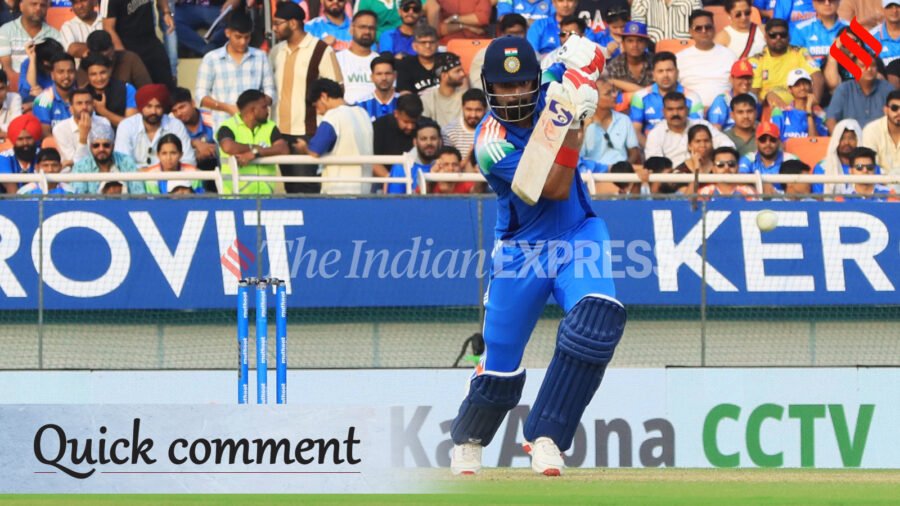
When Rahul subsequently returned at Lord’s for the series decider, the wicket-keeping gloves remained with Kishan. A blockbuster season, runs at the T20 World Cup, runs in Jharkhand’s title-winning domestic run and a century in his ODI comeback series against Afghanistan after three years had begun to blow the winds towards Kishan. Like Rahul, he is a versatile keeper-batter cum floater, but more importantly a left-hander, the missing piece in India’s vaunted batting top six.
Story continues below.
Subscribe to see fewer ads.
AS IT HAPPENED | INDIA VS WEST INDIES 3RD ODI LIVE UPDATES
Over the last two seasons, the think tank had gambled hard with left-handed bowling all-rounders for a floating role between numbers 5 and 7. Rahul has sacrificed the comforts of equilibrium for this inorganic experiment, shunted up and down too often. In the past year, he has batted number six seven times and number five – his designated slot at the previous ODI World Cup – on five occasions. Adding to the middle-order blues is Hardik Pandya’s prolonged absence, the vacuum in power-hitting that permeates through the lower-order with it.
On Saturday at the PCA Stadium in New Chandigarh, Rahul allayed concerns swirling around India’s middle-order lacking a mature figurehead. He did so with a career-best knock — his ninth ODI ton — an unbeaten 129 off 87 deliveries which broke a few important metrics that quite often gauge a finisher’s mettle.
Walking in at 141 for three in the 25th over at the fall of a stoic Rohit knock, Rahul had shrugged off the white-ball rust on a pitch that was progressively slowing down. The discolouring older ball post the 34th over doesn’t make hitting free-flowing anymore in ODIs, and Rahul isn’t as much the sixes man as is Pandya.
Story continues below this ad
Misplaced concerns
But in an impeccable exhibition of his white-ball nous, Rahul reiterated that concerns over his position may be misplaced in this World Cup year. The ghosts of the ‘23 Ahmedabad final still wracks his reputation, but Rahul is so much more in this middle-order than that wretched November afternoon for the Indians.
By the 25th delivery, Rahul’s strike rate had soared above 100, courtesy of a thunderous bunt for four off Jayden Seales, the best bowler of the day who castled Shubman Gill and Virat Kohli with snorters in his opening burst. The tempo remained with a series of delicate cuts and punches on the off-side.
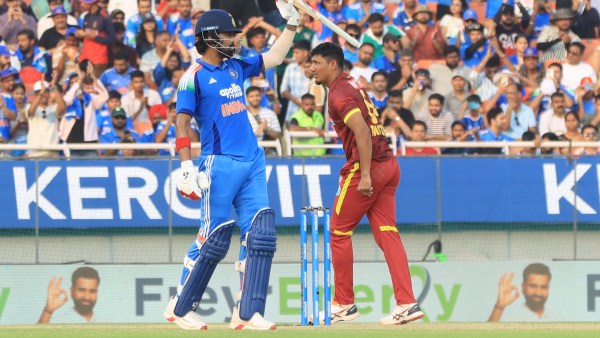 Rahul’s 87-ball 129 took India to 351/7 against West Indies.
The restraint on aerial hitting remained until the dying stages when he pressed down the gas in a remarkable overdrive. With a thunderous swipe, he lifted Alzarri Joseph over mid-wicket in the 48th over. He reached his fifth ODI ton five balls later with a furious hook off Seales over the fine-leg boundary and celebrated an encore with another six over the sight-screen. Four maximums and a four were crammed into his last 10 deliveries, powering a daunting total for India in their first attempt to set a target this series.
He levelled his best sixes (6) haul in an ODI innings, the previous instance coming in one of his earliest knocks at number five against New Zealand in 2020. The 80-ball century was the second-quickest ton of his enterprising career in the middle-order, only behind a 62-ball effort against the Netherlands in 2023.
Story continues below this ad
Across 36 innings, he averages 68.58 at number five. South Africa’s legendary shape-shifter AB de Villiers is the only bat to score more runs at a higher average in the slot. Rahul, in essence, matches up to two of India’s greatest middle-order occupants. He has as many centuries (four) as MS Dhoni at No.5, just one behind Yuvraj Singh (5). His scoring rate is a distinct upgrade over the two, putting him in a rare club of four men to possess a 50-plus average and 100-plus strike rate at number five, alongside de Villiers, Marlon Samuels and Angelo Mathews. The one-ball rule after the 34th over, in effect since July 2025, hasn’t necessarily diminished his returns as yet. In contrast, they have recorded an uptick. Rahul has manoeuvred the phase with an average of 87 for 387 runs, the highest aggregate among all batters in overs 35-50 in this period. His strike rate has risen to 144.40, up from 120.62 between January 2023 and June 2025.
Saturday suggested his evolving capabilities as a middle-order bat are nearing their perceived peaks, enough to warrant a secure run as India’s first-choice wicket-keeper, preferably at number five.

Neeraj Chauhan sold vegetables in 2020. Now he has Asian Games bronze
By Sohail Khan · 3 Oct
How Pranavi Urs shrugged off a triple bogey to win golf gold
By Sohail Khan · 3 Oct
Archery: Big dreams and ‘bhook’ — Kumkum’s Games of gold
By Sohail Khan · 3 Oct
Leave a Reply