Around Town: Inside Santosham, and how a Thane woman in her 60s turned her mother’s recipes into a restaurant
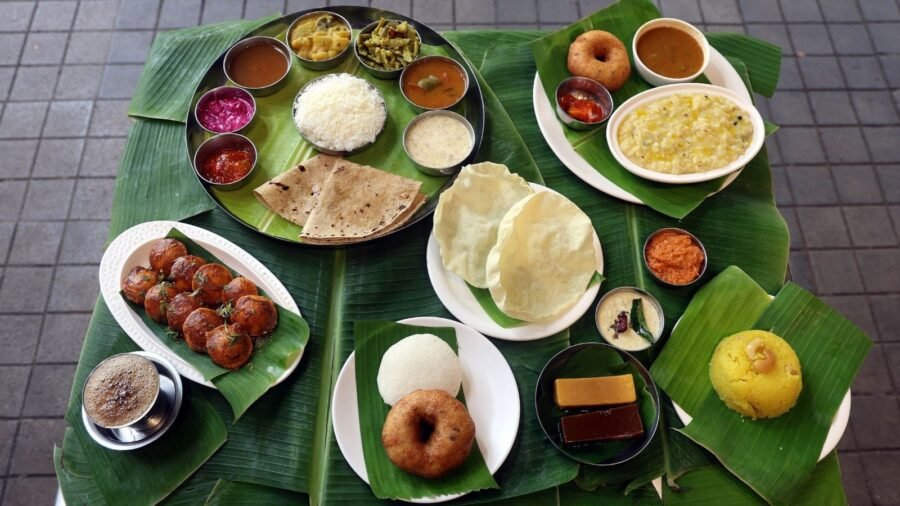
Santosham, the coming together of Bhagyalakshmi and her son Chittaranjan Gohokar, 45, has since opened two more quick-service outlets in Thane, a dine-in space in Powai and a restaurant at Marine Drive. In the pipeline is an outlet in Malad designed by Minnie Bhatt and another in Thane due to open in November this year.
Story continues below.
Subscribe to see fewer ads.
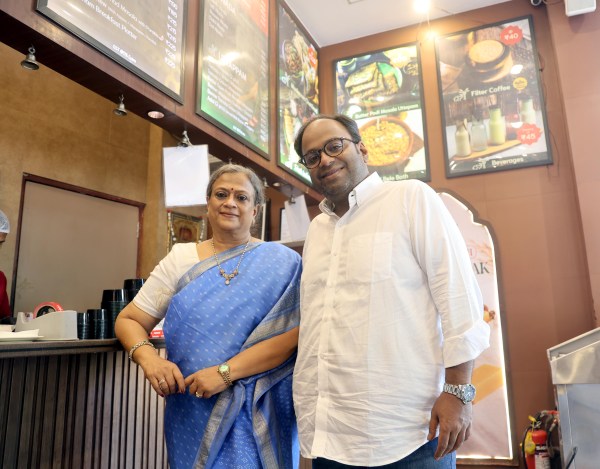 Bhagyalakshmi Gohokar with her son Chittaranjan founded Santosham in 2022. Express Photo by Deepak Joshi
But ask Bhagyalakshmi about her journey, and she takes us back to the late 1950s, and to the kitchen where it all began.
“In 1958, my father moved to Nagpur and started Shanti Bhavan,” she shared. The restaurant served home-style South Indian food to bachelors who had come from the south, many from Kerala, to staff new government offices. “I was the youngest of six and my father’s pet, so he would often take me along. I would see dosas being cooked over wood and coal fires, and women ground batter by hand all day. The aroma, the place buzzing with people — they became my early food memories,” she shared when we took a seat at her home in Thane.
The deeper inheritance came from her mother, Parvathy. Married at 14, she had studied only up to the fourth standard, was hearing impaired and spoke only Malayalam. But she was particular about cooking: vegetables had to be cut uniformly so they cooked evenly, and coconut had to be grated “such that it looks like a flower”, never flecked with brown.
“Whatever I am today is because of her,” said Bhagyalakshmi, who is also the head chef and mentor at Santosham.
Story continues below this ad
But food was not the plan. After her matriculation, Bhagyalakshmi wanted to study music in Chennai, but she was turned away for being underage. Her mother nudged her towards a BSc in Home Science at Nagpur University. There she met her husband and was married soon after.
Her husband came from an influential family. Her father-in-law had chaired the Maharashtra Public Service Commission and later became vice-chancellor of Nagpur University. Her husband ran a factory in Satara that made nickel mesh for the sugar industry. It was one of only three such factories in India, supplied the whole country and exported too. Bhagyalakshmi handled its administration.
But tragedy struck, and she was widowed at 42, in 1997. The kids were still in school. She ran the factory herself until soaring nickel prices and a sugarcane crop disease forced it to close.
Through those years, Parvathy often lived with her daughter. She would cook for them and immediately scribble down the recipe, along with her tips and tricks, in Tamil, a language she had taught herself. Those notes hold her payasams and the sambar podi that Bhagyalakshmi still uses, unchanged. “I have so much faith in that recipe,” she said. Parvathy had learnt it from her own mother, so Bhagyalakshmi proudly calls these recipes more than a hundred years old.
Story continues below this ad
By 2014-15, the family had settled in Mumbai and her sons were grown and busy with their own lives. That bug, as she says, came back. Encouraged by her daughter-in-law Sweta, co-founder and director at Santosham, Bhagyalakshmi started Bhagyalakshmi’s Kitchen from home, selling through a WhatsApp group in their housing complex. She is a strict vegetarian who cooks meat dishes by smell alone, so the menu had a bit of everything. But her real love became the sadya, the Kerala feast she rarely found done well in Mumbai.
When COVID came and there was no help at home, she cooked and Chittaranjan packed. The kitchen brought in at least Rs 2 lakh a month and helped the family through hard times. The pandemic had also shut Chittaranjan’s pasta-and-waffle venture, GrubShub, and his next idea was his mother’s food. He raised seed capital and leased a central kitchen before opening a single outlet.
The cooks he hired knew a hundred kinds of dosa, including cheese and schezwan. Bhagyalakshmi retrained them her way. Today, Santosham has an 8,000 sq ft kitchen with an air-conditioned room where batters ferment naturally, without soda, colour or preservatives. Every dosa is made in ghee, as her mother made them.
Santosham, which means contentment, serves the food of Tamil Iyers raised in Kerala, a cuisine that sits outside the Udupi-style South Indian restaurant tradition familiar to generations of Mumbai diners. Temple prasad from Bhagyalakshmi’s childhood summers in Kerala, such as tamarind rice and ven pongal, appears too.
Story continues below this ad
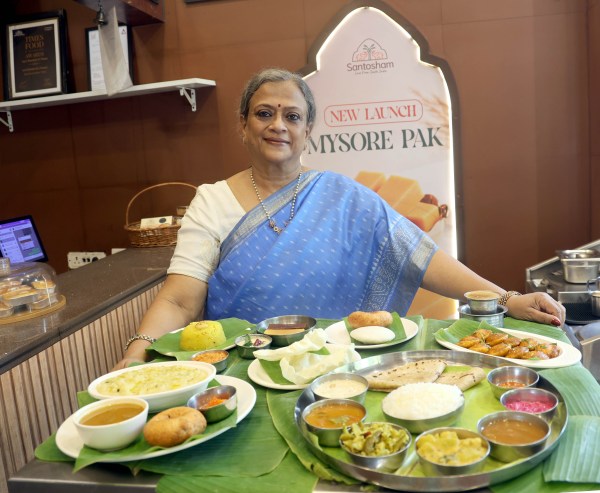 Santosham’s quick-service outlet in Manpada, Thane, opened in 2022 and serves dosas, uttapam, idli, vada and thalis, alongside Mysore Pak brought in from Mysore. Express Photo by Deepak Joshi
Servers learn the correct name of every dish. With the diner’s permission, they also show how to eat it, whether that means mixing curry leaf podi into rice with ghee or crushing a papadam into payasam.
The coffee comes from Mysore Concerns in Matunga, once a lodge that fed South Indian migrants for free until they found work. Bhagyalakshmi’s father was among them, making it a truly full-circle moment.
“Older customers, many from Kerala, say they haven’t eaten like this in years. One woman wept at the counter, telling her the food tastes like her late mother’s cooking,” said Chittaranjan.
“My only sincere effort is to take people back to their roots. Nothing more, nothing less,” added Bhagyalakshmi.


Leave a Reply