Actor Vidya Malavade shares Uddiyana Bandha tutorial: How to practise it safely
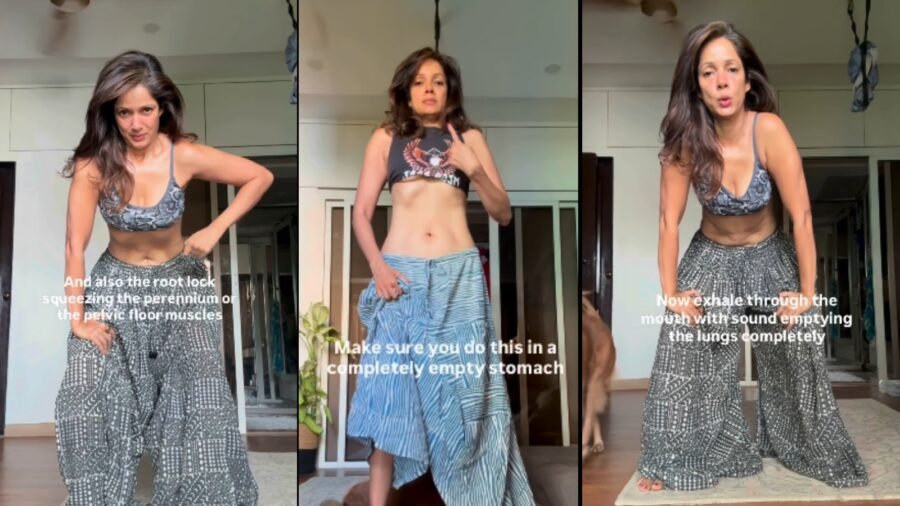
Chak De actor Vidya Malavade recently shared a detailed tutorial on Uddiyana Bandha, a yoga technique also known as the abdominal lock. “The last reel went viral with almost 2000 of you asking for the tutorial,” she wrote in the caption.
Before getting into the technique, Malavade also highlighted an important precaution: “MUST BE PRACTISED ONLY ON AN EMPTY STOMACH ONCE THE BLADDER AND BOWELS ARE EMPTIED COMPLETELY !”
Story continues below.
Subscribe to see fewer ads.
How to practise Uddiyana Bandha
In the video, Malavade starts by standing with her feet comfortably apart. She suggests that beginners bend their knees and place their arms on their thighs. She then exhales completely through the mouth, emptying the lungs, before drawing the abdomen inward towards the spine and upward underneath the rib cage to “create a vacuum”.
“Do not force this,” she says.
Malavade then demonstrates Jalandhar Bandha, or the chin lock, by bringing the chin towards the neck and looking down. She also engages the root lock by squeezing the perineum and pelvic floor muscles. She explains that all three locks together are known as ‘Tri Bandhas’.
The position should be held only for as long as it feels comfortable. To come out of it, the actor releases the chin lock first, followed by the other two locks, then takes a few normal breaths before repeating the practice.
View this post on Instagram
A post shared by Vidya S Malavade (@vidyamalavade)
What can Uddiyana Bandha do?
Ambaji Bodekar, professional athlete and bodybuilding coach, describes Uddiyana Bandha as a traditional yoga technique in which the abdomen is pulled inward and upward after exhalation.
“Uddiyana Bandha can help you control your breathing. It can strengthen your core. When Uddiyana Bandha is practised correctly it may also aid digestion.”
Story continues below this ad
Malavade’s empty-stomach approach also has a practical reason. Bodekar explains that without food in the stomach, the abdominal wall can move more easily, making the retraction more comfortable.
For beginners, he recommends taking the practice slowly and avoiding forcing either the abdominal movement or the breath hold.
“Beginners should not force the stomach in. Beginners should not hold the breath beyond what feels comfortable. Uddiyana Bandha is best learnt with guidance.”
The idea behind the practice
Malavade’s explanation of Uddiyana Bandha goes beyond the physical movement. In her caption, she describes bandhas as internal energy locks that help control the flow of prana, or vital energy, within the body. She says engaging them can stabilise the core, support the spine, improve posture, enhance breath control and deepen meditation.
Story continues below this ad
Uddiyana literally means “flying upward”, referring to the upward movement of the abdominal wall. Malavade says the abdominal vacuum and release can create movement through the abdominal wall and stimulate the abdominal organs. She also links the practice with digestion and JatharAgni, or digestive fire, along with greater awareness and mobility around the abdominal region.
For Malavade, the practice is also about looking inward rather than simply chasing an outward appearance.
“This is a very deep healing science.. and our Yogi’s knew that regulating the breath is a sure shot way.. to healing the body and the mind..”
She writes that while people often focus on staying youthful externally, internal vitality, stillness and wellbeing are equally important.
Story continues below this ad
Bodekar, too, sees practices such as Uddiyana Bandha as a reminder that fitness isn’t only about building muscle.
“Practices such as Uddiyana Bandha remind us that fitness is more than building muscle. It also teaches control… builds awareness… deepens the connection, with your body,” the fitness expert concludes.

Science Snapshots: October 4, 2026
By Sohail Khan · 4 Oct
Gyanesh Kumar row: Key takeaways from Kerala probe, protests against ECI and SIR
By Sohail Khan · 4 Oct
France high school students’ protest: What sparked violence, what’s next
By Sohail Khan · 4 Oct
Leave a Reply