With India as host, here are better goals for BRICS than ‘confronting the West’
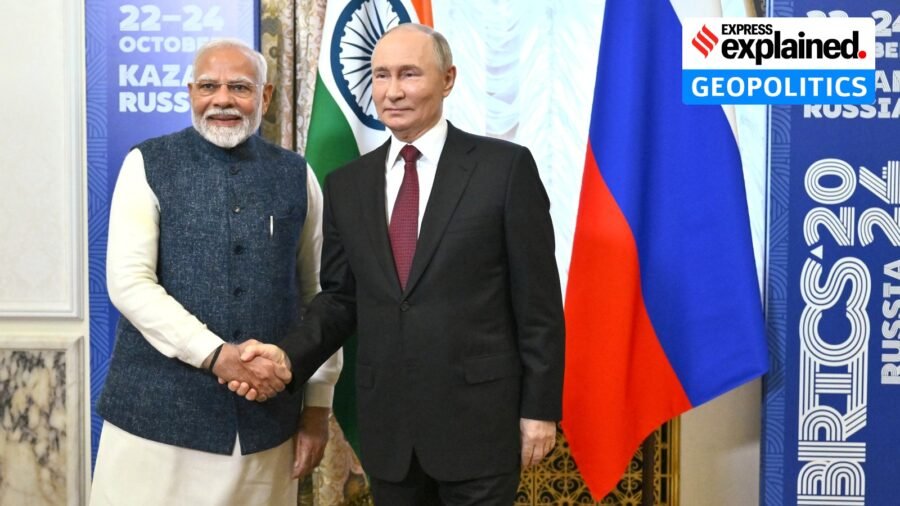
India prepares to host the 18th BRICS Summit in New Delhi (on September 12 and 13) as the grouping marks 20 years since its formalisation in 2006. This anniversary is an occasion to assess whether BRICS has remained true to the concerns that brought it together, and how it must adapt to a rapidly changing global order.
BRICS vs G7: By the numbers
In 2000, Brazil, Russia, India and China together accounted for roughly 23% of global GDP on a purchasing power parity (PPP) basis, while the G7 held nearly 52%. By 2024, the positions had reversed: the expanded 11-member BRICS accounted for approximately 36.8% of global GDP (PPP), while the G7’s share fell below 29%.
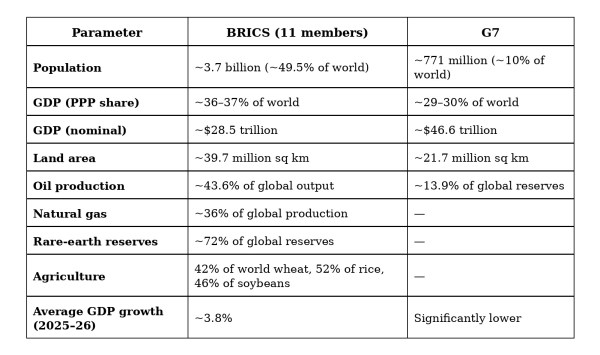 As can be seen from the table, BRICS is ahead of the G7 on almost all the parameters.
BRICS now represents roughly a quarter of global trade, with intra-BRICS merchandise trade reaching $1.17 trillion in 2024, a nearly 13-fold increase from $84 billion in two decades. The grouping holds an estimated $5.2 trillion in combined foreign reserves and accounts for 78.2% of global mineral coal production. On growth, BRICS nations are projected to average 3.8% in 2025 and 3.7% in 2026, more than three times the G7 average.
Yet the per-capita GDP tells a different story: the G7 averages around $53,000, while BRICS averages roughly $8,200. The bloc’s aggregate weight is driven by population and resource scale, not by individual prosperity.
From vision to reality
BRICS began as BRIC, Brazil, Russia, India and China, in 2006, following a Goldman Sachs projection identifying these economies as future engines of global growth. It evolved from a foreign ministers’ dialogue into a leaders’ forum, with its first summit held in Yekaterinburg, Russia, in 2009.
South Africa joined in 2010, and the grouping expanded dramatically in 2024 with the addition of Egypt, Ethiopia, Iran, Saudi Arabia and the UAE. Indonesia became the 11th full member in January 2025.
Story continues below this ad
What started as an economic grouping has become a geopolitical entity of considerable weight, increasingly presenting itself as a voice of the Global South. Yet its central grievance has changed remarkably little: global institutions have not kept pace with the redistribution of economic and political power. The first summit called for reform of international financial institutions and the United Nations, greater energy security, and a more democratic multipolar world order. Two decades later, these demands remain strikingly relevant.
India’s strategic engagement
India’s involvement in BRICS reflects its broader strategy of multi-alignment, underpinned by strategic autonomy.
New Delhi participates simultaneously in BRICS, the G20, the Quad and the Shanghai Cooperation Organization without being tied to alliance commitments. BRICS emerged during an early phase of India-US strategic convergence, and India’s multi-alignment has been less about choosing between competing power centres and more about creating room for manoeuvre.
India has made substantive institutional contributions. At the 2012 New Delhi summit, India proposed a BRICS development bank, which became the New Development Bank (NDB). By mid-2026, the NDB had approved approximately $44 billion across 141 projects. India’s broader objective has been to shape debates on climate change, sustainable development and trade, enhancing its agenda-setting capacity.
Story continues below this ad
Divergences within BRICS: Anti-West bloc or economic forum?
One of the most significant tensions within BRICS is the fundamental disagreement over its purpose. China and Russia increasingly position BRICS as a counterweight to Western dominance, a platform to challenge US-led institutions and the dollar’s hegemony. Beijing has driven the bloc’s expansion, viewing a larger BRICS as a vehicle to project leadership of the Global South and limit Western influence. Moscow, excluded from SWIFT and facing sweeping sanctions, sees BRICS as a critical economic lifeline.
India and Brazil, by contrast, view BRICS primarily as an economic and reform-oriented grouping. India does not share the revisionist enthusiasm for confronting the West.
The divergence was evident when Russia demanded in 2023 that India pay for oil in yuan — India refused, insisting on dollars or rupees only. More strikingly, in February 2026, India signed a framework trade agreement with the United States in which it reportedly agreed to halt purchases of Russian oil in exchange for reduced tariffs, a move that underscored its willingness to prioritise national interest over bloc solidarity.
Iran and the UAE: Members on opposing sides
BRICS expansion has introduced sharp geopolitical contradictions that test the grouping’s cohesion. The most visible fault line emerged at the BRICS Foreign Ministers’ meeting in New Delhi in May 2026, when members failed to agree on a joint declaration, the first such failure in the grouping’s history.
Story continues below this ad
The breakdown was driven by a direct confrontation between Iran and the UAE, two member states on opposite sides of an active conflict. India, as host, issued a chair’s statement acknowledging “differing views among some members regarding the situation in West Asia”, diplomatic language papering over the reality that two BRICS members are on opposite sides of a live military conflict. The episode exposed a structural vulnerability: BRICS operates on consensus, and expansion has made consensus on geopolitical crises far more elusive.
The dollar question
Western countries view BRICS with a mixture of concern and pragmatism, recognising it not as an immediate replacement for the existing international order, but as a platform capable of gradually reshaping the distribution of geopolitical power.
The sharpest clash has come with US President Donald Trump, who has threatened 100% tariffs on BRICS nations if they created a new currency or backed any other currency to replace the US dollar. The threats have had a sobering effect, with the idea of a single BRICS currency largely been shelved.
BRICS members have instead gravitated towards bilateral settlement of trade in national currencies, a more pragmatic, decentralised approach. Russia and China now settle over 90% of their bilateral trade in ruble and yuan. Russia and India have moved roughly 90% of direct payments to national currencies, facilitated by Special Rupee Vostro Accounts authorised by the Reserve Bank of India.
Story continues below this ad
India and the UAE have operated a rupee-dirham local currency settlement system since July 2023 while India and Indonesia operationalised a rupee-rupiah settlement framework in July 2026, with local-currency trade surging 163% year-on-year to $8.45 billion in the first two months of 2026 alone.
The BRICS Pay system, set to be unveiled at the September 2026 summit in New Delhi, will link national payment rails, Russia’s SPFS, China’s CIPS, India’s UPI and Brazil’s Pix, allowing member states to settle trade without routing through dollar correspondent banks.
This is de-dollarisation through the back-door. India’s approach has been to push for interoperable central bank digital currencies (CBDCs) rather than a supranational currency, reflecting its digital payment philosophy shaped by the success of UPI.
Yet the limitations are real: the dollar still accounts for 57.13% of global central bank reserves (Q1 2026), and no BRICS member is building rupee, yuan or rand reserves at meaningful scale.
Pakistan’s membership aspirations
Story continues below this ad
Pakistan formally applied for BRICS membership in November 2023. However, its membership remains contentious. Questions include its recurring balance-of-payments crises and regular dependence on IMF assistance, its record on terrorism, political instability and weak policy continuity. Its deep dependence on China could further increase Beijing’s influence within the grouping.
More importantly, Pakistan has so far had limited capacity to contribute to BRICS’ economic and institutional agenda or shape global governance.
New Delhi’s BRICS Summit priorities
As host of the 2026 summit, India faces a demanding agenda. The conflicts involving Iran, Israel and the US, as well as the Russia-Ukraine war, will test India’s ability to build consensus on a joint declaration. Chinese President Xi Jinping’s visit to India and the presence of Russian President Vladimir Putin could create opportunities for high-level consultations.
Beyond geopolitics, the summit will focus on practical cooperation: resilient and diversified supply chains, reform of global financial institutions, strengthening the NDB and expanding intra-BRICS trade.
Story continues below this ad
Over the next decade, India can contribute by preserving BRICS’ original reform agenda while making the grouping more practical. Digital public infrastructure, climate finance, health cooperation, critical minerals, local-currency payments and inclusive connectivity can give BRICS a concrete developmental agenda.

Good foundation: on India’s strong industrial growth performance
By Sohail Khan · 1 Oct
Bitter pills: on Court’s intervention, drug pricing
By Sohail Khan · 1 Oct
Household debt, financing today against tomorrow
By Sohail Khan · 1 Oct