Will Donald Trump get to meet Kim Jong Un again?
North Korea wants America to drop demands for disarmament
Published on: Sep 28, 2026, 14:50:09 IST
Prefer HTon Google
Share via
Copy link
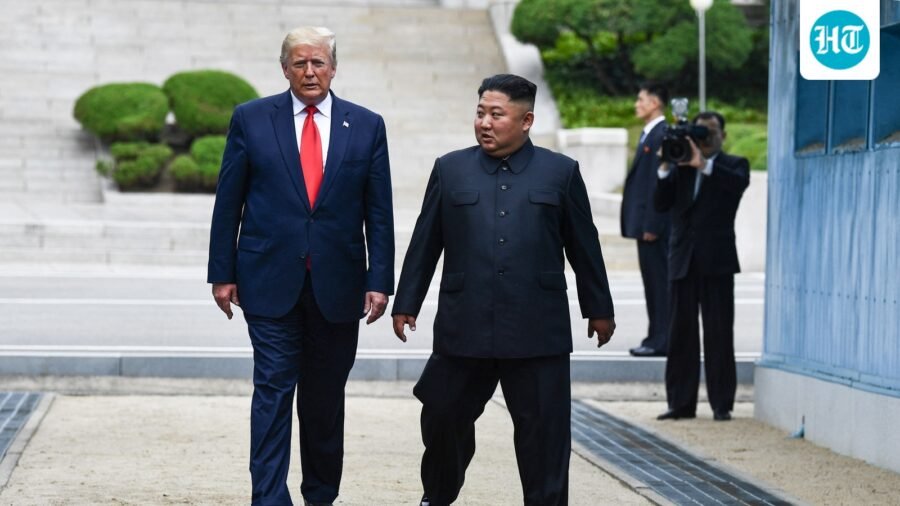
SIX AMERICAN presidents have tried to deal with North Korea’s nuclear weapons programme. Six have failed. Donald Trump would like another shot: he has said he expects to meet Kim Jong Un, North Korea’s dictator, this year. A planned trip to Asia for an APEC summit in November might provide an opening; Mr Trump’s former chief envoy to North Korea said in a recent speech he may even propose meeting in Pyongyang, where no sitting American president has ever been. Yet Mr Kim has made it clear that he will only meet if America drops its longstanding demands for “denuclearisation”, diplospeak for dismantling or removing his regime’s most potent weapons. Just one month after Mr Trump curtailed long-planned military exercises with South Korea in the hopes of rekindling his bromance with Mr Kim, the North Korean dictator, flanked by his teenage daughter, oversaw the test of a new purportedly hypersonic missile. The weapons would be an “incurable headache” for the country’s enemies, he crowed.
Mr Kim’s intransigence reflects a newfound confidence. For decades, America and its allies, together with China and Russia, tried to pressure North Korea to abandon its quest for the bomb. Despite those efforts, Mr Kim now possesses dozens of nuclear warheads, as well as missiles capable of carrying them to targets as far away as mainland America. A renewed alliance with Russia, forged on the battlefields in Ukraine, has given Mr Kim economic and diplomatic breathing room. Principled opposition to a nuclear-armed North Korea is eroding. Russia openly accepts North Korea’s nuclear status, with its foreign minister calling it a “closed issue”; China has fallen silent on the issue. South Korea’s left-wing president, Lee Jae Myung, now proposes leaving denuclearisation as an aspirational future goal. Mr Trump may be tempted to follow suit. If he does, it would mark a major shift in American policy, with big implications for regional security and global non-proliferation efforts.
North Korea signed up to the Nuclear Non-Proliferation Treaty (NPT) in 1985, agreeing to forgo nuclear weapons in exchange for help with civilian nuclear power. But it soon began secretly working towards a nuclear arsenal. Several rounds of international negotiations and wide-ranging economic sanctions over the ensuing decades failed to stop its progress; North Korea conducted six nuclear tests between 2006 and 2017. During his first term, Mr Trump imposed what he called “maximum pressure” sanctions, threatened Mr Kim with “fire and fury”, and then agreed to the first-ever summit between the leaders of America and North Korea. But at a second summit meeting, the talks broke down in acrimony.
American leverage over North Korea has weakened since then. In the past, economic sanctions could put palpable pressure on the government in Pyongyang: during the summitry of Mr Trump’s first term, Mr Kim sought relief from them in exchange for closing down Yongbyon, his main nuclear complex. But in recent years, North Korea has enjoyed a windfall for supporting Vladimir Putin’s war against Ukraine. North Korea has sent Russia artillery shells and ballistic missiles, as well as dispatching some 16,000 troops. Thanks in part to the newfound Russian support, North Korea’s economy appears to be growing, albeit unevenly: South Korea’s central bank estimates that North Korea’s economy has expanded at a punchy average of 3.4% annually from 2022 to 2025.
The alliance between North Korea and Russia continues to deepen. In early September the first road bridge linking the two countries opened over the Tumen river. Russia issued more than 35,000 student visas to North Koreans last year; many are suspected of working in Russia, including in factories producing drones for the war effort. Ukrainian officials fret that North Korea is preparing a fresh deployment of troops to aid Russia on the battlefield this autumn. “We co-operate as equal partners; we have things we want and need from each other,” says one Russian scholar. In addition to food, fuel and money, North Korea primarily wants high-end technology. South Korean officials worry about Russia helping Mr Kim build a nuclear-powered submarine.
This support from Russia has allowed Mr Kim to revive his relationship with China, which fears losing influence over its neighbour, and has left him much less keen to rekindle a bromance with Mr Trump. Since their initial meetings, North Korea has also made significant strides in its weapons programme. In the past, North Korea’s nuclear arsenal was nascent enough that stopping it might have been possible. North Korea enshrined its nuclear status in its constitution in 2023. Now Mr Trump says the country has 57 nuclear warheads; independent estimates place the number as high as 120 (Britain possesses 225).
The regime shows no signs of stopping there. A new uranium enrichment facility has been spotted at Yongbyon, according to the International Atomic Energy Agency. Mr Lee, South Korea’s president, says that North Korea currently produces enough fissile material for ten to 20 additional warheads each year. Mr Trump’s war on Iran has vindicated the Kim family’s bet on nuclear weapons as the ultimate security guarantee: though Iran was close to having the bomb, it never crossed the nuclear threshold. “Especially after the war in Iran I believe that North Korea will be more inclined to not give up its nuclear arsenal,” Mr Lee told The Economist in an interview in June.
Calls have thus been growing for a new approach that shifts the focus away from pressuring North Korea to give up its nukes and toward restarting dialogue with the hopes of merely slowing North Korea’s advances. Mr Lee, who leads a party that tends to favour engagement, proposes a phased approach that would begin with a freeze on the North’s nuclear programme.
In America, too, the winds are shifting. Victor Cha, who helped lead negotiations with North Korea during the George W. Bush administration, argues that America should shift from insisting on denuclearisation to instead seeking a “cold peace” with North Korea, based in part on arms-control negotiations. While American officials still speak of full denuclearisation as an ostensible goal, Mr Trump has taken to referring to North Korea casually as a “nuclear power”.
Recognising North Korea as a nuclear state, even tacitly, would hand Mr Kim a long-sought prize. Mr Kim told his elites that if the country stayed the course, America would cave and acknowledge North Korea’s nuclear status, much as it did with Pakistan, says Thae Yong Ho, a high-level North Korean diplomat who defected in 2016. Unlike Pakistan (or India) North Korea signed the NPT and acquired nuclear technology on the basis that it would be for peaceful use. So legitimising its nuclear weapons now could set a worrying precedent for future proliferators. An agreement that leaves North Korea’s arsenal intact while leaving Japan and South Korea feeling exposed could also push America’s allies closer to developing nuclear weapons of their own. By trying to solve a devilish problem, Mr Trump risks creating new ones.
See Less
Trump confirms meeting with Anthropic’s Amodei, repeats dismissal of AI fears
By Sohail Khan · 28 Sep
Landslides bury homes in Nepal’s Baglung, 10 killed and one missing
By Sohail Khan · 28 Sep
Ireland is helping supply Russia’s war machine
By Sohail Khan · 28 Sep
Leave a Reply