Why Saudi Arabia engages with BRICS without formally joining it
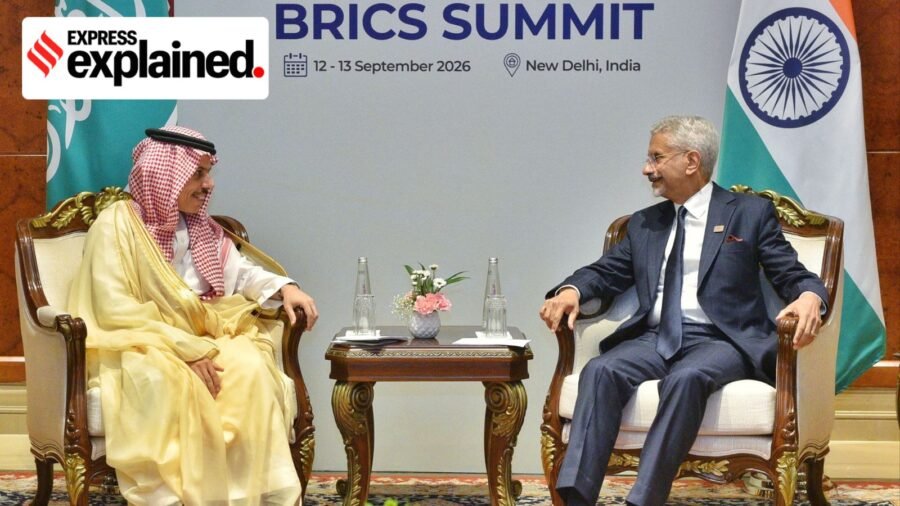
Among the last leaders to arrive, Saudi Foreign Minister Prince Faisal bin Farhan reached New Delhi late on Saturday to represent Crown Prince and Prime Minister Mohammed bin Salman at the 2026 BRICS Summit. Before leaving on Sunday afternoon, he attended the summit’s concluding session and held a bilateral meeting with External Affairs Minister S Jaishankar on the sidelines.
At the summit, the Saudi minister took part in discussions with visiting world leaders on key international issues and ways to strengthen multilateral cooperation among BRICS members, partner countries and invited nations.
However, Saudi Arabia has an unusual status within BRICS. Although it was formally invited to join the grouping in 2023, Riyadh has yet to formally accept the invitation and become a full member.
Story continues below.
Subscribe to see fewer ads.
Why, then, does Saudi Arabia continue to engage with BRICS while stopping short of formally joining it?
Why Saudi Arabia wants a chair at the BRICS table
Although listed among the BRICS members on the grouping’s website after the invitation was extended, Saudi Arabia participated in the New Delhi summit as an invited country. Other BRICS members include Brazil, China, Egypt, Ethiopia, India, Indonesia, Iran, Russia, South Africa and the UAE, which together account for about 40% of global GDP and more than half the world’s population.
The 18th BRICS Summit hosted by New Delhi offered Riyadh an opportunity to deepen economic and diplomatic ties with major emerging markets. It also provided Saudi Arabia with a platform to engage with two of its most important economic partners, China and India, while strengthening ties with other key emerging economies, even as it seeks to expand non-oil exports.
China and India are among the biggest buyers of Saudi crude. At the same time, Riyadh is trying to diversify an economy that has long depended heavily on oil. Non-oil exports accounted for 44% of Saudi Arabia’s total exports in 2025, up from 39% a year earlier and 30% in 2021. Participation in groupings such as BRICS also allows Riyadh to explore alternative trade and settlement arrangements, including greater use of local currencies.
Story continues below this ad
Why has Saudi Arabia not formally joined BRICS?
Riyadh was invited to join BRICS at the 2023 summit in Johannesburg. While successive BRICS chairs, including India, have listed Saudi Arabia among the grouping’s members, Saudi leaders have continued to participate in high-level meetings without formally confirming membership.
Experts say that while the Gulf nation sees BRICS as an opportunity to deepen economic ties with member countries, it also sees strategic value in keeping its options open rather than formalising its relationship with the grouping.
A key factor is Saudi Arabia’s relationship with the United States. The US, under President Donald Trump, has portrayed BRICS as a grouping seeking to challenge Western influence, a notion that the grouping’s members have disputed.
Saudi Arabia relies heavily on US weapons and defence systems for its security. Riyadh is also working with Washington on major technology and civil nuclear agreements. Formalising its BRICS membership could therefore complicate Saudi Arabia’s effort to deepen these ties with the US, particularly while important agreements remain under negotiation.
How Riyadh’s ties with New Delhi matter
Story continues below this ad
Saudi Foreign Minister Prince Faisal arrived on Saturday, hours after Abu Dhabi Crown Prince Sheikh Khaled bin Mohamed bin Zayed Al Nahyan had left New Delhi. Faisal attended Sunday’s outreach session, which the UAE representative did not. Amid regional conflicts and differing stands on Yemen and Sudan, the UAE and Saudi Arabia have diverged on several issues.
Both, however, have strong ties with India and had an interest in participating in the major diplomatic gathering hosted by New Delhi despite their regional differences. Saudi Arabia and India have increasingly broadened their economic relationship beyond energy to include investment, infrastructure, technology, food security and tourism. In 2024-25, bilateral trade stood at $41.88 billion, with Indian exports at $11.76 billion and imports at $30.12 billion.
India and Saudi Arabia have rapidly upgraded their relationship in recent years through the Strategic Partnership Council, moving beyond the traditional buyer-seller relationship centred on oil. The large Indian diaspora is another important link: approximately 24-27 lakh Indian nationals live in Saudi Arabia, according to the Ministry of External Affairs.
For Riyadh, then, BRICS offers access to major economic partners and an increasingly influential forum without, for now, requiring it to foreclose other strategic relationships. That helps explain why Saudi Arabia continues to engage closely with the grouping while leaving the question of formal membership unresolved.

The government’s 7.8 per cent growth number may be accurate. Why doesn’t it feel right?
By Sohail Khan · 15 Sep
West’s BRICS+ worries underline its own decline
By Sohail Khan · 15 Sep
EVM totalisers protect both votes and voters
By Sohail Khan · 15 Sep
Leave a Reply