Why is oil price rising? Brent jumps 2.5% after Trump rejects Iran peace proposal
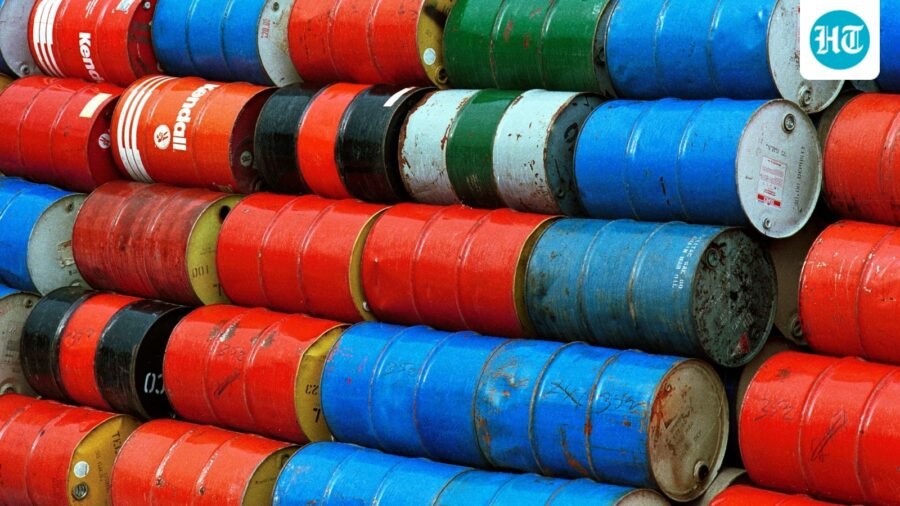
Oil prices rise as Brent crude jumps 2.5% after Trump rejects Iran peace proposal, raising concerns over the Strait of Hormuz and global oil supply.
Updated on: Sep 28, 2026, 17:03:02 IST
Prefer HTon Google
Share via
Copy link
Brent crude oil prices jumped more than 2% on Monday after US President Donald Trump rejected an Iranian peace proposal aimed at resolving the conflict and reopening the Strait of Hormuz. Brent futures rose $2.60, or 2.49%, to $106.92 a barrel at 0803 GMT.
US West Texas Intermediate (WTI) crude also climbed. WTI rose $2.08, or 2.25%, to $94.49 a barrel. The move came as markets reacted to uncertainty over the conflict and the future of oil shipments through the Strait of Hormuz.
Why is oil price rising?
Trump's rejection of the peace proposal was a major reason for the rise in oil prices. Hamad Hussain, senior climate and commodities economist at Capital Economics, said oil prices appeared to have jumped after Trump rejected Iran's proposal, as reported by Reuters.
Iran had presented the peace proposal last week at the UN General Assembly in New York. Iran said the proposal had been sent to the US through Qatari mediators as part of efforts to find a diplomatic solution to the conflict. Trump said on Saturday that he had rejected Iran's plan. However, he also said on Sunday that he expected US negotiators to hold more talks with Iran during the week. Trump made the comments in a phone interview with Axios.
Strait of Hormuz oil supply
The Strait of Hormuz remains central to the oil market. The waterway is a major route for global oil shipments, so any disruption or uncertainty around its reopening can put upward pressure on crude prices.
Oil prices are rising despite some recovery in shipments through the Strait. Hussain said higher flows through Hormuz have reduced some of the pressure on oil prices, but the broader oil market is still facing a supply deficit. That means the market is still worried about a shortage of oil. Even though more barrels are moving through Hormuz, total supply has not fully caught up with demand, keeping the oil market in deficit. Capital Economics' Hussain said, according to Reuters.
Middle East oil exports rise
There is also a wider security risk in the Middle East. Yemen's Saudi-led coalition said early Saturday that it had intercepted two ballistic missiles and two drones launched by Iran-backed Houthis toward Saudi Arabia.
At the same time, Middle East oil exports have started recovering. Crude exports from major Middle Eastern producers reached 12.8 million barrels per day in September, the highest level since the war began in February. Preliminary Kpler data cited by Reuters showed this.
Saudi Arabia and the United Arab Emirates helped drive the increase in exports. Their higher shipments pushed regional oil exports higher in September even as the conflict continued. Oil shipments through the Strait of Hormuz also recovered. Shipments through the waterway were expected to reach about 7.4 million barrels per day in September, according to the preliminary Kpler data.
US diesel export ban fears
Saudi Arabia also changed its export route after attacks damaged its East-West pipeline. The country diverted some oil exports from the Red Sea port of Yanbu to its eastern Ras Tanura port. The oil market has also been dealing with uncertainty over US diesel exports. Brent gained only 0.4% last week, while WTI fell more than 7%, partly because investors were worried that the US could ban diesel exports to bring down record-high domestic diesel prices.
A US diesel export ban could also affect US oil production. Markets are concerned that limiting diesel exports could reduce refinery operations in the US, which could then affect demand for crude oil. Diesel prices in Europe have also surged. The premium of European low-sulphur gasoil over Brent crude futures reached a record of about $95 a barrel last week, showing how tight the global diesel market has become.
Global diesel shortage
The diesel shortage has been linked to a wider global supply problem. Prices have reached record levels, and Trump's support for a possible US diesel export ban has added another layer of uncertainty to the market.
Goldman Sachs warned that a US diesel export restriction could affect markets far beyond America. Europe and Latin America, especially Brazil and Mexico, are major destinations for US diesel exports, according to Reuters.
A US diesel shortage could push other countries to compete for available fuel. Goldman Sachs said Europe and Latin America could start buying more diesel from other suppliers, including countries such as India, which could spread the supply shock to Asia.
Goldman Sachs estimated that the impact could increase European diesel prices quickly. The bank estimated that each week of a US diesel export ban could raise European wholesale diesel prices by about $3 a barrel, or just under 2%.
What could happen to oil prices?
So, the latest Brent price rise is being driven by several risks at the same time: Trump's rejection of Iran's peace proposal, uncertainty over the Strait of Hormuz, the continuing Middle East conflict, a global oil-market deficit and tight diesel supplies.
For now, the key question for oil markets is whether US-Iran talks can reduce the conflict and keep oil flowing normally through Hormuz. Trump has rejected Iran's current proposal but has also indicated that US negotiators could hold more talks this week.
See Less

Why Tesla stock could plunge if oil prices trigger an S&P 500 downturn
By Sohail Khan · 28 Sep
Did UK already know of RAF Fairford suspected bomb plot? What defence secretary said
By Sohail Khan · 28 Sep

Leave a Reply