Why Gloria Steinem’s legacy matters for the feminist movement and its many waves
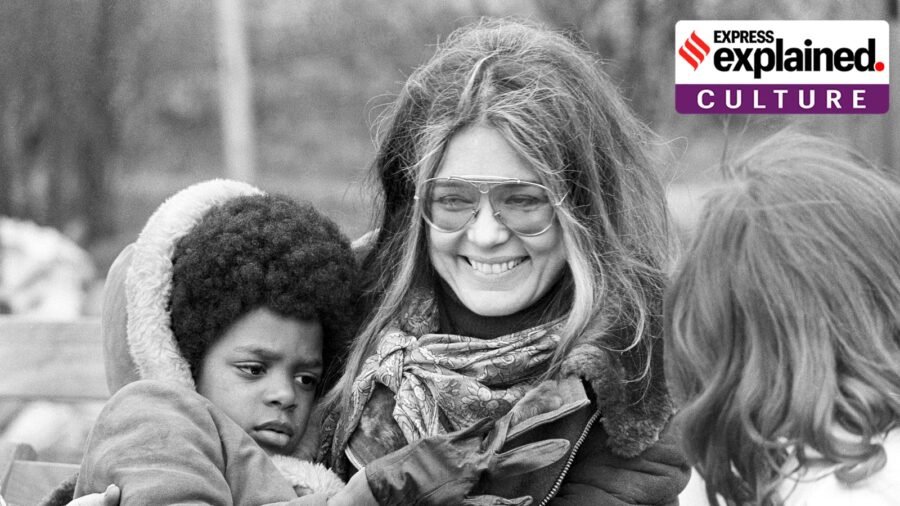
Gloria Steinem, considered among the most well-known feminist activists of the 20th century, passed away on Thursday (September 3) at 92.
Steinem was a pioneering figure of the Second Wave of the Feminist Movement of the 1960s and ’70s, which saw women fight for rights in the workplace and in making reproductive choices. It followed First Wave feminists of the late 19th century who waged the struggle for voting rights — a key step towards being considered full citizens. The second wave broadened the fight to areas seen as strictly part of private life until then, such as reproduction.
Coming from humble beginnings, Steinem went on to work as a journalist and even went undercover as a Playboy employee to reveal the exploitative inner workings of clubs run by the men’s entertainment enterprise. She also visited India in 1957 in her early 20s as part of a fellowship at Miranda House, the women’s college in Delhi University.
Story continues below this ad
Dr Bijayalaxmi Nanda, principal at Miranda House and a professor of political science, told , “She brought out the first women’s magazine in the US on her own, and she remains an iconic figure for her work. Steinem was grounded and committed to causes such as anti-child trafficking in India and her feminist criticism of pornography — all of that is still relevant.”
What are the Waves of Feminism?
Steinem grew up when women in the United States lacked legal safeguards in public life. By the 1960s, however, the tide was turning, and several civil rights movements — including for women and Black Americans — emerged.
One prominent figure was Betty Friedan, who wrote The Feminine Mystique in 1963, identifying women’s desire to go beyond the domestic sphere. “We can no longer ignore that voice within women that says: ‘I want something more than my husband and my children and my home.’”’
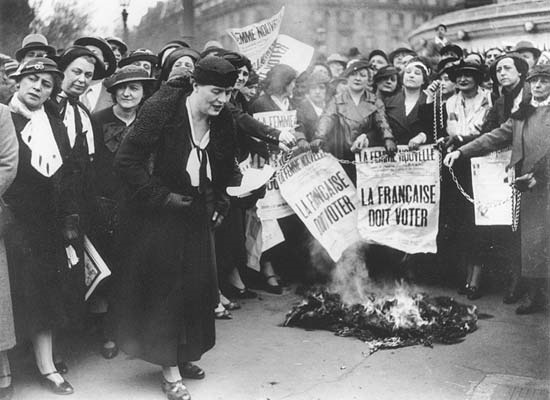 Louise Weiss along with other Parisian suffragettes (who fought for the right to vote) in 1935. The newspaper headline reads, in translation, “THE FRENCH WOMAN MUST VOTE”. (Wikimedia Commons)
Nanda said, “Steinem and her longtime collaborator in India, Devaki Jain, were openly second-wave feminists. Their whole focus was on women gaining rights in the public sphere, and they would question the public-private divide to stress the value of reproductive rights and other concerns.”
Story continues below this ad
Women’s associations led by the likes of Steinem, and writings like those of Friedan’s, helped shift the momentum. The decade saw landmark laws, like the Equal Pay Act of 1963, which banned discrimination based on sex for doing the same work. Title VII of the Civil Rights Act of 1964 prohibited employment discrimination based on race, colour, religion, sex and national origin.
Later court rulings also focused on rights such as access to contraception, allowing women to better plan their careers. The US Supreme Court’s Roe v. Wade judgment of 1973 gave women the constitutional right to abortion.
Steinem was a vocal advocate for women in public life, challenging gender-based stereotypes. In a satirical article for her Ms. magazine titled “If Men Could Menstruate”, she asked, “What would happen, for instance, if suddenly, magically, men could menstruate and women could not? The answer is clear — menstruation would become an enviable, boast-worthy, masculine event.”
Her larger argument was that “Characteristics of the powerful, whatever they may be, are thought to be better than the characteristics of the powerless—and logic has nothing to do with it.”
Steinem’s criticism and legacy
Story continues below this ad
Not everyone agreed with Second-Wave feminists’ approach. As the movement arose at a time when Black women were fighting for more basic rights, they faced a double burden that the feminist movement led by White women was not acknowledging.
These gaps became the focus of the Third Wave of Feminism in the ’90s. Lawyer and scholar Kimberlé Crenshaw developed the concept of “intersectionality”, which explored how overlapping identities, such as race, class, gender, sexuality, or caste in the case of India, influence people’s social experiences. This led to broader awareness about harassment in the workplace. The Fourth Wave, in the 2010s, built on these gains (the #MeToo movement being a major example) and further widened the scope to LGBTQ identities.
Second Wave feminists also often put gender in binary terms — man and woman. “Steinem felt the binary was important in order to be able to speak for women. It’s like a strategic essentialism. While she was open to understanding intersectionality, I think she said that to bring about an understanding of reproductive rights and to bring about any policy change, we have to look at gender as a critical category,” Nanda said. “Feminists have always disagreed with each other. New issues may have emerged, like on LGBTQ rights, but while agreeing to be more dynamic, it is important to recognise what we have built on.”
Steinem visited India again in the early 2010s. In an interview, she recognised the role caste played alongside gender, comparing it to race in the US and reflecting an evolving understanding of intersectionality. “A major reason that women of the powerful group are restricted and women of the less powerful group exploited is to keep the visible differences of race or caste alive. They can only be uprooted together,” she said.
Story continues below this ad
Nanda added that Steinem’s work was important across time and space. “As feminists, Steinem and Devaki Jain had similar concerns. They were talking about employment, more control over their bodies, more childcare, and so on. This transversal practice, this dialogic citizenship of women all over the world, was very similar despite different contexts.”
With reproductive rights again being curtailed in the US, and Roe vs. Wade overturned four years ago, Steinem’s ideas become relevant again. “Her work was accessible, and she brought together people who would otherwise never have been together, and that is something to recognise,” Nanda said.

TQWL on your train ticket: What it means, confirmation chances and boarding rules
By Sohail Khan · 29 Sep