Why do wombats poop cubes? Scientists explain how their intestines shape the bizarre droppings
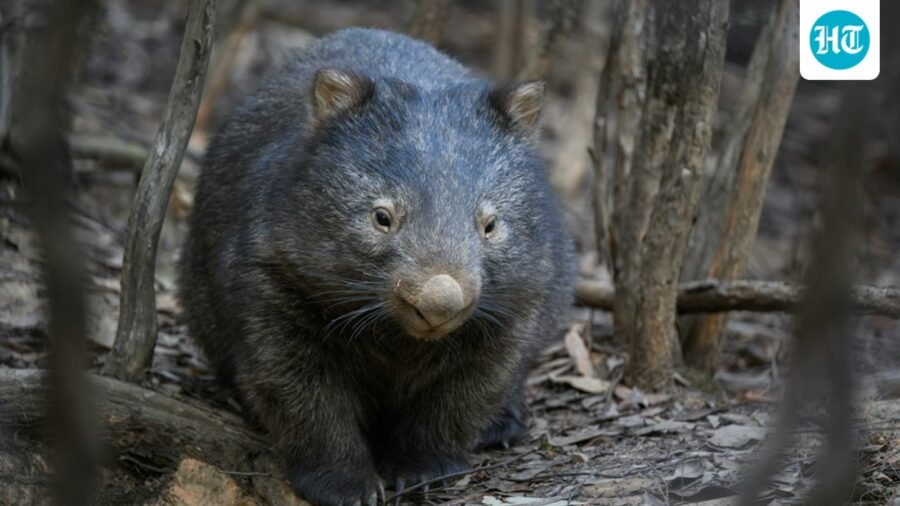
Wombats produce cube-shaped poop because of uneven stiffness in their intestines, new research shows.
Published on: Sep 22, 2026, 05:23:21 IST
Prefer HTon Google
Share via
Copy link
Wombats are well-known for their obstinacy, having short bodies and the unique ability to use their hard backsides to defend themselves against predators that might be after them. However, the feature that stands out when it comes to wombats is their droppings, which are the only known cube-shaped feces. The mystery behind this feature was not solved until now because nobody could understand how a tube-like soft intestine can shape feces into such geometric forms.
Hard structures formed by a soft intestine
Patricia J. Yang of the Georgia Institute of Technology presented initial findings on wombat feces at the American Physical Society's Division of Fluid Dynamics meeting in 2018. The conference abstract lists Yang, Miles Chan, Scott Carver and David L. Hu as the authors of the work. The study examined how wombats produce their distinctive cubic feces and helped lay the groundwork for later research into the role of intestinal structure in shaping the droppings. Studying wombats killed in vehicle collisions in Tasmania, they found that the feces were mostly soft and amorphous but hardened into 2-centimeter cubes near the end of the intestine.
The team's later paper, published in the journal Soft Matter, titled Intestines of Non-Uniform Stiffness Mold the Corners of Wombat Feces, picks up where that early presentation left off. Using histology and tensile testing, the researchers found that the final 17 percent of the wombat's intestine contains regions with substantial differences in tissue thickness and stiffness. Certain regions of the intestinal wall were about twice as thick and four times as stiff as others. As the intestine contracts to move waste forward, the stiffer patches clamp down faster while the softer patches stretch more slowly. Over roughly 40,000 contractions as the feces move through the intestine, these differences in stiffness progressively accentuate the flat faces and corners of the developing cube. To test the idea, the scientists modeled a stretchy ring made of alternating stiff and soft zones, and the simulation backed up their dissections: the greater the difference in stiffness, the more the resulting shape resembled a square.
Timing is also an important factor. Wombats' digestion takes up to several days, giving their digestive systems far more time than most mammals have to extract water and nutrients from food. As a result, by the time waste reaches the final section of the intestine, it is dry enough to hold its shape after it exits the body.
Why create a cube in the first place
Understanding how the cube forms is one thing; scientists are still investigating why the trait evolved in wombats. These solitary animals appear to rely heavily on smell for communication, using scat-associated chemical signals at latrine sites. Their relatively poor eyesight may make olfactory cues particularly important, while environmental features such as rocks, logs and burrow entrances may also help wombats locate these signaling sites. They generally excrete their feces in easily visible places like a tree stump, rock, or a higher part of the ground as a way to mark their territory. The cubic form gives the feces an advantage for this purpose: it does not roll away.
The findings may also have practical implications beyond animal biology. Humans usually make cubes by casting or cutting, but the wombat intestine offers another model for forming cube-like shapes from soft material through uneven pressure. Scientists and engineers involved in the project have speculated that the finding could one day inform mold-free ways of shaping soft materials. However strange it may be, the wombat remains unique as the only known animal to produce cube-shaped feces.
See Less




Leave a Reply