What is the 90-year-old Navier-Stokes problem that OpenAI says AI has solved?
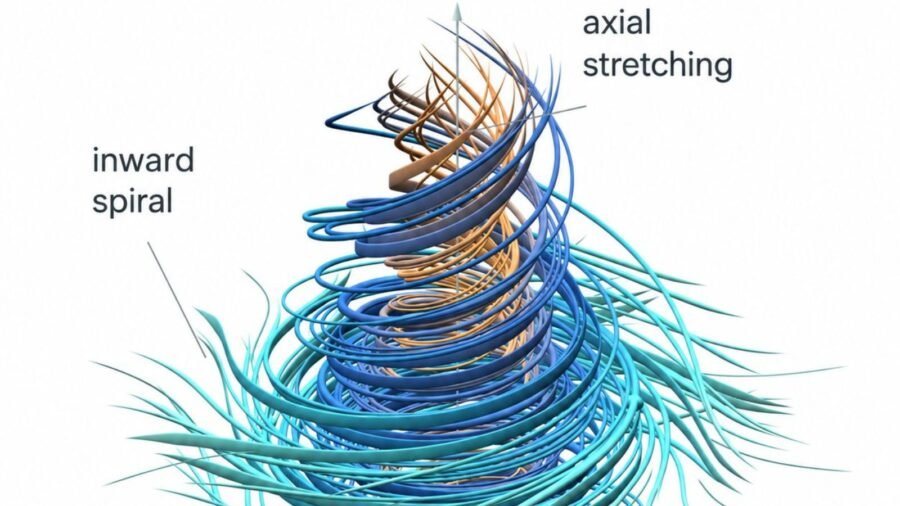
OpenAI on Tuesday, September 8, said that its artificial intelligence (AI) model has solved one of the most popular, unanswered problems in mathematics – the Navier-Stokes existence and smoothness problem.
One of the seven Millennium Prize Problems, it is a group of major math questions identified by the Clay Mathematics Institute in 2000. Each of these problems carries a prize of $1 million for a recognised solution. The Navier-Stokes question deals with whether smooth three-dimensional fluid motion can break down, and it has remained unsolved for about 90 years.
OpenAI said its internal AI system has produced a proof showing that the dynamics of the Navier-Stokes equations for fluid motion can develop a singularity in finite time. But what is the problem, and why does it matter?
Decoding Navier-Stokes equations
Imagine trying to predict exactly how water in a river will move over time. This is what the Navier-Stokes equations do; they are essentially a set of mathematical rules that explain how any fluid (water, honey, air, etc.,) flows based on two simple physics ideas, such as fluid mass and force equals mass times acceleration.
These equations can help in forecasting weather, designing aeroplanes and cars, and predicting ocean currents. The catch here is nobody has proven whether the equations always produce sensible answers. This unsolved problem is one of the seven Millennium Prize Problems with a $1 million reward for solving it.
Since fluid flow is chaotic, the difficulty comes from turbulence. This means tiny changes in starting conditions could lead to wildly different outcomes, which is also why weather cannot be predicted more than a week ahead.
What has OpenAI found?
The Sam Altman-led AI startup has claimed that its internal AI system has generated a proof showing that such a breakdown can indeed happen. The company said that the solution involves a vortex, essentially a spinning swirl of fluid, that spirals inward while being increasingly stretched. As the central region shrinks, the fluid’s speed increases considerably until the mathematical singularity forms. Most importantly, OpenAI said that the fluid still has finite energy. Hence, the singularity does not come from simply applying an infinite force from outside. Instead, it develops from the dynamics as described by the equations. OpenAI has also said that the proof has been formally verified using Lean, which is a computer system used to check mathematical proofs step-by-step.
Story continues below this ad
OpenAI said that around 10,000 AI agents worked on the problem simultaneously. The system generated about 2.7 million messages and used about 130 billion output tokens while working on the Navier-Stokes problem.
The AI agents reportedly explored different approaches, shared useful discoveries with other groups, and eventually came together for the solution. According to the company, the agents found the result in about 88 hours, and the formal verification took another 17 hours. OpenAI also said that the AI model used to produce the proof is significantly more capable than the newly launched GPT-6 Astra.
Is the problem officially solved?
However, when it comes to the actual solution to the decades-old mathematical problem, some caution is needed. OpenAI claims that its work resolves the problem and has released the proof for mathematicians to examine. It needs to be noted that the broader mathematical community still needs to examine the result. The AI start-up itself claims that it does not intend to claim the $1 million Millennium Prize.
OpenAI’s announcement has also triggered a dispute involving mathematicians Tristan Buckmaster of New York University and Levent Alpöge of Anthropic, who had been working on related mathematical problems. They have essentially raised questions about how OpenAI’s research was conducted and whether their unpublished work could have influenced the result. “I have not seen OpenAI’s proof. I do not know what their model did, or how. I do not know whether our data was used. I am not accusing anyone of anything,” Buckmaster said in a statement. In turn, OpenAI has denied accessing their work and says its proof is substantially different.
Story continues below this ad
The best way to describe this development is that OpenAI has introduced an AI-generated solution to the Navier-Stokes problem which is yet to be scrutinised by mathematicians. If the proof withstands scrutiny, this would be a major milestone for mathematics and AI, as it would mean that an AI system helped resolve a mathematical problem that humans were grappling with for about a century.